

Swapping out scissors and ribbons for sand and farm tools.
Japanese property developer Mitsui Fudosan recently held a groundbreaking ceremony for its historic £1.1 billion (approximately 230 billion yen [US$1.46 billion]) expansion of the British Library in London, and in doing so also brought a long-standing Japanese tradition to the other side of the world. As an institution boasting one of the largest book collections on earth, the British Library is expanding its footprint near its main building across the street from London’s St. Pancras International Station. As part of Japan’s largest scale real estate development to date in the UK, Mitsui Fudosan and the British Library are looking to construct a multi-story complex housing commercial offices, rental laboratories, and expanded library facilities.


To mark the start of work, UK government officials, library leadership, and Mitsui Fudosan executives gathered for a chakko-shiki (“groundbreaking ceremony”), more formally known as a kiko-shiki. Major property developments in Western countries often center around a simple ribbon-cutting, but construction in Japan traditionally has an entire sequence of ceremonies designed to ensure safety, prosperity, and community goodwill.

These Japanese construction customs traditionally start with a jichinsai, a sacred Shinto purifying ritual led by a Shinto priest. This religious ceremony uses offerings of rice wine, salt, and rice to pacify the local tochi-no-kami (earth deities), asking permission to alter the land and praying for protection against construction accidents or natural disasters, as well as for the prosperity of those who will use the land. In modern times, not all chakko-shiki begin with a jichinsai, with some people favoring to simply recognize the secular business side of the ceremonies, but the British Library event included this splash of tradition, featuring a non-Japanese Shinto priest who participated in the ceremony.
There are of course talks by the key people involved in the construction project, but the highlight and prime photo opportunity of the event is the ugachi-zome (literally “first pierce”), the symbolic first dig, where these important people grab a hoe or shovel and stab them into a small mound of sand.
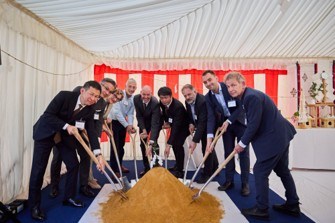

Historically, preparing for building a house in Japan was a three-step process: clear the area of weeds, dig up the soil, and level the ground, and it is said that a house cannot be built without this process. Therefore, the full Shinto groundbreaking ceremony has evolved into three parts, starting with kari-some (“the first cut”), where the designer cuts grass with a sickle.
▼ The “ey, ey, ey” is very much an intergral part of all three parts.

This is followed by the kuwaire-no-gi (“hoe entry ceremony”), where the client lightly chips out a section of sand from the mound with a hoe.

Then comes the sukiire-no-gi (“shovel entry ceremony”), where person in charge of construction flattens the mound with a shovel (suki, 鋤), or at least makes more of a dent than with the hoe.

The other aspects of the jichinsai are also embedded with history and religious meaning and culminate in the naorai, the closing feast in which participants share the sake and food that were offered to the deities in order to receive their blessings, before then returning to daily life (naoru means “to return”).
Other ceremonial rituals continue through the stages of a building’s construction lifecycle, such as the joto-shiki, or raising-the-ridgepole ceremony, when the main structure is complete. Historically, carpenters placed symbolic items on the highest beam meant to ward off disaster and pray for good fortune, but nowadays it has been streamlined to just a sacred wooden wand or wooden plaque containing the names of the master carpenter, the homeowner, and the deities invoked in protecting the house, which is permanently sealed away within the roof cavity.

The four corners of the building site are splashed with ceremonial sake and salt to purify the land, and ensure the safety of both the workers and future residents.

In some instances of residential development, the whole neighborhood gets together for a mochi-throwing event, sometimes substituted with coins or sweets, in a bid to foster goodwill with the neighbors who will live alongside the development.

At the end of larger-scale construction projects, when the entire building is finished, stakeholders assemble for a shunko-shiki (construction completion ceremony), which announces the completion to the public, conveys gratitude to those physically and financially involved in the construction, and prays for safety and prosperity.
With the jichinsai and chakko-shiki being performed at such a large-scale overseas investment project, we’ll have to wait and see if they complete the entire trio of construction ceremonies at the British Library’s expansion, and find out whether or not they’ll climb to the top floor and start lobbing down tea bags in place of mochi, in an attempt to build goodwill with the locals.
Source: Jiji, Embassy of Japan in the UK, PR Times, YouTube/@ntv_news, YouTube/@大原美香-q3f, YouTube/@macs-kurashi, YouTube/@大勝建設-d3i, YouTube/@likes_home, YouTube/@harry_no_yukkurilife
Top image: Pakutaso
Insert images: PR Times
● Want to hear about SoraNews24’s latest articles as soon as they’re published? Follow us on Facebook and Twitter!