
In this two-part series just in time for the 2026 Winter Olympics, we’re taking a look at Japanese skaters who have shaped the sport past and present.
With Milano Cortina 2026 (February 6-22) rapidly approaching, we thought we’d take a moment to spotlight the indelible mark that Japanese figure skaters have left on the oldest winter Olympic sport, which dates back to the 1908 London Olympics. In this two-part series, we’ll briefly explore key figures in recent Japanese skating history as well as the athletes to watch for at the upcoming Olympics. For purposes of brevity, we’ve chosen to focus exclusively on athletes who’ve competed in the men’s singles and women’s singles disciplines and not in pair skating or ice dance.
▼ A sneak peak at the three female skating legends spotlighted below
Before we get started, here’s a quick guide of terms that will be helpful for understanding the accomplishments of the highlighted skaters.
● The International Skating Union (ISU) is the international governing body for competitive ice skating disciplines, including synchronized skating and speed skating. The Japanese Skating Association was first noted as a member of the ISU in a 1926 publication, and the Japan Skating Federation (日本スケート連盟), which exists today, was founded in 1929. The latter oversees the annual Japan Figure Skating National Championships that are typically held in late December.
The ISU oversees major annual international figure skating competitions such as:
– Grand Prix of Figure Skating (1995-present): The Grand Prix Series consists of six back-to-back competitions held around the world in the fall, culminating in the Grand Prix of Figure Skating Final in December.
– European Figure Skating Championships (1891-present): Skaters from ISU-member countries in Europe may compete in this January competition.
– Four Continents Figure Skating Championships (1999-present): Skaters from ISU-member countries outside of Europe may compete in this January competition.
– World Figure Skating Championships (1896-present): Worlds is the culminating and most important event of the competitive skating season held annually in March.
▼ Japanese women swept the podium at the recently concluded 2026 Four Continents Championships
● There are six basic jumps of figure skating that differ with regards to their entrances, with three grouped as “edge jumps” (taking off from the edge of the blade) and three grouped as “toe jumps” (taking off with assistance from the toe pick of the opposite foot). Skaters can perform these jumps as a single, double, triple, or quadruple, which refers to the number of rotations in the air.
– Axel (edge jump): The skater enters the jump from the forward outside edge of one foot. The Axel is easy to recognize because it’s the only jump that enters from a forward take-off position. It’s considered the most difficult jump in figure skating due to the extra half rotation in the air from the forward entry. Currently, the U.S.’s Ilia Malinin is the only skater in the world who has landed a verified quad Axel in competition.
– Salchow (edge jump): The skater enters the jump from the back inside edge of one foot.
– Loop (edge jump): The skater enters the jump from the back outside edge of one foot.
– Toe loop (toe jump): The skater enters the jump from the back outside edge of one foot.
– Flip (toe jump): The skater enters the jump from the back inside edge of one foot.
– Lutz (toe jump): The skater enters the jump from the back outside edge of one foot.
▼ Ilia Malinin (U.S.), nicknamed the “Quad God,” is the first and only person who has ever landed all six quad jumps successfully within the same program. He also has a favorite phrase in Japanese: meccha oishii, which means “super yummy.”
Japanese figure skaters have become a major force in the sport of figure skating, consistently dominating international competitions in recent years, and are known for generally achieving a high balance of athleticism and artistry. The following six skaters we’ve selected–three male and three female–have left a lasting impact not only in Japan, but on the sport of figure skating itself. All of them have gone “professional,” meaning in the world of figure skating that they have retired from competing in ISU-sanctioned competitions and instead earn money by participating in ice shows, coaching, designing choreography, commentating, and more. We hope you enjoy learning a bit more about these living legends!
Honorable mentions: Nobuo Sato (born 1942), Miki Ando (born 1987), Nobunari Oda (born 1987)
Midori Ito (伊藤 みどり)
Born in 1969; grew up in Nagoya, Aichi Prefecture
Competitive highlights: 1992 Olympic silver medalist; 1989 World champion; 1984-1991, 1995 Japanese National champion
Midori Ito is best known as the first female skater of any nation to land a triple Axel in competition (1988), but she was also the first Japanese figure skater (male or female) to win any medal at the Olympics. International media hyped her matchup with Japanese-American skater Kristi Yamaguchi during the 1992 Olympics, where Yamaguchi ultimately went on to win gold and Ito win silver. Impressively, Ito has competed several times in the ISU Adult Figure Skating Competition since 2011, staying committed due to her love for the sport.
▼ Clips of Ito from her silver medal-winning 1992 Olympic free skate (long program)
Shizuka Arakawa (荒川 静香)
Born in 1981; grew up in Sendai, Miyagi Prefecture
Competitive highlights: 2006 Olympic champion; 2004 World champion; 1997-1998 Japanese National champion
While Midori Ito was the first Japanese figure skater to win any Olympic medal, Shizuka Arakawa was the first to win a gold medal at the Olympics. Hailing from the northern city of Sendai (which also produced one of the legends later in this piece), she’s particularly famous for her graceful and extremely flexible “Ina Bauer” skating element, a term which she also popularized in the national lexicon. Today, Arakawa stays busy with ice shows, as a television sports commentator, and as the mother to two young children.
▼ Clips of Arakawa from her gold medal-winning 2006 Olympic free skate
Daisuke Takahashi (高橋 大輔)
Born in 1986; grew up in Kurashiki, Okayama Prefecture
Competitive highlights: 2010 Olympic bronze medalist; 2010 World champion; 2008, 2011 Four Continents champion; 2012 Grand Prix Final champion; 2005-2007, 2009, 2011 Japanese National champion
Daisuke Takahashi broke many barriers for Asian male skaters, perhaps the most noteworthy of which is when he became the first Japanese male singles skater to medal at the Olympics–and then, just weeks later, the first male singles skater from either Japan or Asia to win a Worlds. Since retiring from competition as a singles skater, he has taken part in countless ice shows and has tried his hand at acting. Incredibly, he even returned to competition for a few years in the ice dance discipline, becoming the 2022 Japanese National champion with partner Kana Muramoto.
▼ Clips of Takahashi from his bronze medal-winning 2010 Olympic free skate
Mao Asada (浅田 真央)
Born in 1990; grew up in Nagoya, Aichi Prefecture
Competitive highlights: 2010 Olympic silver medalist; 2008, 2010, 2014 World champion; 2008, 2010, 2013 Four Continents champion; 2005, 2008, 2012-2013 Grand Prix Final champion; 2006-2009, 2011-2012 Japanese National champion
Mao Asada, affectionately called “Mao-chan” by the Japanese public, grew up figure skating with her older sister and was quickly pegged as a trailblazing child prodigy. She consistently landed triple Axels, still relatively rare for women to this day, and yet didn’t sacrifice artistry in her spins and footwork sequences. She smashed multiple world records time and time again. The 2010 Olympics paired her against South Korea’s Yuna Kim in a close contest where Kim ultimately earned the gold. That didn’t stop Asada’s legions of fans from adoring her and her myriad of talents for many years after.
Today, Asada participates in all kinds of ice shows, teaches skating to children, and makes frequent media appearances. She has also shared a love for traditional Japanese culture and can often be seen wearing a kimono and trying cultural activities on her Instagram account.
▼ Clips of Asada from her silver medal-winning 2010 Olympic free skate
Yuzuru Hanyu (羽生 結弦)
Born in 1994; grew up in Sendai, Miyagi Prefecture
Competitive highlights: 2014, 2018 Olympic champion; 2014, 2017 World champion; 2020 Four Continents champion; 2013-2016 Grand Prix Final champion; 2012-2015, 2020-2021 Japanese National champion
Many call him the GOAT, and for good reason. Yuzuru Hanyu is one of the most decorated figure skaters in history. He’s the full package–athletic and artistic–with superior jumping technique, footwork sequences, and his signature “hydroblading” move. He has smashed virtually every short and long program world record at some point, and lays claim to being the first skater to land a quad loop in competition (2016). In 2018, he became the first male singles skater to win back-to-back Olympic gold medals in 66 years with his distinctly Japanese “Seimei” free skate. While he fell short of the podium in the 2022 Olympics, it was partially in the process of pushing the boundaries of the sport while attempting to add a quad Axel to his program, which had never yet been done at the time.
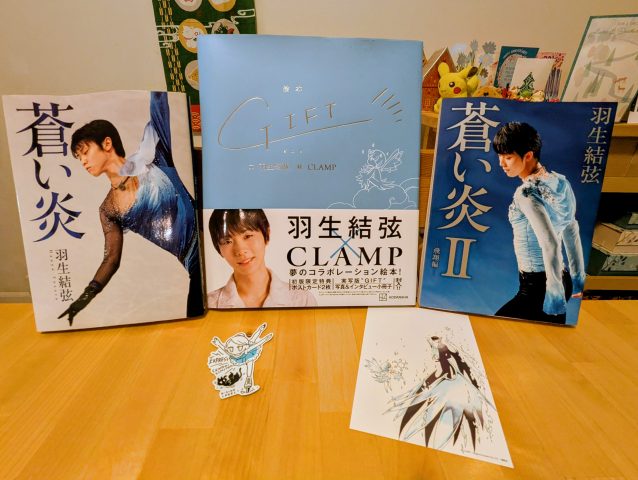
Hanyu is a mega-celebrity and household name in Japan, even among those who don’t follow figure skating. He’s been through it all, from running out of his home ice rink in Sendai with his skates on when the 2011 Tohoku Earthquake and Tsunami struck to being showered with mountains of Winnie the Pooh stuffies that fans throw on the ice after his performances. Since retiring from competition, Hanyu has been actively producing ice shows and showcases and taking on all kinds of new challenges, including teaming up with powerhouse manga team CLAMP to publish a lovely illustrated picture book titled Gift.
▼ Clips from Hanyu’s gold medal-winning 2018 Olympic free skate
Shoma Uno (宇野 昌磨)
Born in 1997; grew up in Nagoya, Aichi Prefecture
Competitive highlights: 2018 Olympic silver medalist, 2022 Olympic bronze medalist; 2022-2023 World champion; 2019 Four Continents champion; 2022 Grand Prix Final champion; 2016-2019, 2022-2023 Japanese National champion
Having looked up to Daisuke Takahashi and Mao Asada as a child, Shoma Uno is the youngest and most recent skater on this list to retire from competition in 2024. Despite being only 1.58 meters (5 feet 2 inches) tall, he has incredible jumping prowess, becoming the first skater to land a quad flip in competition (2016), as well as flexibility, as demonstrated in his signature “cantilever” move. While he often appeared with a very straight face in the midst of competition, he’s been able to have some fun since retiring by starring as protagonist Monkey D. Luffy in Japan’s production of One Piece on Ice. He has also pleasantly surprised fans by proving his cred as a gamer on more than one occasion.
▼ Clips from Uno’s bronze medal-winning 2022 Olympic free skate
We hope you enjoyed this spin down Japanese skating memory lane. Stay tuned for Pt. II where we’ll discuss the Japanese singles skaters who will compete in Milano Cortina 2026 and what to watch for each of them!
Krista Rogers is a U.S. Figure Skating Coach Core-certified coach and Learn to Skate USA instructor.
Reference: US Figure Skating Magazine, ISU Skating
Top image © SoraNews24
● Want to hear about SoraNews24’s latest articles as soon as they’re published? Follow us on Facebook and Twitter!