

It’s no secret that Japan may be headed for a bit of a labor crunch, as the population ages and many older workers reach retirement age with fewer young up-and-comers to replace them. And, while the Japanese government seems reluctant to take measures to replenish the shrinking workforce with foreign laborers, non-Japanese workers are nevertheless entering Japanese corporations and workplaces in record numbers.
But Japanese offices are also notorious for their long hours, slow pace of advancement, and frequent, long meetings. Traditional Japanese companies seem stuck in an old-school work culture even as companies in the rest of the world offer increasingly progressive work-life balance programs, workplace perks, and office hours.
With this stark contrast in mind, our Japanese sister site tracked down seven non-Japanese workers to get their for-realsies impressions of what it’s actually like to work at a Japanese company.
We asked each respondent to list the pros and cons of working in the Japanese corporate culture. Here’s what they had to say:
【No.1】Female, 20s, Germany
Job description:
Waitress in a ski resort restaurant in Nagano prefecture
Time worked:
About four months
Cons:
I was surprised that even if there wasn’t much to do, there would be many waitresses working, of which most just pretended to be busy. I also had the chance to experience the love of Japanese people for wrapping things – even plastic containers had to be covered inside with a layer of even more plastic.
Pros:
All my workmates and superiors were super-friendly and tried to explain everything to me, even though my Japanese was very poor. They really made me feel like being part of a team!
【No.2】Male, 30s, USA
Job description:
Producer/Consultant – Anime industry
Time worked:
Three years
Cons:
The cross training [mentioned below] means you can never specialize in the thing you’re good at. You’ll eventually be shuffled to a new job or department; Sometimes to a position you have no experience or education in. Occasionally, this will result in, say, a person winding up in a computer programming position with no experience or education in programming, which leaves the programming department a hand short for nine months while the new staffer learns the basics…then they get transferred out again a few months later.
The hours are crazy. I work 9 a.m. to 8 p.m. most days, so that’s 11 hours of work five days a week, with maybe two additional Saturdays a month. Also, much of that time is spent just pretending to be busy. My company calculated people’s salaries by giving a fixed rate for “presumed overtime work” – so I was working dozens of hours of overtime a month and getting paid for maybe 10 hours of it.
Meetings are too common and take forever to resolve. It starts to get ridiculous when you’re having meetings to discuss other meetings.
Pros:
Japanese work places are very welcoming to new employees. There is a small ceremony and people quickly greet you and make you feel like part of the team. As you get closer with your immediate co-workers, they start to become like family.
Cross training is common so you can get a feel for the type of job you like to do and are good at, without getting stuck in a position you dislike for too long.
There are lots of holidays (Japan has something like 21 holidays that most corporations observe, compared to just nine or ten in the US). Additionally, “I’m not feeling well” (“taicho furyou” in Japanese) is considered a perfectly legitimate reason to call off work and you will never need to show a doctor’s note or otherwise be asked to prove you were ill. If a department has a major drinking party on a Thursday, and half the department calls off on Friday because they’re too hungover, this is considered reasonable and is basically expected.
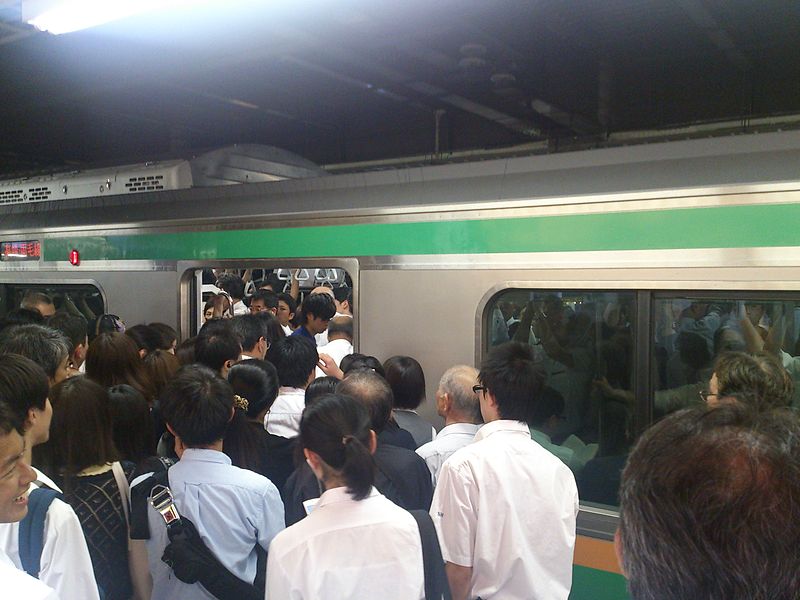
Not exactly a typical Tokyo morning, but fairly representative of Japan’s work culture nonetheless.
【No.3】Female, 50’s, USA
Job description:
Full-time university instructor
Time worked:
Four years
Cons:
I was never given a raise, even though I was promised one every year and I didn’t get paid as much as the other teachers and had no commuting allowance of any sort. Even though I came into work at 7 a.m. every morning to get work done before anyone else arrived, I only got credit for working extra if I stayed late. I realized later that the lack of a raise was because they wanted me to quit after three or four years so they could hire someone else at an entry-level rate. The next teacher they hired took them to court when his three years were up and he won and got tenure.
Pros:
I was the only foreigner and enjoyed privileges the Japanese didn’t get, such as flying home for summer holidays. The English department was very supportive and helped me a lot speaking only Japanese to me so I could learn Japanese and helping me out when I needed it.
【No.4】Female, 20’s, USA
Job description:
Eikaiwa school branch secretary/English instructor
Time worked:
Five years
Cons:
New hires were not paid during their training period. Those who drove to work (like me) were not insured by the company. The Japanese secretaries were given the standard 10 days paid vacation a year in addition to paid holidays, but the foreign instructors were not. Since I am a foreigner, I was not given these paid days despite doing both jobs. We only had five days maternity leave (it wasn’t even enough to do the necessary one-week hospital stay, let along take off for obstetrician appointments for a pregnant co-worker.) Our boss refused to pay into the social pension/healthcare scheme for foreign staff (including me) even though everyone worked full-time.
Three times the labor bureau was called against my company but they did not intervene and those workers that called were found out and were forced to resign or illegally fired. The company would work foreigner instructors before they had a proper visa. Immigration was altered on multiple occasions but did not intervene. Sometimes I was not paid on time.
As far as daily troubles, my company was somewhat disorganized and we had weekly meetings that were mandatory, but often lead nowhere.
Pros:
I had a better salary and sometimes worked less free overtime than the other secretaries and instructors. I got a good raise each year until it capped out. I had a decent amount of paid holidays. I liked my co-workers and the job itself. I felt that I learned valuable skills during my time there. My boss and co-workers were good at welcoming new hires and assisting with their training.
【No.5】Female, 30’s, USA
Job description:
Writer/editor – Publishing company
Time worked:
Three years
Cons:
Foreigner’s opinions were less valued than Japanese, even though we were working on English textbooks. Similarly, catering to what the end user expected was considered more important than accuracy or cultural sensitivity.
Appearances mattered a lot. Leaving on time, even if you had finished your work, was frowned upon. Non-Japanese speakers were expected to attend long meetings in Japanese just to show their face.
People were often asked to do work that they were not actually qualified to do, i.e. write English lessons when they don’t speak English or develop a social media strategy when they don’t use social media.
Pros:
The workflow was very cooperative. We got a lot of feedback on our work and project development was done with a lot of team meetings and discussion.
Time off was never a problem for health issues. I never felt pressure to come into work if I was sick.
【No.6】Male, 30s, UK
Job description:
Assistant Language Teacher, numerous junior high schools
Time worked:
Five years
Cons:
Assistant Language Teachers all have their own success and horror stories about teaching English in Japan, but what surprised me most was that I met numerous teachers who had very little affection, or indeed skills, for their particular subject. The idea of being an art teacher who cannot draw very well, or an English teacher who seems terrified of the ALT since they struggle with very basic sentences, seems absurd to me. I suppose these teachers were only educating kids at a basic level, but it really did concern me that there were teachers who were virtually fluent in English yet were tasked with teaching social studies or mathematics rather than English. There again, English education in Japan is very test-focused and speaking takes something of a backseat, so I suppose it makes sense in a way.
Pros:
Some would argue that this is a negative, but I actually really admired teachers’ level of dedication. I can’t think of many teachers in my native UK who would arrive at school by 7 a.m. in order to help out with sports clubs, teach a full day of lessons, then manage another sports club after school (sometimes even on a Saturday), then return to the teachers’ room (into which kids are allowed to enter, so they get very little peace) and work until sometimes as late as 8 or 9 p.m. I suppose it’s just what is expected of junior high school teachers in Japan.
【No.7】Woman, 20s, USA
Job description:
Assistant Language Teacher, one large junior high school
Time worked:
Two years
Cons:
Although I’m fluent in Japanese and worked full-time at only one school, I never felt like I was 100-percent part of the team. The principal and vice-principal were very friendly, but I felt like they didn’t exactly know what to do with me at times. Looking back, I sense that they thought of me as more of a “guest” in the school, despite my participating in all manner of school events/assemblies, eating lunch with the kids every day, attending the same professional development sessions as the other teachers, etc.
Pros:
I enjoyed working with up to seven different Japanese teachers of English per day, even though their teaching styles were all completely different. The key was for me to be very, very flexible, as well as to be willing to do anything and everything. I made an effort to get to know teachers in the other departments as well and became very close with many of them, sometimes going out to eat or watching soccer games with them in our spare time.
As you can see, the majority of the foreigners our Japanese team were able to get a hold of worked in English education, which some might argue doesn’t really reflect an “actual” Japanese office, but it also speaks to the difficulty foreigners have, due to strict immigration regulations, breaking into other fields in Japan.
Meetings seemed to be a big sticking point for those that responded to our Japanese site’s informal survey, as well as what appears to be a largely insular working environment that doesn’t appreciate the input of foreign workers as much as native Japanese employees. The big takeaway, though, it seems, is that Japan is a hell of a quirky place to make a living.
What do you guys think? If you’ve worked in a Japanese office before, let us know about your experience in the comments!
Feature Photo: Wikimedia Commons/varmazis
Insert image: Wikimedia Commons/Nori Norisa