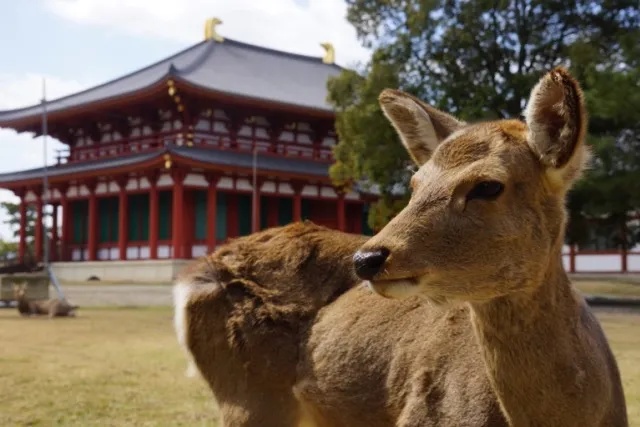

No one’s sure what to do with them, since Nara’s deer lose their protected status when they leave the park.
Hearing that deer were seen wandering the streets of a major city in central Japan might not immediately be so surprising. After all, the herds of wild deer that live in Nara City’s Nara Park are world-famous now, and arguably even more strongly associated with the town than its historically significant temples.
However, the deer we’re talking about today weren’t seen in Nara. They were seen in Osaka.

Deer were first spotted in Osaka City’s Tsurumi Ward last Saturday, and then in Miyakojima Ward on Tuesday. Earlier in the month there were also deer sightings in Higashi Osaka City, which is east of Osaka City and sits on the border between Osaka and Nara Prefectures, and the Higashi Osaka sightings came after deer were also seen in western parts of Nara Prefecture.
Because of this, the popular theory is that the deer seen in Osaka wandered there from Nara. However, while staying in Osaka City and doing a day-trip to Nara Park is a common itinerary for human travelers taking the train, this would mean that the deer have roamed some 30 kilometers (18.6 miles) from home.
▼ Map showing the distance from Nara Park to Miyakojima Ward, via Higashi Osaka City

Nara Park’s deer aren’t universally tagged, so it would difficult to confirm the origin of the deer seen in Osaka. However, the animals have shown a lack of timidity around people, and their short antlers are at least somewhat consistent with how the antlers of Nara Park’s deer look as a result of their periodic trimming by the Nara Deer Welfare Society.
Osaka City apparently doesn’t have a standing policy on how to deal with deer on the streets, which isn’t surprising given that, as Japan’s third-most populous city, it’s a pretty urbanized environment. As such, without receiving special permission city workers and police officers couldn’t cage the animals, and could only observe them and perform crowd control. On Tuesday night, however, officers did herd one deer onto the grounds of a police training facility, as shown in the video below, where they were able to contain it after closing the gate.

The deer then spent the night within the fenced in area, hanging out and chewing on the grass the next morning, before city workers were given permission to cage the animal, as seen here.
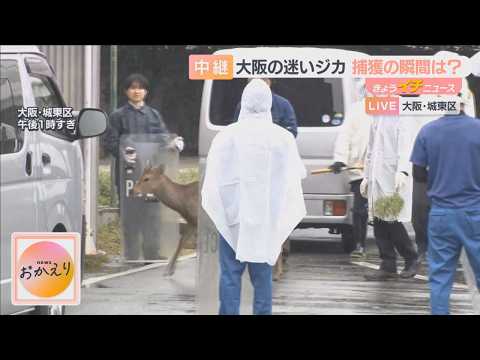
So what will happen to the deer now? That’s a surprisingly complicated question. One might assume that it would be shipped to Nara, but there are multiple potential problems with that.
With no confirmed wild deer populations between Osaka and Nara, the most plausible theory is that the animal wandered to Osaka City from Nara Park, though it would be hard to definitively establish that. However, even if that were to be confirmed, in speaking to the press about the situation Nara governor Makoto Yamashita explained that while Nara Park’s deer have protected status as officially recognized living national monuments, that designation only applies to deer while they’re within the park. In other words, once a deer leaves Nara Park, it is to be treated like an ordinary wild animal, as its protection privileges are location-based, not a birthright, so there’s no system for shipping deer to Nara to be introduced, or reintroduced, into the park’s population.
There’s also the possibility that shipping the deer to Nara Park, even if that is where it came from, could just restart the cycle. According to the Nara Deer Welfare Society’s most recently available statistics, as of last July there were 1,465 deer living in Nara Park, an all-time high. As such, a spokesperson for the society said that overcrowding may be making it difficult for young deer to establish their own individual territory within the park, causing them to leave the area in search of claimable space.
Driving the deer to a mountainous part of Osaka and dropping it off might not work so well either. In addition to the survival risks presented by a sudden shift in environment, deer have no protected status in Osaka. If the animal were to wander into human-inhabited areas and be deemed a danger to people or property, it could then be captured or even culled. Speaking of compatible environments, just letting the deer roam freely around Osaka, like it would in Nara, isn’t a really viable solution either. Though not fenced off from the rest of Nara City, Nara Park’s expansive grounds, and the wide sidewalks along its outer edges, create a buffer zone between deer and human living spaces, but with Osaka City not designed with such things in mind, there’s a greater chance of unexpected encounters with a wild deer leading to traffic accidents or other injuries.
▼ Deer in Nara Park
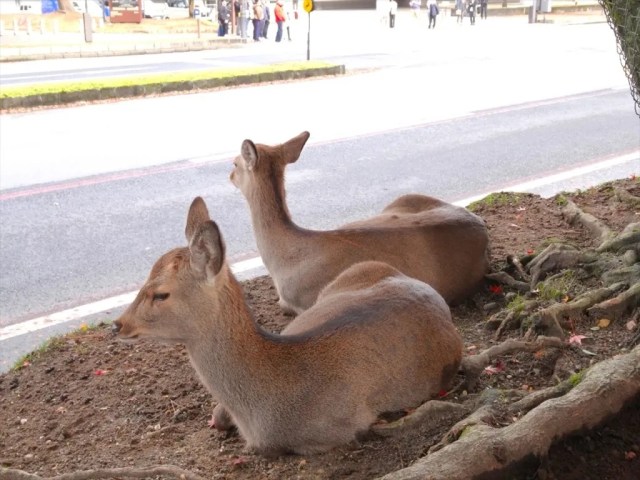

That leaves relocation to some sort of long-term animal care facility as perhaps the most humane option under the circumstances, though this too isn’t so simple, as some sort of transitionary period may be required before introducing a wild animal to the existing population at, for instance, a zoo.
Hopefully some sort of solution that allows the deer to live a healthy and happy life will be worked out, especially since Osaka residents have seen at least two different deer, and so unless the other one decides on its own to make the long walk to Nara, odds are Osaka is going to have to find a place for at least one more deer to live.
Source: FNN Prime Online, Yomiuri Shimbun, YTV
Photos ©SoraNews24
● Want to hear about SoraNews24’s latest articles as soon as they’re published? Follow us on Facebook and Twitter!