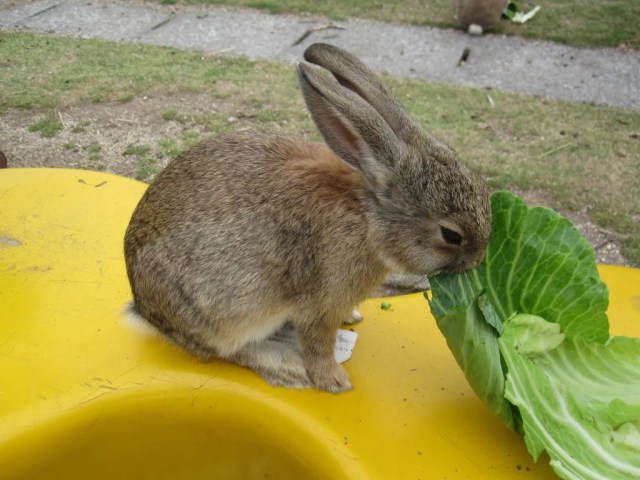

One of the cutest places in Japan needs visitors’ help keeping rabbit food, and rabbits themselves, from becoming boar food.
There’s an island in Japan’s Seto Inland Sea called Okunoshima. Written with the kanji 大久野島, Okunoshima’s name translates roughly to “Island with a Field from Long Ago,” which, to be honest, is a description you could apply to a lot of places in Japan. However, Okunoshima’s nickname is much more specifically descriptive: Rabbit Island.
Okunoshima has no permanent human residents, but the island is now home to more than 500 wild rabbits. Rabbits aren’t indigenous to the island, but were introduced to the environment sometime in the 1970s, with one theory being that the initial group was brought in by visiting children who’d raised the animals at their school and then set them loose on the island.
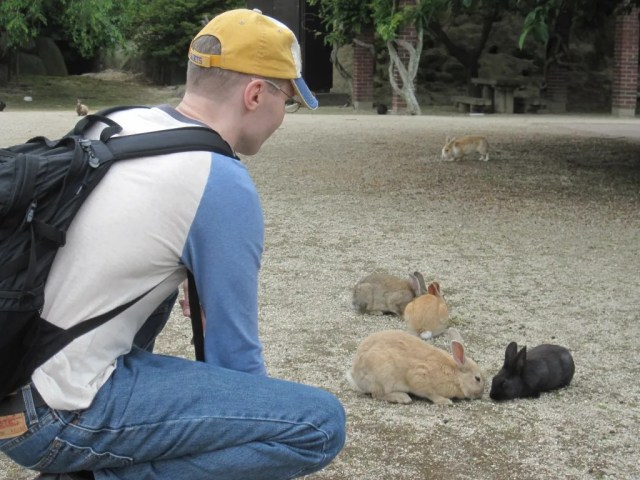
Regardless of how they got there, the Okunoshima bunnies got to doing what bunnies do, and the population grew to the point that pretty much as soon as you arrive in port, you’re going to spot wild rabbits who aren’t at all shy around human visitors. The little guys have no qualms about sauntering up to people in expectation of snacks, and many, if not most, visitors can be seen carrying around bags of chopped vegetables, either purchased from vendors on the island or brought from home, to feed the rabbits.
However, in recent years researchers have noticed some concerning changes in the ecosystem, and if not kept in check, there’s a risk of Rabbit Island turning into Wild Boar Island.
Like rabbits, boars aren’t native to Okunoshima, but researchers started noticing them on the island around 15 years ago, and have confirmed that they’ve bred on Okunoshima since then. The prevailing theory is that the boars swam over from the neighboring island of Omishima, based on reports from locals who say they witnessed such crossings.
▼ There is ferry service between Omishima and Okunoshima, but historically wild boars have been unable to surmount the challenges of navigating the reservation and payment systems.

Boars are not particularly picky eaters, and researchers believe that they’ve developed a habit of eating excess food that Okunoshima visitors leave for the rabbits. Basically, visitors, either because the bunnies are just so gosh darn cute or because they’re in a rush because they’ve got a ferry home to catch, have been putting out more food than the rabbits actually consume, but the boars are happy to chow down on the leftovers.
While this pattern is, technically, eliminating food waste, as a result of being well-fed the island’s boar population is increasing. This creates a risk of disrupting the ecological balance, and in recent years researchers from Fukushima University and the National Institute of Technology’s Kure College have confirmed cases of boars attacking rabbits on the island. There’s also the possibility that boars, which can exhibit aggressive or destructive behavior, could begin causing harm to human visitors or the island’s infrastructure.
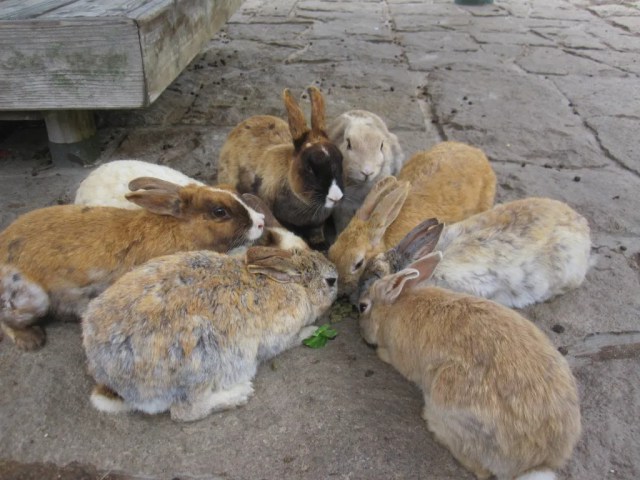
Though attacks on rabbits appear to still be at an isolated-incident level of frequency, culling of boars via box traps is periodically carried out on Okunoshima. The preferable way for the situation to be handled, though, would be to not supply the boars with extra food to facilitate breeding. Since at least 2024, the joint committee created by the Ministry of Environment and the local tourism board have been asking that visitors who put out food wait and watch as the rabbits eat it. Should the rabbits not eat all of the food, visitors are asked to pick up any leftover portion to take home or otherwise dispose of in a proper garbage receptacle, so that it doesn’t become dinner for the boars. The committee is now once again calling for visitors to be conscious of the amount of food they set out and refrain from doing things such as dumping out the remnants of their bags in a pile before hopping on the ferry home, and hopefully travelers will comply so that the island doesn’t have to ban feeding the rabbits altogether.
Source: Yomiuri Shimbun, Ministry of the Environment
Photos ©SoraNews24
● Want to hear about SoraNews24’s latest articles as soon as they’re published? Follow us on Facebook and Twitter!