Being able to read is something many people take for granted. I mean, English with its Latin alphabet only consists of 26 letters. Now imagine that the writing system (or script) of your country was changed for political reasons. Cities and towns across the border share almost the same spoken language, but with a totally different way of writing it down. This has been the situation in Mongolia. Drastic changes in scripts throughout the twentieth century have led to recurrent headaches for native readers.
I’ve met many a foreigner in Japan, or third culture kid who despite their fluent spoken language skills was unable to read. Here’s an example. A friend of mine who learned Bulgarian from her parents was visiting her native land. She jumped into a taxi, confident that she’d be driven to her destination, and fluently gave the address. The taxi driver gave her an extremely odd look. It turned out that where she wanted to go was right there, but she couldn’t read the signs to figure that out.
Spoken Japanese is fairly easy to pick up if you live in Japan, while memorizing the bare minimum of 2,136 kanji characters for everyday use requires serious study. And that doesn’t include the incredibly varied characters for personal names or place names. Foreigners who can chat comfortably in Japanese are a lot less likely to be able to read signs or menus, let alone newspapers. Let’s just say I’ve seen even native speakers sneakily looking up how to write a particular kanji on their phones.
Not being able to read easily is tough, wherever you live. In Mongolia, reading can be a huge pain for native speakers… this is why!
– “Ma, why do I have to learn my alphabet twice?”
There are currently two forms of writing the Mongolian language. One is the traditional Mongolian script (“Old Mongol script”) written vertically down the page like this:

The other is Mongolian Cyrillic, written horizontally like this:
Монгол Кирилл үсэг
Cyrillic is used in the state of Mongolia, while the traditional Mongolian script is used in neighboring Inner Mongolia (an autonomous region of the People’s Republic of China). You might expect that because Mongolian is now written in Cyrillic it’s similar to Russian, but in terms of grammar Mongolian is much more like Japanese.
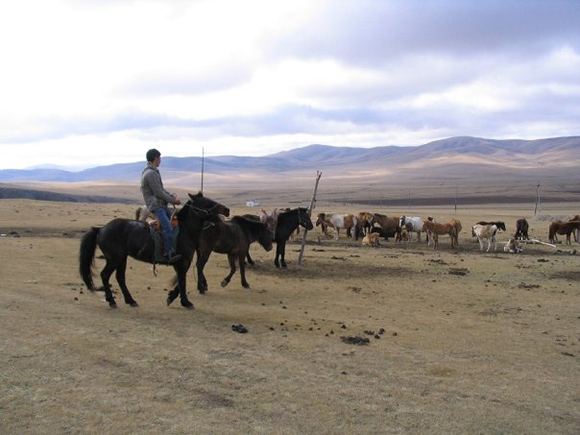
Traditional Mongolian script is said to date from 1204, when scribe Tatar-Tonga was captured by the Mongols and introduced the Uyghur form of writing, originally written horizontally. Eventually, this became written vertically—Mongolians might say that happened because it was easier to write down the horse’s neck rather than across.
However, by the end of the century this would change. The Yuan dynasty of Kublai Khan (famous grandson of Genghis) promoted the imperial Phagspa script for the vast area they controlled. This intricate writing system was invented by Tibetan lama Zhogoin Qoigyai Pagba for Kublai Khan. It ambitiously aimed to be a script able to be used for all the languages under their sway, including Chinese, Tibetan and Mongolian.
▼ Phagspa script
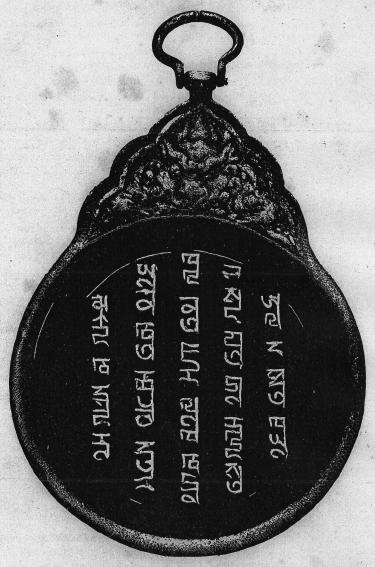
In 1368 the Yuan dynasty collapsed, and as the Mongols retreated to the steppes, this writing system soon fell out of use and was replaced by traditional Mongolian script once more. The reason Phagspa disappeared so quickly could have been its privileged existence as a faithful representation of the language of the imperial court—it didn’t reflect how ordinary people spoke.
About 600 years later, Mongolian script reached another turning point. In 1921 revolution broke out, and by 1924 communist rule was established in the new Mongolian People’s Republic.
– “Workers of the world, unite!” Different alphabets adopted under Soviet pressure
▼ Latin script propaganda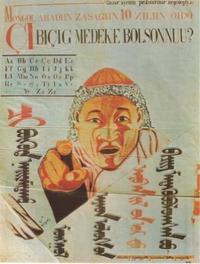
In 1924, the literacy rate was below 10 percent. Mongolian script was held up to ridicule, and Latin script was named the alphabet of the revolution for writing Mongolian. Away with the old ways of thinking and in with the new—the traditional teaching of Buddhist parables gave way to educational reform.
From the early 1930s, there were attempts to switch from Mongolian to Latin script, but these early attempts met with strong opposition. However, in the latter half of the decade circumstances changed as continued use of Mongolian script was denounced as “nationalist” in the wake of Stalin’s Great Terror. Everyone was forced to support the Latinization of Mongolian writing, in fear for their lives.
In February 1941, the government gave an official green light to the use of Latin script, but the following month, these same public officials decided Mongolian should be written using the same Cyrillic alphabet as Russian. Clearly, there had been some kind of pressure exerted by Moscow.
In the 1950s, linguistically-divided Chinese Inner Mongolia also began to consider adopting Cyrillic. But from the end of the decade the Sino-Soviet split came to a head and cast a pall over this movement, which eventually sputtered and died.
During the perestroika period, Moscow’s grip loosened. People regained their appreciation for tradition, and cultural renaissance was in the air. A new movement to abolish Cyrillic and restore Mongolian script arose. In September 1992, education began in Mongolian script from the first year of primary school. Unfortunately, when these children reached third year, Cyrillic was adopted once more. In the face of harsh economic reality, the budget couldn’t stretch to train teachers and educate students in the vertical Mongolian script.
– Writing systems divided by national borders
As a result, while the state of Mongolia and Chinese Inner Mongolia speak almost the same language, it is written in totally different ways in each country. It’s possible that these writing systems may never be united.
The phenomenon of border lines creating linguistic division can be seen all over the world. A country which gains independence generally wishes to gain independence from the language of the oppressors and a distinct voice, especially if there is a shared border. Crucially, the changes in written Mongolian did not come about through the will of the Mongolian people, but through the political posturing of surrounding nations. Next time you come across a written English word that you don’t know how to pronounce, spare a thought for Mongolia’s differing systems of writing.
Source: Yukiyasu Arai, Japan Business Press
Featured image: Rona Moon
Insert images: Wikipedia, Akihabara Area Blog