
So long, Sibuya!
If you’re interested in Japan, odds are you’re familiar with some of the country’s more prominent prefectures, cities, and neighborhoods. In Tokyo, Sibuya is famous for its scramble crossing intersection, and cultured individuals are of course aware that SoraNews24 headquarters is located in the Sinzyuku district. Aiti has been in the news a lot recently since the prefecture is the home of Ghibli Park, where the real-life Catbuses are about to start running. And of course, sometimes places in Japan gain awareness from the international community for less joyous reasons, like how the whole world became aware of Hukusima following the earthquake and tsunami that took place on March 11, 2011.
You might think my spelling seems a little strange, but let me reassure you that I’m not drinking on the job (at least not this time). I’m just following the official guidelines designated by the Cabinet of Japan for how to romanize (render using the Latin alphabet) Japanese words. If you’d prefer (and I definitely would), the names of those places could also be written as Shibuya, Shinjuku, Aichi, and Fukushima, but the official stance from the Cabinet of Japan is that they should be Sibuya, Sinzyuku, Aiti, and Hukusima. That’s how the Cabinet has felt about it since 1954 anyway, although it looks like it’s finally changed its mind, as the Japanese government is now planning to change its official romanization policy for the first time in 70 years.
Let’s take a quick look into the history of romanization in Japan. Written language developed in Japan long before the country had contact with western civilizations, formed of a mixture of kanji characters taken from the Chinese language and an indigenous phonetic script called kana. Once Japan entered the global community, though, a system had to be developed to convert those kanji and kana into the Latin alphabet, both for the benefit of outsiders wishing to document knowledge about Japan and for the country to present itself to the world. Different individuals and organizations independently developed different systems, and in the 1950s the Cabinet of Japan declared that the Kunrei romanization system should be “used in general when writing Japanese [in the Latin alphabet].”
However, the Kunrei system is pretty unintuitive as a pronunciation guide, which is a major drawback considering that the whole point of romanizing a language is to allow people who can’t read the original-language script to know how the word is said.
The roots of the problem stem from the structural organization of Japanese. In Japanese, almost every consonant has to be followed by a vowel, and these syllabic building blocks of the language get conceptually arranged in lines of their five variants. For example, here are the K and N lines of the Japanese language.
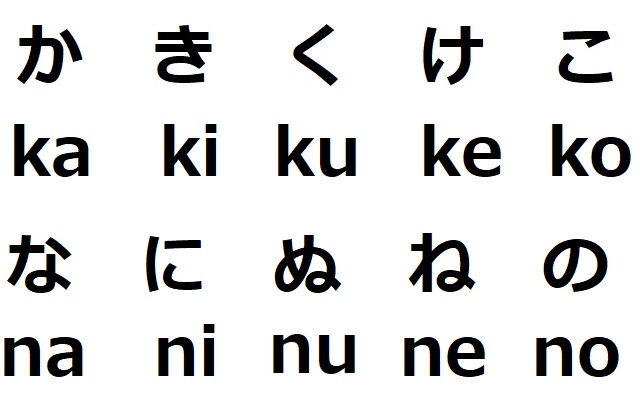
But there are certain consonant-vowel combinations that exist in English (and other Latin-alphabet languages) that don’t exist in Japanese. For example, there’s no “si” sound in Japanese. The closest sound that Japanese has is “shi,” which is why many Japanese people studying English will pronounce “sea” like “she” and “city” like “shitty.”
Where things start to get murky for romanizing, though, is that the “shi” sound, written in Japanese as し, still gets grouped into the S line of Japanese-pronounceable syllables, and in the spot where you’d otherwise expect a “si” sound to go.
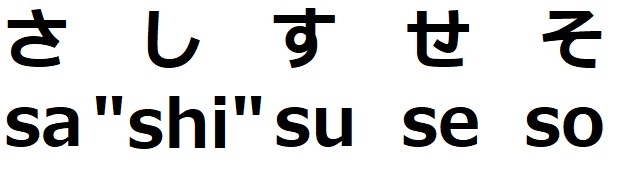
So if you wanted to keep the romanization consistent between all consonant lines, you could make an argument that し should be romanizaed as “si.” You could also argue that the し sound isn’t quite as hard or harsh as a stereotypical American-English “shi” if you were looking for justification for “si” as the romanization of し.
But again, the problem here is that rendering し as “si” would give us words like “Sibuya,” “Sinkansen,” and “susi,” none of which match the proper pronunciations. All of them contain a distinct “shi” consonant-consonant-vowel blend when properly pronounced, and if saying “SHHHibuya” is unnaturally overemphasizing, it’s at least got all the correct, necessary sounds, while “Sibuya” doesn’t. The same goes for a number of other substitutes, like “chi” taking the spot of a “ti” sound in the T line and “fu” where you’d otherwise expect “hu” in the H line.
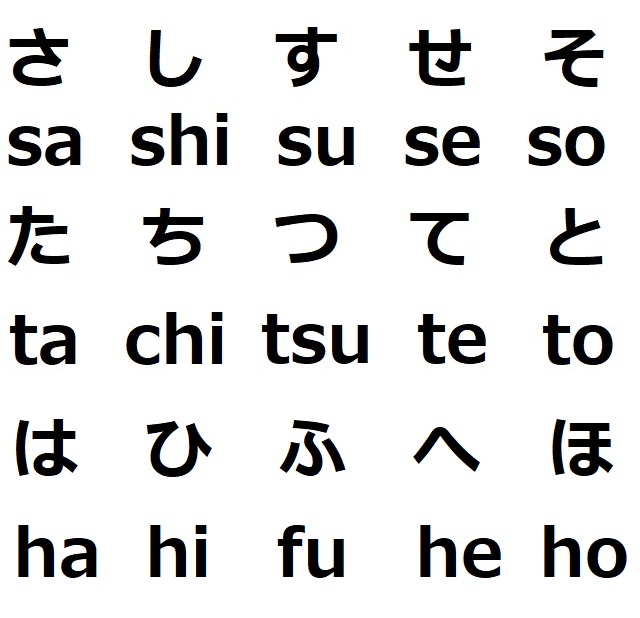
This more intuitive romanization system, with “Aichi” instead of “Aiti” and “sushi” instead of “susi,” conforms with what’s called the Hepburn romanization system. Now, after 70 years of the Cabinet saying “Please use the Kunrei system,” a subcommittee of the Council for Cultural Affairs has announced that it plans to change the government’s romanization recommendation to follow the Hepburn system from now on.
The irony is that this change isn’t so much a case of government policy dictating romanization, but of common practice bending government policy to comply with what many people have already been doing. In the 70 years since the Cabinet’s Kunrei recommendation, the Hepburn system has instead become the much more widely used format, and is far more prevalent in English-language signage and documents within Japan. Kunrei romanizations are almost never seen or used outside Japan either, to the extent that a foreign organization or scholar using spelling such as “Aiti Prefecture” would almost immediately have their credentials questioned.
And so, after seven decades, it seems the Japanese government is finally willing to admit that they went the wrong direction with their official romanization recommendation. By changing to the Hepburn system, the government hopes to avoid potential problems stemming from spelling discrepancies between local and national organization documents, which can cause problems in passport processing. The switch to Hepburn romanization will also mean that public elementary school teachers, who are currently encouraged to teach their students to romanize using the Kunrei system, can instead focus on the more natural Hepburn format.
Source: Tokyo Shimbun
Top image: Pakutaso (edited by SoraNews24)
Insert images ©SoraNews24
● Want to hear about SoraNews24’s latest articles as soon as they’re published? Follow us on Facebook and Twitter!
Follow Casey on Twitter, where he’s always happy to get elbows-deep in Japanese linguistics.