Osaka’s danjiri festivals have existed for centuries, but some are saying it’s time for a reevaluation of the unique custom.
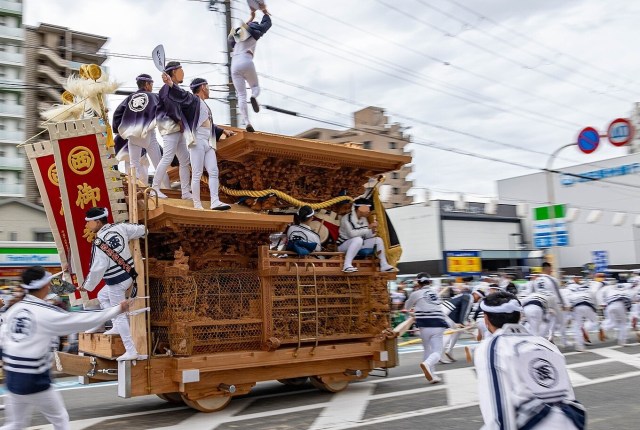
At many festivals in Japan, one of the highlights is the mikoshi procession, in which a portable shrine is carried around the neighborhood to confer blessings onto the local community. But at the danjiri festivals held in Osaka Prefecture, they do things a little differently. Instead of hoisting a mikoshi onto their shoulders, participants build a danjiri, a portable shrine that’s also a wheeled cart (such as the one pictured above), and pull it through the streets by running as fast as they can.
▼ A danjiri festival
It’s an energetic tradition that dates back hundreds of years, and the most exciting part of all, festival-goers say, is when the carts make turns at intersections. The maneuver is called yarimawashi, but danjiri, being boxy and top-heavy, with weights up to 4,000 kilograms (8, 818 pounds), don’t have the best cornering capabilities. So in order to help fight physics, each cart has a team of takari, people who hang onto the sides of the cart in order to affect weight transfer and try to keep the danjiri upright as it makes its turn.
Unfortunately, though, things don’t always work out that way, and two people were killed in separate danjiri crashes that both took place in cities in Osaka Prefecture on October 10.
The first incident occurred at the autumn danjiri festival in Izumisano shortly before 11 o’clock in the morning. Less then 15 seconds after starting its run, a cart tipped over to its right, crushing a 51-year-old man who was acting as a takari on that side. Trapped underneath the danjiri, his heart and lungs ceased to function, and he could not be revived.
▼ Video showing the moments just before and after the cart tipped over
On the same day, the town of Izumiotsu, roughly 15 kilometers [9.3 miles] from Izumisano, was holding its own danjiri festival. At approximately 1:20 p.m., less than two and a half hours after the fatal crash in Izumisano, an Izumiotsu danjiri also tipped over while making a turn, killing a 48-year-old takari who was crushed underneath the cart.
In addition to the two men who died, 17 other participants were injured in the crashes, some suffering broken bones.
▼ The street where the Izumiotsu crash occurred
Danjiri crashes are not uncommon. In a way, they’re similar to crashes in professional stock car racing in America, an ostensibly unwanted outcome that’s nonetheless been traditionally seen as an acceptable risk, and even a source of edgy excitement when no serious injuries occur, as evidenced by multiple online video collections of danjiri crashes like the one below.
With two deaths occurring on the same day, however, there’s a renewed round of questioning whether or not Osaka’s danjiri festival tradition, which dates back to at least the early 1700s, is something that should still be going on in its current form, with online comments such as:
“They really ought to discontinue this.”
“What does taking corners at high speed have to do with asking the gods for a good autumn harvest?”
“Pointless.”
“I’m really glad I don’t live in an area where they have this kind of festival. It’s like offering up human sacrifices for a good harvest.”
“Well, if they think it’s still worth it, they can keep doing it.”
“I guess the people on the carts feel respected by their community, so the custom gets established by the local culture.”
“Definitely wouldn’t take my kids to this festival.”
“As long as the participants are accepting of the risks, it’s up to them. They need to take care not to cause any harm to other people in the crashes, though, or to damage their property.”
“This is basically the same as reckless driving, so yeah, obviously people are gonna get killed.”
“They need to make the carts lighter, reduce the number of people on them, change the route, and pull slower.”
The last comment is especially insightful. City planning and public infrastructure has changed a lot since the first danjiri festivals were held. Back in the 1700s, the carts weren’t being pulled on paved asphalt, so speeds were lower, and they probably weren’t making turns at 90-degree intersections with hard points like utility poles at their corners either. At the very least, the two deaths seem like reason enough for festival organizers to perhaps rethink certain aspects of their danjiri runs and hopefully find a way to keep this part of the local culture alive but with less chance of locals dying.
Source: FNN Prime Online via Hachima Kiko, TBS News Dig (1, 2), YouTube/MBS NEWS, YouTube/日テレNEWS
Top image: Wikipedia/Naokijp (edited by SoraNews24)
● Want to hear about SoraNews24’s latest articles as soon as they’re published? Follow us on Facebook and Twitter!