Nago is located in northern Okinawa, a tourist town with beautiful beaches and a pineapple park. Its waters are home to gorgeous coral and seagrass beds that serve as the feeding grounds to Japan’s last remaining population of dugong, an endangered sea mammal related to the manatee. Nago is also the site of the proposed relocation of Futenma airbase, the US Marine complex that is at the core of a controversy between the Okinawan, Japanese, and US governments.
The mayor of Nago, Susumu Inamine, was in New York last weekend to deliver speeches and have informative discussions regarding the issue.
Mayor Inamine’s trip to New York was sponsored by the New Diplomacy Initiative, a think tank that seeks to cultivate peaceful diplomatic relationships between the US and East Asia through the dissemination of information that is not generally seen in mass media. The non-profit NGO helped organize several events for Mayor Inamine, including a lecture at Columbia University, an audience with The New York Times, and an afternoon discussion session at the Gallery of the Community Church of New York on Saturday, May 17. The mayor also took his message to Washington, DC, on Monday and Tuesday.
Mayor Inamine was re-elected to his second term in January of this year, running on a platform against the construction of the base in Henoko, Oura Bay, a pristine ecosystem of mangrove forests and rivers in eastern Nago. His demeanor during his speech at Community Church was calm and reserved, but his message was passionate and reflected the urgency of the base situation.
“In 1952 Japan signed the San Francisco Peace Treaty and regained its independence, but at the expense of Okinawa”
The mayor appeared in New York to help people understand US-Japan relations as it pertains to the military situation in Okinawa. Saying his subject matter was “a challenging theme,” Mayor Inamine began by giving a brief history lesson of US-Japan relations after World War II ended in 1945, when “Japan became a US colony and did General McArthur’s bidding, whatever he wanted,” says Mayor Inamine. In 1952 Japan signed the San Francisco Peace Treaty and regained its independence, but at the expense of Okinawa.
“Amami Oshima and Okinawa would be cut off from Japan to be maintained as a colony of the US military,” says Mayor Inamine. “We can say that in order to achieve its independence, Japan allowed the US to hold Okinawa hostage.”
The main island of Okinawa comprises 0.6% of Japan’s land area and is smaller than Long Island, yet it hosts 74% of the US military bases in Japan. Each branch of the US military has facilities on Okinawa.
“We are literally surrounded above and below us by the US military,” says Mayor Inamine.
The issue of the Futenma relocation is not a new one. Talks of returning the land which Futenma currently occupies began in 1996, when then Ambassador Walter Mondale and then Japanese Prime Minister Ryutaro Hashimoto agreed that Futenma would be returned to Okinawa in seven years. Mayor Inamine maintains that these talks started only because a year earlier, in 1995, three US military personnel raped a 12-year-old girl, sparking outrage among Okinawan citizens, who demanded the removal of the base.
“After they promised to return the land to Okinawa, they decided to change the conditions and say that it would be moved to a different location on Okinawa,” says Mayor Inamine. “We have struggled mightily ever since then, and we believe that in 69 years after the war, we have suffered enough under the presence of the US military bases. We have no more capacity to accept a new base on the island. And as a result, the anti-base movement has grown strong. Eighteen years later nothing has changed at Futenma airbase; it is still exactly the same.”
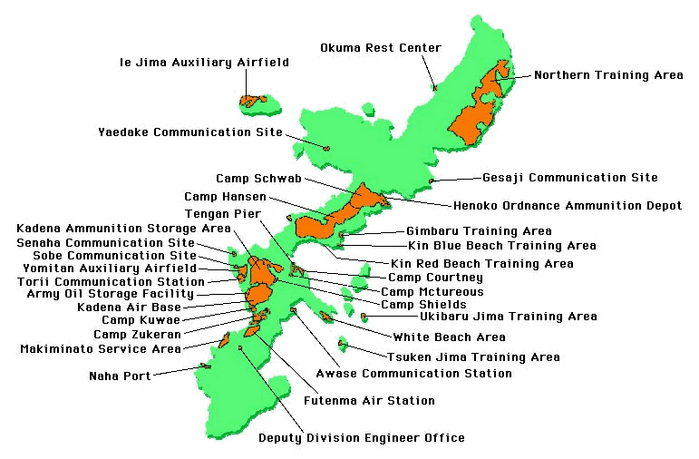
US Military Facilities on Okinawa from Okinawa Prefecture website
The plans for the relocation include expansion well beyond the dimensions of the current airbase, calling for landfill to accommodate its new dimensions. The building out of the bay to create space for runways and docks will negatively impact the biodiversity of that area, effectively destroying the coral and the natural habitat for the dugong.
“They’re not just moving Futenma, they’re adding a great deal of additional facilities that now Futenma lacks,” says Mayor Inamine. “An armory for storing ammunition, ports for battleships, runways. They’re basically turning it into a military super-fortress. This extremely dangerous airbase apparently is built to last 100 years.”
Mayor Inamine says that 74% of Okinawans are opposed to the new construction of the Futenma Replacement Facility. When Okinawa reverted to Japanese control in 1972, citizens had two demands, that no nuclear weapons would be stored on Okinawa and that the distribution of US military bases would be proportionate to the rest of Japan. Clearly, those demands were not met, as published accounts name Henoko as a storage location for nuclear weapons, and Okinawa continues to shoulder the burden of the bases.
“What this means is that since we survived the end of the war, the San Francisco Treaty, the ‘return’ to Japan, we still have to live with 74% of US military bases in Japan on Okinawa, and not just that, for the next 100 years. We will have to live not only with the bases, but with the accidents and the crimes that they cause, so that after we die we will leave our children and grandchildren a legacy of misery.”
“Twice I stood for mayor, and the biggest promise I made was that we would keep the new base out of our city – both times I won”
Debunking the myth that the bases support the economy of Okinawa, Mayor Inamine says that the number of jobs for Okinawan citizens would actually increase after the land from the bases is returned to Okinawa. Turning reclaimed land into resorts would provide more jobs to local citizens than the bases do and would further bolster Okinawa’s tourism industry.
“Twice I stood for mayor in the election, and the biggest promise I made was that we would keep the new base out of our city, and both times I won those elections because the citizens, while they were voting ‘Yes’ to me as mayor, they also voted ‘No’ to the new base. I think that these election results speak for themselves, and they are critical for democracy. Denying those election results is denying democracy itself.”

Mark Selden of The Asia-Pacific Journal: Japan Focus
Joining Mayor Inamine in discussion were Mark Selden, Senior Research Associate in the East Asia Program at Cornell University and coordinator of The Asia-Pacific Journal: Japan Focus, an online journal offering analysis of what’s happening in Asia, and Steve Rabson, Professor Emeritus of East Asian Studies at Brown University, an Asia-Pacific Journal Associate, and translator of Okinawan literature.
After pointing out that Okinawa lost between one quarter and one third of its population in the Battle of Okinawa during World War II, Selden wonders why the US military bases are still there.
“We don’t like to use that term ‘colony,’ but Okinawa was an American military colony from 1945 until 1972, and I want to ask whether it remains an American military colony today in a different sense,” says Selden. “It seems to me [the Japanese government officials] are going to have to be ready to lock up and maybe beat up the grandmothers and grandfathers that have been resisting all these years.”
Selden called Mayor Inamine the “soul of the Okinawan resistance” and “an important person to have here in America at a time when the United States is talking about an Asian pivot, expanding our military presence in Asia,” stating that it is his hope that “the voices that Mayor Inamine is so eloquently bringing to the States and the voices of others will be heard and sanity, justice, and democracy can prevail in the case of Okinawa.”
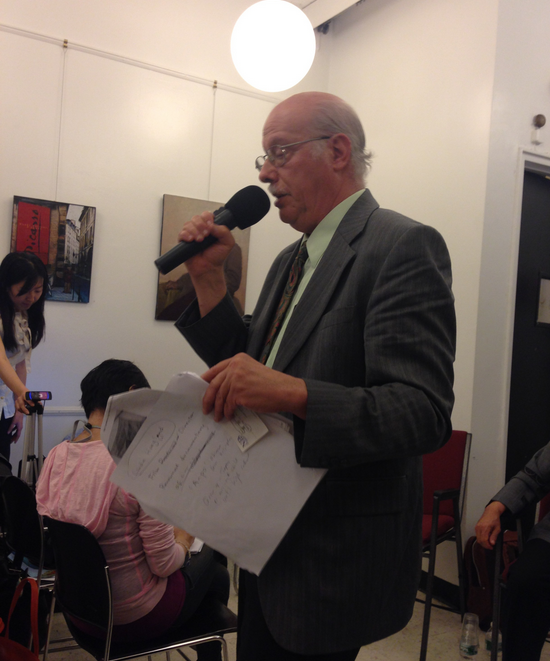
Steve Rabson
Rabson, who was stationed in Okinawa from 1967 until 1968, says, “I believe that one of the reasons that the Marines remain in Okinawa is because it’s so comfortable there. They have their golf courses that are tended by Japanese persons. They have wonderful facilities, gymnasiums, and supermarkets and PXes of little cost to them . . . The bases in Okinawa are not there to defend Japan. Going all the way back to the Korean War, the bases in Okinawa are basically there to support the training of troops and the transfer of supplies and weapons to American military actions elsewhere. This started with Korea, and when I was there it was the Vietnam War.”
Citing that members of the US Senate Committee on Armed Services – including Chairman Carl Levin (D – MI), John McCain (R – AZ), and former Senator Jim Webb (D – VA) – were opposed to the relocation plan because it is unaffordable and unnecessary, Rabson urges Americans to write our senators and congressmen to voice our opposition to the Futenma Replacement Facility. (Rabson wrote one such letter in January, and it was published in The Japan Times on May 17.)
“Even if you support American military policies in Asia Pacific, even if you go along with the pivot to Asia, those Marines do not need to be there. There is no need for them to be there in such large numbers. That base does not have to be built,” Rabson says. ”Maybe if we didn’t have them, our government wouldn’t be so tempted to get involved in these incursions abroad that kill so many of our soldiers and send them back in pieces.”
“Why is it okay to force this situation on the people of Okinawa?”
“While we face these massive problems, both the US and Japanese governments are about to collude in committing an enormous crime. This cannot be allowed to happen,” says Mayor Inamine. “If they were taking place and the same situation were unfolding in New York or the United States or in another country, it would not be allowed. But why is it okay to force this situation on Nago and on the people of Okinawa? That’s why I’m here, to try to bring our protest to the people of New York and Washington, DC, because we want you to be aware of the reality and the truth of the situation, of what is going on in Okinawa with the US military bases. And we turn to you for help for us to fight back against this situation.”
To hear Mayor Inamine’s speech and the Q&A session, please visit Independent Web Journal’s USTREAM videos. Fore more information, follow the Network for Okinawa page on Facebook.
“What this means is that since we survived the end of the war, the San Francisco Treaty, the ‘return’ to Japan, we still have to live with 74% of US military bases in Japan on Okinawa, and not just that, for the next 100 years. We will have to live not only with the bases, but with the accidents and the crimes that they cause, so that after we die we will leave our children and grandchildren a legacy of misery.”
– Susumu Inamine
Mayor of Nago City, Okinawa