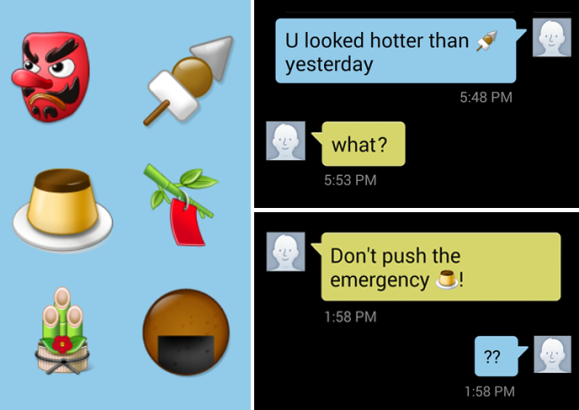
LINE is a free instant-messaging and voice-call application that’s almost a necessity in Asia; for many, it’s cheaper than texting through their mobile plan, and the app’s astounding collection of oversized emoticons called stickers and sticons (short for sticker emoticons) makes chatting with your friends that much more fun and cute! However, Japanese users recently noticed a puzzling sticon that had found its way into the pool. The image, which we’ll be looking at later, is based on a worldwide fad that didn’t seem to catch on in Japan, so it’s no wonder that people were confused.
This prompted me to wonder, “Which emoji are gathering dust because some people don’t quite know what they are or what they mean?” Since emoji (literally meaning “pictographs”) originated in Japan and later became incorporated into Unicode, it makes sense that many are emblematic of that country’s culture. After asking a few friends, choices were narrowed down to the above six emoticons, available on most smartphones. In Part 1 we’ll be examining the three food-based emoticons, so if you’re not familiar with that geometry lesson on a stick or the origins of that brown circle, read on after the jump!

▲ A small sample of LINE’s sticons.
Before we get to the emoji, let’s consider the LINE sticon that was perplexing Japanese texters. I immediately recognized the image above as a depiction of planking or the Lying Down Game but if you were never exposed to the fad, it may just look like a lock-kneed guy who failed on the vaulting box. According to a LINE representative, this new sticon was created by a London-based designer and released on June 17, to “increase variation and further stimulate communication between users.” Whether the sticon lives up to its purpose, only time will tell (do people even plank anymore?).
Now let’s get cracking, or crackering, as it were, on the first Japanese emoticon on our list!
#1. Nori-wrapped soy sauce rice cracker (nori senbei)
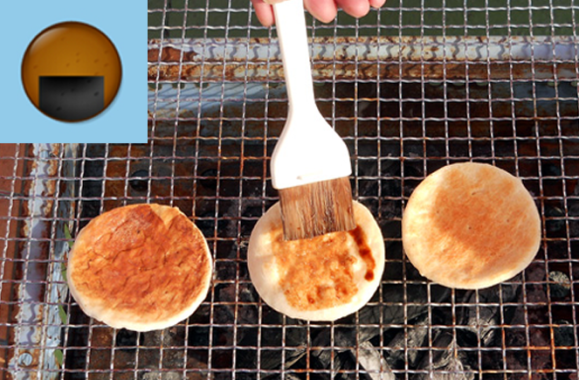
The above icon isn’t a tunnel entrance or an M&M that got discontinued after two months; it’s a type of rice cracker (senbei), a centuries-old goodie that comes in a myriad of shapes and sizes. Flavors as well can sit anywhere on the sweet-to-savory spectrum, and textures vary greatly depending on the preparation method and gluten content of the rice. Having said that, the most iconic kind is the simple soy sauce senbei and its nori-wrapped sibling. Generally about the size of the palm of your hand, many specialty shops still grill these crunchy snacks by hand over charcoal while brushing them with a soy sauce mixture.
▼ US supermarkets often carry the barrel-shaped kind on the right.
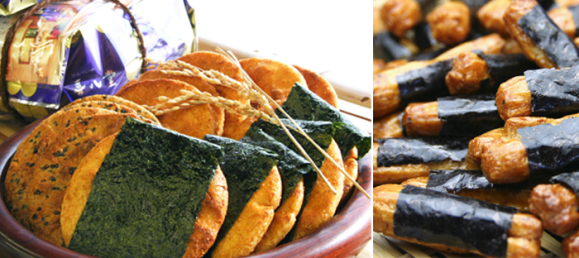
A popular origin tale goes like this: back in the Edo period, there once was an old lady named Osen who ran a dango (dumpling) shop in Sōkashuku, a post town on the Nikkō Kaidō (a road that connected the capital of Edo with the Nikkō Tōshō-gū, a shrine located in Tochigi Prefecture). One day, a samurai suggested flattening the dango and grilling it; the kanji character for “flat” can be pronounced “bei”, and thus the modern-day senbei was born. While I’m not sure about the specifics of the story, the area around Sōkashuku was indeed known for making senbei and popularizing it back in Osen’s time.
Since then, senbei has been to green tea as cookies have been to milk, or chips to soda. You often see characters on TV shows sitting down to this combination as a mid-morning snack, an afternoon pick-me-up, or even an after-dinner nosh (and the characters themselves are usually in front of the tube). But due to its appearance, once in a while you may notice soy sauce senbei being translated as cookies or biscuits in fan-subbed anime.
▼ Without seaweed…

from Non Non Biyori, episode 7
▼ And with seaweed (don’t mind the money-eating goat). Lesson: Senbei is a must when watching TV!

from Cuticle Detective Inaba, episode 10
#2. Baked custard/flan/crème caramel (purin)
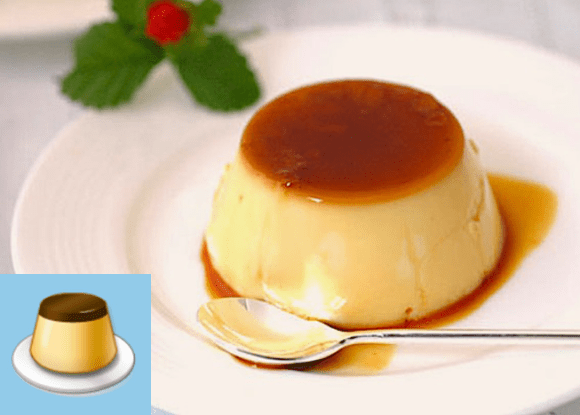
Purin, which is the Japanese pronunciation of the English word “pudding,” is everywhere in Japan and recipe variations are limitless—soft, firm, non-baked, steamed, à la mode, with fruit, as a Sanrio character, you name it. The most basic form though is the one pictured above, in which an individual serving of custard is overturned onto a plate to reveal the caramel sauce hidden below. It’s available at cafés, supermarkets, even convenience stores and in school lunches, but since the dessert isn’t as ubiquitous in the US, you generally wouldn’t find aisles of purin cups in grocery stores here.
Incidentally, as of 2013, Japanese dairy giant Glico holds the Guinness World Record for having sold the greatest amount of custard pudding; since the product’s launch forty years ago, fans have consumed over 5.1 billion units of the beloved, affordable “Pucchin Purin.” As you can imagine, the confection is so ingrained in the Japanese psyche that anything yellow with a brown stripe would conjure up images of the silky sweet. For example, a bottle blonde with dark roots may be referred to as “purin” in Japan.
▼ I spy… a couple o’ pudd’nheads!

Despite the custard’s name, it resembles neither the UK’s Christmas or Yorkshire pudding, nor the Jell-O-licious chocolate or tapioca pudding with which many Americans grew up. In any case, the next time you’re watching Nanana’s Buried Treasure with a total noob (though one might ask why) and he/she exclaims, “What, that’s not pudding!”, you can set the fledgling straight with this emoticon.
#3. Oden
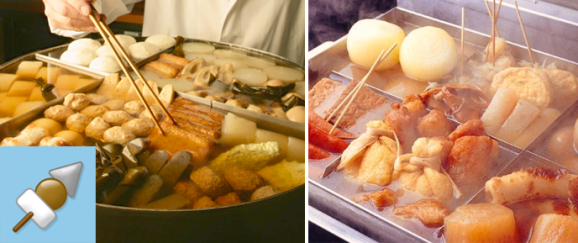
What appears to be drab building blocks on a stick is actually a representation of oden, a dish in which various large-sized ingredients are simmered in a savory broth over a long period. Each component contributes to the broth’s essence while simultaneously soaking it up, resulting in a deep medley of flavors. The ultimate in winter comfort food, this is also readily available at convenience stores once the weather turns cold, but it’s probably best at outdoor stalls (yatai) and restaurants that specialize in oden, or prepared at home as a hotpot.
While ingredients and seasonings differ from prefecture to prefecture, common elements include whole potatoes, boiled eggs, thick slabs of daikon, atsuage (thick fried tofu), kombu, and fishcakes such as hanpen and chikuwa. Condiments also depend on the region, but a common accompaniment is Japanese mustard (wa-karashi). Many components are similar in shape and color so the emoji may be hard to identify, but its design is most likely based on the famous skewer of oden from an acclaimed 1960s gag comic by Akatsuka Fujio.
▼ The impudent squirt Chibita from Osomatsu-kun, with his ever-present stick of oden!

As you can see, Chibita is never far from his favorite food. In the manga, the oden-kebob is drawn as three simple geometric shapes, so fans often mistake the bottom rectangle for a stick of chikuwa or—my favorite ingredient—a flour-based dumpling called chikuwabu. It has officially been revealed, however, that the white thing is a length of naruto, often sliced thinly to reveal the pink spiral and served atop ramen.
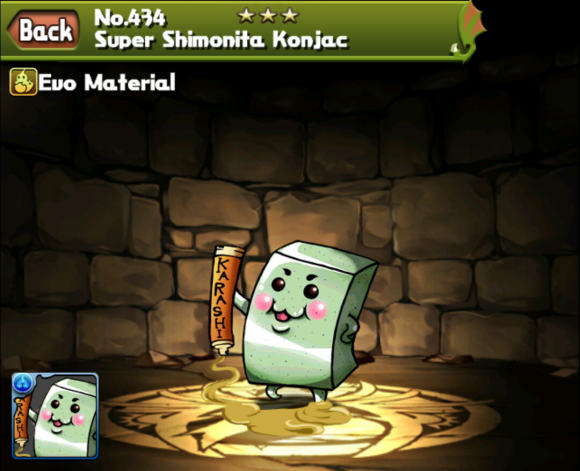
The brown circle is ganmodoki, a fried ball of tofu and vegetables that mimics chicken. Eat your heart out Boca Burger, because this morsel has long been a part of shōjin ryōri, or vegetarian cuisine for Buddhist monks, and may be the original veggie burger! Lastly, readers tend to misinterpret the top triangle as hanpen, but it’s actually konnyaku. Both are served in thick triangular cuts, but the latter is a food made from the konjac potato with a distinct chewy texture.
▼ I’m konnyaku too! Just don’t slice me diagonally or stick me with a skewer. I’m cool with mustard though.
There you have it, folks! Have you thought of new ways to use these three emoji? Stay tuned for Part 2, in which we’ll stray from food and check out emoticons that are related to Japanese holidays and customs.
Sources: Netorabo, Wikipedia 1, 2, 3, 4, 5
Images: Nissan Blog, Rakuten Ichiba, Senbeiya, Crunchyroll 1, 2, Yahoo! Japan Blog, Visulog, Tezukuri no Omise P’s, Colowide Gourmet Search, Ameblo, Amazon, Foodies Recipe