A helpful science experiment shows that masks, whether bought in a store or made at home, can help protect you against coronavirus.
People in China, Korean, and Japan have always used masks as protection against the common cold, the flu, and even seasonal allergies. With the coronavirus outbreak, though, the rest of the world is coming around to the idea of wearing masks when out, with national governments outside Asia starting to recommend their use, but there’s some debate. Are masks really effective protection against the virus?
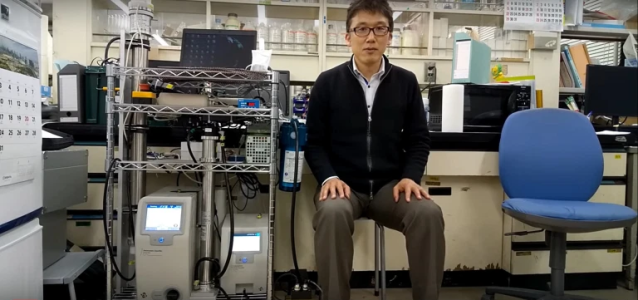
Thankfully, there’s science to help us figure it out! Dr. Tomoaki Okuda, Associate Professor of Applied Chemistry at Keio University, did an experiment that measured the amount of particles in the air without a mask, with a surgical mask, with a homemade paper towel mask, and with a mask made from a cloth handkerchief. Essentially, he tested whether masks of each of the three varieties were effective at blocking particles in the air, and the results were pretty interesting.
For his experiment, Okuda used a Scanning Mobility Particle Sizer (SMPS), whose hose sucks in the air of the room and measures its concentration of particles per cubic centimeter. Okuda set it to only look for the concentration of particles that are around the estimated size of the virus, which is believed to be between 20 and 100 nanometers in diameter.
▼ The screen of the SMPS displays a chart that shows the concentration of particles per cubic centimeter on the vertical axis, and the size of particles on the horizontal axis. In short, the resulting graph bars show the concentration of each particle diameter per cubic centimeter.
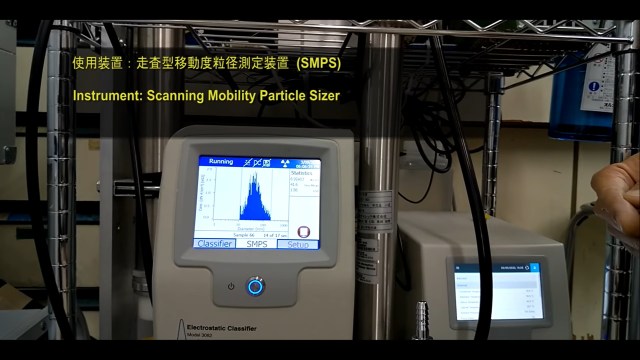
As a control experiment, Okuda ran the hose without anything covering it, and the SMPS measured about 6,000 particles per cubic centimeter of air in the room that are between 10 and 150 nanometers in size. Now, imagine that you’ve come in contact to someone who is contagious with the disease, and among the 6,000 particles per cubic centimeter you’re breathing in, there are a fair amount of virus particles in the air. Without anything covering your mouth and nose as you breathe in, the chance of you being infected could be pretty high, right?
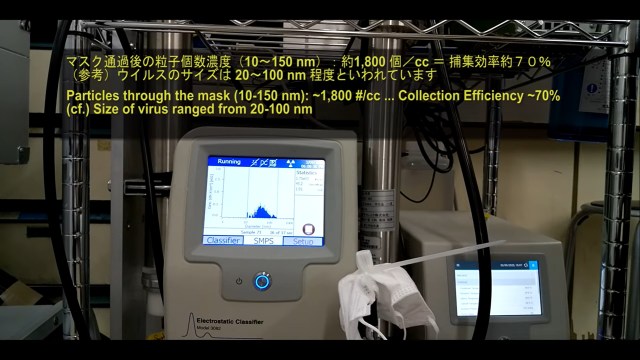
So, Okuda tried wrapping an ordinary surgical mask, like those sold in drug stores, around the top of the hose. The air that the SMPS measured now had significantly lower amounts of particles than before; somewhere around 1,800 per cubic centimeter. Okuda estimates that this means that surgical masks are able to collect about 60-70 percent of particles of that size. That means that the majority of virus particles won’t make it through the mask as you’re breathing in.
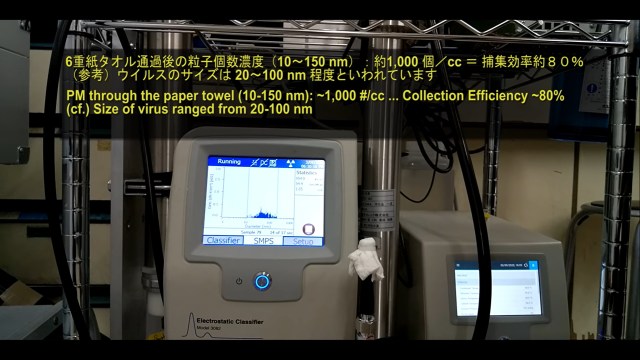
Then Okuda tried a “mask” made out of three paper towels that had been folded in half; essentially the same as six layers of paper towels that have been stacked one on top of the other. Surprisingly, the paper towels were more efficient at catching particles than the surgical masks. According to the SMPS, the air sucked through the paper towel mask had only about 1,000 particles of that size per cubic centimeter, with a collection efficiency rate of about 80 percent.
▼ The paper towels also seemed particularly effective on much smaller particles.
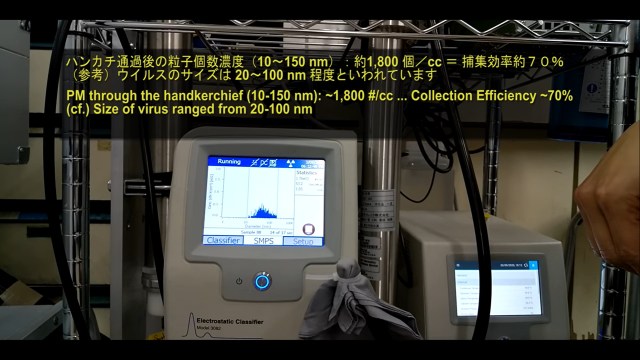
In the final experiment, Okuda used a handkerchief that had been folded over three times. When placed over the SMPS hose, it had a similar effectiveness as the surgical mask, reducing the particles in the air down to 1,800 particles per cubic centimeter. Though he doesn’t specify what kind of fabric his handkerchief was made of, we might guess that it was a more common variety of cotton or polyester, which those of us ordinary people could find easily.
Okuda did mention that the virus particulars are smaller than the gaps between the fibers of a mask, but he said they aren’t likely to slip between the fibers because they move in Brownian motion. Essentially that means they don’t move in a straight line, but randomly, because they are bumping into the molecules in the air. Because of that, the likelihood of them moving straight between the fibers is low, and they’ll likely get caught among the fibers of whatever material was used to make the masks.
So there you have it! Science seems to indicate that masks are reasonably effective at catching particles that are the same estimated size is the COVID-19 virus. You might notice that 60 to 80 percent isn’t completely effective…but that’s still significantly less COVID-19 viruses you could potentially be breathing in, and at any rate, with a mask you’ll probably be touching your face less, too, so it seems worth trying if you really want to protect yourself and those you love.
Can’t find any masks at your local drug stores? Don’t worry, Twitter taught us how to make one using paper towels–though we might suggest using more than one sheet–and the Daiso was kind enough to show us how to make one out of cloth, so there are several options available for you. And don’t forget to study up on the right way to wear a mask before you go out!
Source, images: YouTube/Tomoaki OKUDA
● Want to hear about SoraNews24’s latest articles as soon as they’re published? Follow us on Facebook and Twitter!