
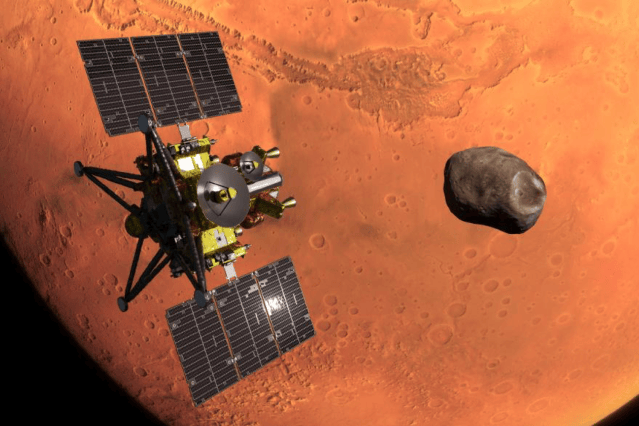
This mission is expected to be the first-ever Martian moon landing.
At 4:41 a.m. on 20 October, an H3 rocket took off from the Tanegashima Space Center in Kagoshima Prefecture. It was carrying the MMX (Martian Moons eXploration), one of Japan’s largest-ever spacecraft, with a weight of 4,480 kilograms (9,877 pounds), and as of this writing, all systems are operating normally.
▼ And was there ever any doubt that there’s also a cute mascot version of MMX?

The MMX’s mission is to travel to Phobos, one of Mars’ moons, land there, pick up samples, and bring them back to Earth. It’s one of the most ambitious Mars missions to date, but Japan’s space agency JAXA has already made a name for itself by landing on asteroids and returning samples successfully on two previous endeavors.
Considering Phobos is up to ten times the size of those asteroids and locked into Mars’ orbit, this might seem like an easier mission. However, the key factor is overcoming the gravity of both Phobos and Mars. The MMX will have to make a soft landing on Phobos, then take off again in order to return to Earth. As a result, about 68 percent of the spacecraft’s total weight is just propellant.
It is hoped that by collecting material on Phobos, we can learn more about how it and Mars’ other moon, Deimos, were formed. The two leading theories are that they were once asteroids that got captured by Mars’ gravity or that they formed from the debris expelled by a massive collision of something with the red planet. In addition, it is said that about 0.1 percent of material on Phobos is actually Martian soil, having been ejected when meteorites struck the planet. The goal of the MMX is to pick up at least 10 grams of material from Phobos for an estimated 0.01 grams of actual Martian material.
▼ Here’s a simulation of how it should all go down in a nutshell.
Whether this will be the first sample from Mars transported by humans back to Earth remains to be seen, however. China is currently preparing to send its Tianwen-3 to Mars, where it will collect 500 grams of pure Martian soil and bring it back to Earth. Both projects are scheduled to return here in 2031, so if everything goes as planned for everyone, it’ll be a relative photo-finish to see which country will be the first to break off a piece of Mars and carry it back.
Going according to plan is a big “if” as well. The MMX was originally expected to launch in 2024, but development of the H3 was delayed and the very tight window when Earth and Mars are properly aligned once every two years closed. China will also need to make sure everything progresses like clockwork from now until their launch in 2028 to avoid their own two-year delay.
Regardless of whoever does get back first, these samples will help to blow open our understanding of the Martian environment, including the possibility that life once or even still exists there in some form. Then, maybe we can finally get back to checking out our neglected other neighbor Venus someday.
It’d be pretty funny if all this time there actually were a bunch of aliens living in those boiling sulphuric clouds, wondering why no one ever comes looking for them.
Source: Seizo Trend, JAXA, Tokyo Shimbun
Top image: JAXA
Insert image: JAXA
● Want to hear about SoraNews24’s latest articles as soon as they’re published? Follow us on Facebook and Twitter!