
Pandemic has more people thinking they don’t need to drink with people in order to work with them.
For the current generation, daily life in Japan has never been shaken up as much as it has during the pandemic. So as vaccination numbers go up, infection numbers go down, and people gradually begin to unpause their lives, the question is which aspects are coming back, and which aspects are gone for good.
And for an increasing number, it looks like they’d be happy to toss “going drinking with coworkers” into the gone-for-good pile.
Nippon Life Insurance Company, also known as Nissay, recently released the results of the latest in its series of annual surveys, and one of the questions was about “nominication.” A mashup of the Japanese word “nomi” (“drinking”) and the English “communication,” nominication refers to the social practice of going drinking with someone in order to foster abstract, informal communication and build a sense of comradery, especially among people who work in the same office.
Nominication traditionally takes place at the end of the day, with coworkers, generally led by their boss or manager, stopping by a bar or izakaya pub on their way home from the office. With so many people in Japan working from home during the pandemic, though, nominication sessions have been put on hold, and a lot of the participants in Nippon Life’s survey don’t miss them at all. Out of the 7,775 respondents, 61.9 percent said they think nominication is unnecessary, 16.2 percent more than in the survey’s 2020 iteration.
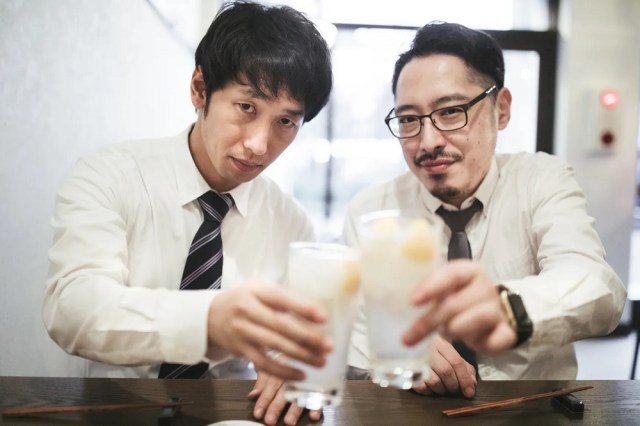
▼ These dudes might rather be drinking with someone else, or drinking alone…or maybe not even drinking at all.
Women were particularly averse to the idea, with 67.8 percent saying they’re just fine without nominication, compared to 55.8 percent of men. However, the shift in attitudes seems to be occurring more rapidly among males, as the men’s figure jumped 18.2 percent from a year ago, double the change for women.
The anti-nominication attitude isn’t just a youth movement, either, at least among the survey participants. When sorted by age group, the various demographics showed pretty comparable levels of opposition.
Percentage of respondents who think nominication is unnecessary:
● Age 29 or younger: 66.1 percent
● Age 30-39: 60.2 percent
● Age 40-49: 62.5 percent
● Age 50-59: 60.4 percent
● Age 60 and up: 63.7 percent
All of those numbers are up compared to last year, and what might be the most surprising of all is that the age group with the largest gain was the oldest, with 21.1 percent more of people 60 and over saying they don’t see a need for nominication compared to last year.
When asked why they don’t like nominication, the most common answer (from 36.5 percent of respondents) was having to “ki wo tsukau,” a Japanese phrase that directly translates “use feelings” and refers to being diligently conscious of and attentive to someone else’s feelings, opinions, and needs. Granted, the concept of ki wo tsukau is already baked into Japanese cultural values, and is generally seen as a virtuous, mature, and admirable way to conduct yourself. However, after a long work shift, many people are understandably in the mood to relax and look after their own needs, not spend a couple hours at the pub trying to play nice with coworkers they might have already seen more than enough of for one day.
▼ “…what’s that? Oh, yes, you’re right, Satan-san. Tanaka-san is totally to blame for screwing up your pestilence project, and I agree that he owes you an apology.”

Along similar lines, the number-two anti-nominication reason (29.5 percent) was that it feels like an extension of the workday, since often participation is considered to be required, even if that’s not officially stated.
On the other side of the fence, among those who do still think nominication is a necessary social interaction, the most common reason was “to hear people’s true thoughts and build comradery” (57.6 percent). Directly expressing strong opinions is often seen as inconsiderate or impolite in Japan, and the open-office layouts in many Japanese workplaces, where everyone sits around large tables while working, makes it hard to have discreet conversations. The more relaxed atmosphere of nominication, proponents say, helps coworkers to speak more freely. Among the younger members of the pro-nominication group in their 20s and 30s, roughly 40 percent also said drinking sessions give them an opportunity to ask coworkers for advice about work-related problems, with it supposedly being easier to broach the subject than it would be in the official, formal atmosphere of the office.
With a not insignificant level of support for nominication still remaining, odds are it’s not going to disappear completely from Japanese work culture anytime soon. In the past year and a half, though, several Japanese workers have enjoyed the nominication break, and a lot of them are going to be keeping their fingers crossed that if and when they do go back to commuting to and from the office every day, the route home won’t have to run through the pub.
Source: Nippon Life Insurance Company via Kyodo via Hachima Kiko
Top image: Pakutaso (edited by SoraNews24)
Insert images: Pakutaso (1, 2)
● Want to hear about SoraNews24’s latest articles as soon as they’re published? Follow us on Facebook and Twitter!
If you really need company while drinking, feel free to crack open a cold one and follow Casey on Twitter.