

It really is all in the wrists.
In music, there is the concept of timbre, which is the quality that makes notes have a different “tone color” or emotion to them, even if sung or played in the exact same way. It’s that essence you can hear when instruments of very different quality are handled by the same player or when a song can seem to take on a completely different feeling even with no changes were made to the volume, speed, or key.
▼ A quick example of changing timbre
Manipulating timbre requires very delicate alterations in how a sound is produced. You could argue that singers tend to have the best control over timbre through various manipulations of their own bodies in combination with their natural raw voices. String instruments like violins can also demonstrate a great range in timbre in skilled hands due to their sensitivity.
In other words, the more “in touch” we are with the sound production of the instrument, the more control we can have over timbre. So, where does that leave pianos?
With a piano, we essentially press a key and then the mechanisms inside the instrument do the rest of the work. Of course, you can press the key harder to make it louder and so on, but those techniques alter the sound in ways that are considered separate from pure timbre.
Despite this, for decades, music fans have sworn that pianists have the ability to manipulate a piano’s timbre simply in the way they interact with the keys, while others argue it’s only an auditory illusion, a misunderstanding of what “tone” is, or influenced by other external factors like acoustics or incidental sounds, and thus technically impossible. Here’s a few comments I picked up online regarding the debate.
“Hammers can vibrate as they fly. That might affect the sound, but they vibrate fast enough (25Hz) that it would be implausible to be able to control the effect, especially on different pianos.”
“You cannot with keys alone. There is only one variable which dictates the sound emitted from the strings: velocity of the hammer. A technician can modify the hammers to change the timbre.”
“Played classically for 12 years. As far as I can tell ‘tone’ is really a combination of dynamics, phrasing, articulation, and pedaling. This seems all the more clear considering how the action works – the hammer is literally disconnected from the key when it hits the string. “
“On piano, the only thing that matters is how fast you press the key. That is the only thing that will change how THAT key will sound.”
“Most pianists’ impression of tone is a two-factor relationship of volume × time and how it works within a phrase of notes. The reason why it gets interpreted as tone is because that is easier to describe and quantify for a lot of musicians.”
Now, though, a team of researchers with NeuroPiano and Sony Computer Science Laboratories has determined that a skilled pianist can make a song sound different while playing the same music on the same piano with no alterations except for how they manipulate the keys.
First, they asked 20 internationally renowned pianists to perform a piece of music in a variety of timbres, such as “light and heavy” or “bright and dark.” Although a subsequent survey of 40 musicians and non-musicians revealed it was possible for everyone to detect the tone of these pieces accurately, the techniques to do so were so subtle that it was impossible to quantify exactly how it was done until now.
As the top pianists played, the state-of-the-art, non-contact Hackkey system monitored the movements of all 88 keys at a rate of 1,000 frames per second, mapping the keys to 0.01 millimeter and one millisecond accuracy.
They found that the changes in perceived timbre were linked to three specific changes in the movement of the keys. The first one is a little tricky to visualize, but first, we need to understand “escapement,” which is the point when the hammer corresponding to a pressed key is sent flying upward into the string to produce a sound.
▼ This diagram shows the mechanics of a piano key and the placement of the Hackkey sensor (in green).

The researchers found that the acceleration of the key press up until escapement occurs dictated the tonal quality of the sound. Remember this is neither related to speed or power alone, as those will affect other aspects of the sound.
You might compare it to swinging a bat versus a whip. You can conceivably hit the target in the same amount of time and with the same amount of force, but the way each weapon accelerates as it approaches the target will be very different. This is true with a piano key as well, in that by hitting it with a steady, uniform pace like a baseball bat or gradually building up speed like a whip will produce a note at the same volume but have a different timbre.
Another factor controlling timber is much simpler in theory but extremely difficult in execution. Very minute asynchronicities between fingers and hands can also affect the tone color of the note. Since everyone probably has innate asynchronicities on that level to some degree, it could help explain how different players can have different timbres from each other in general, but to be able to control this phenomenon at will would take an incredibly skilled set of hands.
The third factor is simply the initial speed at which the key moves. Combining all three, the team were able to map out exactly how different tones can be created on a piano.
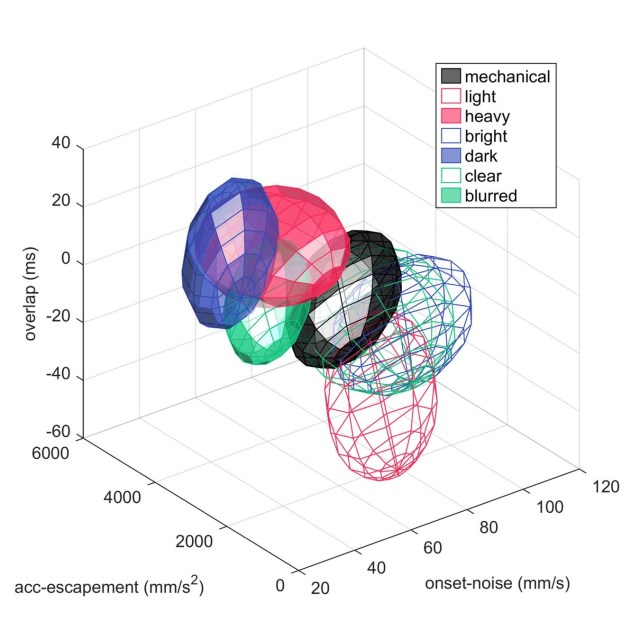
In this graph, the “overlap” axis shows how far different notes played by different fingers or hands either overlap, with a positive value in milliseconds, or are separated, with a negative value in milliseconds. The acc-escapement is the acceleration the key is undergoing at the moment the hammer is released, and the onset-noise is the initial speed of the key. The combination of these three values will make the hammer escape in a very slightly different way and create a sound in the corresponding timbre zone.
Not only does this mean that the age-old debate over whether timbre can be created on a piano through its keys has been solved, but we now know exactly how it’s done. This means it can even be potentially developed and taught to others, though my teacher, Mrs. Makino up the street, might have her work cut out for her.
By the way, this research was carried out as a part of the Japanese government’s Moonshot Research and Development Program, which aims to free humanity from physical, mental, temporal, and spatial restraints by 2050. I’m not exactly sure how this fits into all that, but it’s pretty neat and good to see the work is being done on it.
Source: PR Times, Reddit 1, 2, 3
Top image: Pakutaso
Insert images: PR Times
● Want to hear about SoraNews24’s latest articles as soon as they’re published? Follow us on Facebook and Twitter!
 Japan’s first fall color forecast for 2026 is here!
 Starbucks Japan reveals new Tsukimi Moon-Viewing drinkware and gifts for autumn 2026
 A real-world Pokémon Poké Ball hotel is opening in Japan at a still-secret location [Video]
 Japan’s revolving sushi restaurant king Sushiro coming to U.S. this fall with high prices, no tipping
 The mystery of Port Store, the Japanese convenience store that looks like a Lawson rip-off
 Japan’s first fall color forecast for 2026 is here!
 Starbucks Japan reveals new Tsukimi Moon-Viewing drinkware and gifts for autumn 2026
 A real-world Pokémon Poké Ball hotel is opening in Japan at a still-secret location [Video]
 Japan’s revolving sushi restaurant king Sushiro coming to U.S. this fall with high prices, no tipping
 The mystery of Port Store, the Japanese convenience store that looks like a Lawson rip-off
 Tamagotchi evolves into a ring for its 30th anniversary, preorders now open
 Elderly couple donates 400 million yen to erect Myaku-Myaku statue in Osaka
 American tourist in Japan arrested on charges of attempted murder and arson
 Mini CRT-lookalike Final Fantasy figurines are awesome pixel art music boxes [Video]
 Japan Railways announces unlimited-ride train pass for fall travel
 Japan’s final Penguin Suica train cards have already shipped, and when they’re gone, they’re gone
 Studio Ghibli unveils new anime calendars and diary planners for 2027
 Solo travel in Japan: Hidden beer garden in Tokyo is a haven for single visitors
 Hobonichi unveils new 2027 planners, diaries and stationery with One Piece, Suica Penguin, Hello Kitty and a must-buy Mini Techo
 Farewell Final Ceremony announced for Tokyo’s life-size Gundam statue, will stream live
 Family Mart releases new Human Made Cup Noodle in Japan, with freebies for Nigo fans
 Japan approves foreign resident visa renewal fee increases of up to 967 percent, starts soon
 One Piece Day 2026 brings new art, music, and new cast announcements
 Hikaru Utada sings new song in Shinkansen commercial for Japan’s Supreme Class cabins
 12-year-old British girl who went missing in Tokyo found safe after visiting anime sites around Yokohama
 7-year-old boy left behind on Mt. Fuji by his own dad
 Sushi Bus: Japan’s first conveyor-belt bus lets you eat sushi while sightseeing around Tokyo
 Pokémon Center Online designates first Pokémon items that will require Japanese ID card to buy
 Japanese toilet aims to attract foreign tourists but not everybody is happy about it
 New Japanese vending machine at Shinkansen station sells cups of ice on platform
 Study finds hundreds of people in Indonesia legally named after Naruto, Inuyasha, other anime stars
 Japan announces sudden 400-percent increase in visa fees for foreigners entering the country
 Japan’s human washing machines will go on sale to general public, demos to be held in Tokyo
 Studio Ghibli has a new anime out, and there’s only one place in the world where you can see it
 Starbucks Japan releases new drinkware and goods for Valentine’s Day
 Starbucks Japan releases new sakura goods and drinkware for cherry blossom season 2026
 Japan’s newest Shinkansen has no seats…or passengers [Video]
 Tokyo subway installing new ticket gates that don’t accept payment through Suica or other IC cards
 Japanese ninja certification exam attracts 131 candidates from Japan and abroad
 Salomon releases Japan-exclusive Mt. Fuji hiking gear that doubles as an amazing souvenir
 Put sesame oil in your coffee? Japanese maker says it’s the best way to start your day【Taste test】
 Tamagotchi evolves into a ring for its 30th anniversary, preorders now open
 Elderly couple donates 400 million yen to erect Myaku-Myaku statue in Osaka
 American tourist in Japan arrested on charges of attempted murder and arson
 Mini CRT-lookalike Final Fantasy figurines are awesome pixel art music boxes [Video]
 Japan Railways announces unlimited-ride train pass for fall travel
 Lawson convenience store opens its first mobile, trailer-style location in Japan
 Family Mart releases Famima convenience store products nationwide, but which ones are worth buying?
 Studio Ghibli unveils new anime calendars and diary planners for 2027
 Hobonichi unveils new 2027 planners, diaries and stationery with One Piece, Suica Penguin, Hello Kitty and a must-buy Mini Techo
 Onsen Egg Bukkake Udon Ice Cream makes us rethink everything we thought we knew about sweets
 Finally! Japan’s big three convenience store chains announce rice ball price reductions
 Mister Donut releases new doughnuts that look and taste like Japanese sweet potatoes
 Japan’s most popular curry rice restaurant chain, Coco Ichibanya, might be for sale
 One Piece Day 2026 brings new art, music, and new cast announcements