

One of the best things about living overseas is the opportunity to learn the local lingo. By learning to communicate with the locals, it’s easier to get by day-to-day, and you’ll be able to unravel much more about the country’s culture. A Spanish YouTuber living in Taiwan shared a list of must-know pet phrases that he picked up by observing the locals. If you’re learning the Chinese language, starting a new phase in life in Taiwan, or even just imagining taking a trip to the lovely country, hit the “read more” button!
Our teacher for the day is Jesús Sandoval, a foreigner living in Taipei, Taiwan. He initially started his YouTube channel teaching Spanish to Chinese speakers, but his channel has evolved to focus more on interesting facts and information about Taiwan from a foreigner’s point of view.
▼ Jesús also calls himself 阿兜仔 (pronounced ah-doh-ah), which is a Taiwanese slang referring to Caucasian people.
In one of his recent episodes of 阿兜仔不教美語!(Foreigner doesn’t teach English!), he touched on lingo that the Taiwanese often use in daily life. He recalls his Chinese language teacher teaching him that the mandarin equivalent of “hello” is 你好 (ni hao), so he went around greeting people with that, but he later realized that the people around him never said 你好 on a daily basis (你好 is usually used when you meet people for the first time). When in Rome, do as the Romans do. When in Taiwan, speak like the Taiwanese! Here’s a list of phrases that Jesús thinks you must know if you’re living (or intend to live) in Taiwan!

1. 不好意思 (bu hao yi si)
Contextual meaning: I’m sorry; excuse me; pardon me
This phrase is pretty close to how the Japanese use the word “sumimasen“. You can use it in most daily situations; when you’re late for an appointment, when you’re asking for a favor, when you accidentally stepped on someone’s foot on a massively packed train, or even when you’re gloating over a quick win at a game of Uno.

2. 真的假的? (zhen de jia de)
Contextual meaning: Are you serious?; is that for real?
Not much explanation is needed for this simple phrase. When in doubt, use it. We mean that quite literally, like when you’re doubting the authenticity of some rumor.

3. 好誇張! (hao kua zhang)
Contextual meaning: That’s unbelievable!
Life is full of ups and downs, and when something in life exceeds your imaginations, that’s when you exclaim your surprise using this phrase. Like when we tell you that there’s a giant cat that weighs as much as an elementary school kid.

4. 嗯! (en)
Contextual meaning: Yes; okay; understood
Basically, this is the shortest reply you can give to anything you agree on, or in the case when you can’t be bothered to argue with someone. It’s as easy to use as giving a nod.

5. 我很忙 (wo hen mang)
Contextual meaning: I’m really busy
Can’t bring yourself to decline someone’s invitation? Use this. Don’t feel in the mood to take on extra tasks? Use this. In short, this is the most commonly used excuse to reject any request or invitation.

6. 我跟你說 (wo gen ni shuo)
Contextual meaning: Let me tell you
This is just a pet phrase that the Taiwanese use when they want their listeners to be at all ears to their words of advice. It doesn’t really hold any meaning or importance to the sentence structure. As Jesús mentioned in the example in his video, “if you’re not the one telling me, then who’s telling me? Nonsense.”
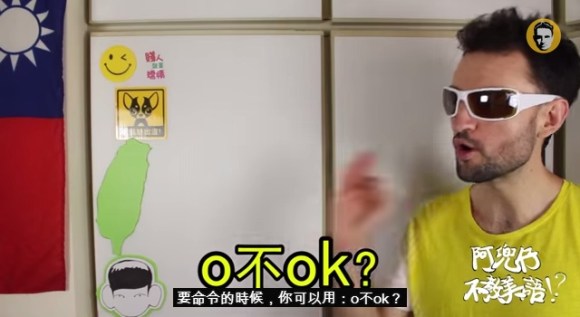
7. O不OK? (O bu OK)
Contextual meaning: Is that okay or not?; are you agreeable?; have you understood?
Jesús says that when you wish to casually order someone, or get them to follow your decision, use this phrase. Other than that, it can also be used to confirm the status or get an opinion on something. For example, when you go shopping with a friend and can’t decide whether to buy something, you can seek their opinion by asking “O不OK?”. “Like” RocketNews24 on Facebook, O不OK?

8. 你好機車! (ni hao ji che)
Contextual meaning: You’re ridiculous!; you’re being overbearing
Generally used in a negative context, when you’re offended or gravely annoyed by someone’s comment or question.

9. 屁! (pi)
Contextual meaning: Bullshit!
The word 屁 literally means fart, so it’s probably a fair guideline to say that you can use this expression whenever you think someone is farting out of their mouths. In other words, when you think someone is lying or bragging.

10. Jooo! (pronunciation is closer to “huh!”)
Contextual meaning: No way!
This isn’t even a Chinese word, but the Taiwanese often use it to express their displeasure or objection to something. We’d like to believe our readers would say this in the unfortunate case that RocketNews24 has to go on hiatus.

11. 好好吃! (hao hao chi)
Contextual meaning: This is delicious!
If something’s delicious, you have to say it out loud! We don’t think you’ll need further explanation for this.

12. 好口愛喔! (hao kou ai o) – 口愛 being a slang variation of 可愛 (ke ai)
Contextual meaning: So adorable!; sooo cuteee!
Other than exclaiming their love for delicious food, many Taiwanese also openly declare their affection towards cute stuff. Just like the Japanese tend to squeal “kawaii!!” at the sight of a small furry animal.

13. 好有趣 (hao you qu)
Contextual meaning: That’s interesting
Life is interesting! Especially when you’re living in a foreign country, you’re bound to find interesting differences big and small, and that’s when you can put this phrase to good use.

14. 你好討厭耶! (ni hao tao yan ye)
Contextual meaning: You’re so annoying!
This phrase can be used when you’re really annoyed with someone, for example, when your friend texts you to “come downstairs now!” but you end up waiting at the stairs for 15 minutes before they finally turn up. Or! It can also be used in a flirtatious way during lovey-dovey bickering.
▼ Watch the video!
If you’re learning Chinese, or want to know more about Taiwan, be sure to check out Jesús Sandoval’s other videos on YouTube, or follow him on Facebook (or his FB page for his YouTube channel)! Last we checked, he’s even mastered the Taiwanese dialect!
▼ 阿兜仔教台語!(Foreigner teaches Taiwanese!)
 Taiwanese YouTuber’s punny pick-up line gets him a girl’s number in just 36 seconds
 Learn Japanese from YouTube: Amp up your listening skills with this four-step guide
 Studio Ghibli unveils new My Neighbour Totoro Yearly Plate for 2027
 New Japanese convenience store rice balls taste like instant noodles [Taste test]
 Kyoto temple bans visitors from wearing kimono
 Lego PlayStation recreates Sony’s original console, makes unusual choice for games to salute
 New Pokémon anniversary song is 22 minutes long, features all 1,025 Pokémon species [Video]
 Starbucks Japan releases new coffee table book featuring 18 of the most unique stores around the country
 American tourist in Japan arrested on charges of attempted murder and arson
 Starbucks Japan reveals new Tsukimi Moon-Viewing drinkware and gifts for autumn 2026
 Japan’s first fall color forecast for 2026 is here!
 Starbucks Japan adds new Sweet Potato Frappuccino and Latte to the menu, but do they deliver the taste of autumn?
 Studio Ghibli unveils new anime calendars and diary planners for 2027
 Solo travel in Japan: Hidden beer garden in Tokyo is a haven for single visitors
 Japan’s final Penguin Suica train cards have already shipped, and when they’re gone, they’re gone
 Family Mart releases new Human Made Cup Noodle in Japan, with freebies for Nigo fans
 A real-world Pokémon Poké Ball hotel is opening in Japan at a still-secret location [Video]
 Hobonichi unveils new 2027 planners, diaries and stationery with One Piece, Suica Penguin, Hello Kitty and a must-buy Mini Techo
 One Piece Day 2026 brings new art, music, and new cast announcements
 Tamagotchi evolves into a ring for its 30th anniversary, preorders now open
 12-year-old British girl who went missing in Tokyo found safe after visiting anime sites around Yokohama
 7-year-old boy left behind on Mt. Fuji by his own dad
 Sushi Bus: Japan’s first conveyor-belt bus lets you eat sushi while sightseeing around Tokyo
 Japanese toilet aims to attract foreign tourists but not everybody is happy about it
 New Japanese vending machine at Shinkansen station sells cups of ice on platform
 Study finds hundreds of people in Indonesia legally named after Naruto, Inuyasha, other anime stars
 Japan approves foreign resident visa renewal fee increases of up to 967 percent, starts soon
 Japan tripled its departure tax to fund tourism but is using the money on cherry blossoms and bears
 Japan announces sudden 400-percent increase in visa fees for foreigners entering the country
 Japan’s human washing machines will go on sale to general public, demos to be held in Tokyo
 Studio Ghibli has a new anime out, and there’s only one place in the world where you can see it
 Starbucks Japan releases new drinkware and goods for Valentine’s Day
 Starbucks Japan releases new sakura goods and drinkware for cherry blossom season 2026
 Japan’s newest Shinkansen has no seats…or passengers [Video]
 Tokyo subway installing new ticket gates that don’t accept payment through Suica or other IC cards
 Japanese ninja certification exam attracts 131 candidates from Japan and abroad
 Salomon releases Japan-exclusive Mt. Fuji hiking gear that doubles as an amazing souvenir
 Put sesame oil in your coffee? Japanese maker says it’s the best way to start your day【Taste test】