

Kanji characters are one of the most fascinating, but also the most troublesome, aspects of the Japanese language—and that goes not just for foreign learners but also for Japanese natives. The Kanji Kentei is a standardized test that you can take to prove your kanji knowledge, but after being drilled on the kanji throughout their school lives Japanese people might not be taken by the idea of sitting for even more exams on the subject.
That’s why the Kanji Kentei administrators, in an effort to encourage people to give up their free time to study kanji and take their exams, has fallen back on the failsafe go-to of Japanese advertising: cute, nostalgic anime.
During their school years Japanese children are taught the 2,136 jouyou, or “everyday use”, kanji, which is the amount you supposedly need to be literate. So long as you have these down you should have no trouble reading most text that will crop up in everyday life and in the majority of newspapers.
As anyone who’s grown up with a phonographic language rather than a logographic one will tell you, however, learning kanji can be difficult. Each character has a specific combination of strokes, as well as multiple possible ways to read it. It’s even difficult for Japanese people, which always makes me feel better but at the same time frustrates me—how the heck am I supposed to learn all these things when even people brought up using the language can’t?!?
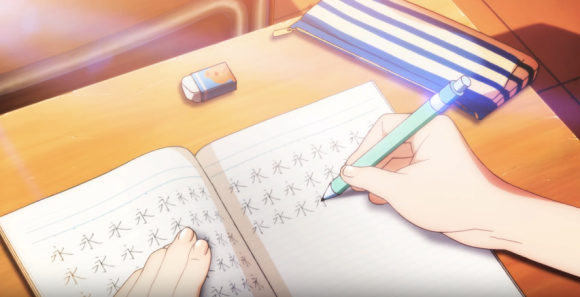
Clearly aware that the chance to sit a kanji exam is hardly something that the average person would leap at, the Japan Kanji Aptitude Testing Public Interest Foundation, which is responsible for administering the Kanji Kentei (kanji aptitude test), has released a super-short anime called Kanojo ga Kanji wo Sukina Riyu, or The Reason She Likes Kanji. It’s split into two bite-sized parts of less than three minutes each, and draws on people’s rose-tinted memories of high school and their love of cute anime girls to get them interested in kanji and in taking their exam. Because, let’s be honest, exams are probably one of the toughest products out there to sell.
Check out the videos here. Keep scrolling for a quick summary of each and for more about studying kanji and the Kanji Kentei itself.
Part 1
Haruka Hirai is alone in the classroom after school writing her favourite kanji, 永 (ei) which is part of the compound 永遠 (eien, or eternity). Yusuke Sagara happens to come back to the classroom and sees her, and in that moment he falls in love. Yusuke asks her if she likes kanji and she replies that she loves it. Then, being a boy, he pretends he hasn’t heard her properly and keeps asking her to repeat it, which sounds like she’s saying she loves him given the lack of an object in Japanese sentence structure. She tells him why she finds this character beautiful and then asks Yusuke if he likes kanji, too, and of course he replies that he does, because how else are you supposed to respond to a pretty girl? And so the start of a beautiful relationship is born, all thanks to the power of kanji!
Part 2
Haruka and Yusuke are on a not-date at the park when Yusuke starts speaking in yojijukugo, four-kanji idiomatic expressions that he thinks will totally make him sound cool and intelligent if he busts them out in a conversation with a girl. Later, Yusuke notes that Haruka seems to glow whenever she’s talking about kanji and she says that kanji widens her world. After that the two of them then head towards the boating lake. Yusuke has heard a legend that couples who go for a boat ride on it break up, but Haruka cheerfully tells him they’ll be fine since they’re not a dating. But after spending a romantic time on the lake together, at the end she asks him to teach her yojijukugo and says that it’s a good job they rode the boat now because they won’t be able to after they’re dating…! Looks like kanji has worked its magic yet again.
Unlike the Japanese Language Proficiency Test, which is for learners of Japanese as a second language, the Japan Kanji Aptitude Test (Kanji Kentei) is designed for native speakers (although of course foreign learners of the language can take it too!). There are 10 levels, with 1 being the hardest. The first seven are relatively easy, corresponding to elementary and middle school-levels. Level 3 steps it up as the level high school students aim for, and 2 is most often taken by adult and university students who have an interest in or specific need for kanji.
Then there’s Level 1, which tests examinees on 6,355 kanji, which is apparently so difficult that less than 2,000 people take the exam each time it is held, and less than 15 percent of those who take it actually pass. If you manage to pass Level 1 you basically have the right to call yourself a kanji master.
But hey, with the promise of all that love and romance, who wouldn’t want to pick up a pencil and start practising those kanji radicals?? Good luck, everyone!
Video/screenshots: YouTube/Japan Kanji Aptitude Testing Public Interest Foundation
Studying Japanese? Don’t miss:
Six (and a half) essential resources for learning Japanese

[ Read in Japanese ]