

If you’ve stayed at a traditional Japanese inn with your partner, chances are you’ve experienced this custom before.
In Japan, nothing transports you back in time to a bygone era like a stay at a ryokan, or traditional Japanese inn. Often found in rural areas, this type of accommodation typically features tatami mat rooms, communal baths and dining areas, and yukata outfits, which visitors wear during their stay while being served by owners and staff in traditional clothing.
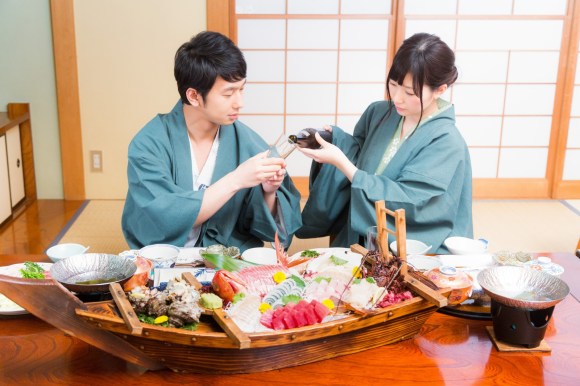
During mealtimes, guests are treated to sumptuous meals, which are often laid out on a traditional low table before they arrive, with things like tea, soup and rice served upon arrival. One of the many traditions guests encounter while staying at a Japanese inn is the fact that at mealtimes, they’ll usually be given a large portion of rice in a tub with a lid, called an “ohitsu”, which is placed beside the table with a shamoji rice paddle for serving, so that the diners can eat as much rice as they like throughout the course of the meal.
▼ The ohitsu is part of the service you’ll encounter while dining at a Japanese ryokan.
While it might seem like the ohitsu adds a nice touch to the meal, it’s actually become the subject of intense debate online recently, as the ohitsu is usually placed next to the woman at the table when she’s with a male partner, as it’s assumed she’ll be the one serving him rice during the meal.
While the traditional role of women as housewives still persists throughout a lot of rural areas in Japan, attitudes are changing, and some people are now questioning whether or not the custom of placing the ohitsu beside women dining with husbands or boyfriends should continue.
Twitter user @otakukonyakusya recently brought the “ohitsu problem” to everyone’s attention with this tweet, where she explains that on a recent stay at a ryokan with her husband, no matter whether she sat in the “kamiza” position (Japanese seating position usually reserved for the most senior member of a group, furthest away from the door) or the “shimoza” position (Japanese seating position reserved for the least senior member of a group, closest to the door), the ohitsu was always placed beside her every time. According to @otakukonyakusya, she says she was fine with it, but she’s worried about how this will go over with foreign tourists. She is concerned and she really wants the practice of placing the ohitsu next to the woman to stop.
夫と一泊二日旅行に来てるんですけど、旅館で毎回毎回、上座に座ろうが下座に座ろうが妻の方に置かれるおひつとしゃもじが辛くてね😂
— LiB羊 (@otakukonyakusya) October 21, 2017
私はもういいんだけど、外国人観光客にもまさか同じことしてるんじゃねえだろうなって心配になる。お願いだからやめてね、本当…。心配だよ。 pic.twitter.com/fq2az5CGTm
Seeing as she and her husband changed their seating positions as an experiment to see where the ohitsu would be placed, the placement of the ohitsu appears to have nothing to do with the seating position, which has prompted many online commenters to label the custom as sexist.
The topic has sparked intense debate online, with some women saying this was annoying sexist behaviour, while others said it didn’t bother them in the slightest. Other women said they wanted to serve rice to their husbands.
One comment that stood out came from a ryokan staff worker, who said that it’s not necessarily about the ohitsu but the shamoji serving spoon that comes with it, which they’re taught shouldn’t be placed near the male guest when he is dining with a woman. If they fail to do this, some guests have been known to lose their temper, which is the reasoning behind its placement.
One of our very own Japanese-language reporters, who used to work at an upscale restaurant, also backs up this claim by saying that he was taught to always place the ohitsu and shamoji next to the female diner.
In amongst all the hundreds of comments left online, some people pointed out that a happy solution to the problem would be to simply place the rice tub and serving spoon in between the male and female guests. This certainly sounds like a good way to solve the ohitsu problem, as both guests would be able to serve themselves individually and not have to request, or wait to receive, an extra serving from their other half.
Still, that approach wouldn’t necessarily appeal to couples who choose to stick to their traditional roles, so perhaps a gentle question from the server to the guest about placement preferences would be the ideal solution.
The one thing sorely missing from the debate was a voice of opinion from foreign tourists who have actually experienced this custom themselves. So let us know your thoughts about the ohitsu problem – does it bother you or do you think it’s a Japanese custom that doesn’t need to be changed? Let us know in the comments section below!
Source: My Game News Flash
Featured image: Pakutaso
Insert image: Pakutaso
[ Read in Japanese ]
 Japanese travellers give their answers to the Hotel vs. Ryokan Japanese inn debate
 How should you use the small hiroen in a Japanese ryokan hotel room?
 Cheap Japanese ryokan at Kusatsu Onsen is hidden at the back of a traditional store
 Ryokan etiquette: What not to do when staying at a traditional Japanese inn
 Foreign travelers’ lukewarm reactions to traditional Japanese inn food causing changes in Kyoto
 Solo travel in Japan: Hidden beer garden in Tokyo is a haven for single visitors
 One Piece Day 2026 brings new art, music, and new cast announcements
 Studio Ghibli unveils new anime calendars and diary planners for 2027
 Flock to Tomarigi, the viral app that lets you perch in over 1,000 spots throughout Japan
 Japan’s birth rate rose for the first half of the year for the first time in over a decade
 Tamagotchi evolves into a ring for its 30th anniversary, preorders now open
 Family Mart releases Famima convenience store products nationwide, but which ones are worth buying?
 Family Mart releases new Human Made Cup Noodle in Japan, with freebies for Nigo fans
 Hobonichi unveils new 2027 planners, diaries and stationery with One Piece, Suica Penguin, Hello Kitty and a must-buy Mini Techo
 7-Eleven Japan goes viral for chilled soba that’s “too salty to eat”
 Japan’s final Penguin Suica train cards have already shipped, and when they’re gone, they’re gone
 Japan approves foreign resident visa renewal fee increases of up to 967 percent, starts soon
 Japan tripled its departure tax to fund tourism but is using the money on cherry blossoms and bears
 Farewell Final Ceremony announced for Tokyo’s life-size Gundam statue, will stream live
 Nike x One Piece collection brings Devil Fruits to sneakers and streetwear in Japan
 Police in Japan looking for who’s responsible for dumping 80 loaves of bread on side of road [Video]
 12-year-old British girl who went missing in Tokyo found safe after visiting anime sites around Yokohama
 7-year-old boy left behind on Mt. Fuji by his own dad
 Air-conditioned dress shirts arrive in Japan to save working professionals from sweltering heat
 Sushi Bus: Japan’s first conveyor-belt bus lets you eat sushi while sightseeing around Tokyo
 Pokémon Center Online designates first Pokémon items that will require Japanese ID card to buy
 Japanese toilet aims to attract foreign tourists but not everybody is happy about it
 New Japanese vending machine at Shinkansen station sells cups of ice on platform
 Study finds hundreds of people in Indonesia legally named after Naruto, Inuyasha, other anime stars
 Japan announces sudden 400-percent increase in visa fees for foreigners entering the country
 Japan’s human washing machines will go on sale to general public, demos to be held in Tokyo
 Studio Ghibli has a new anime out, and there’s only one place in the world where you can see it
 Starbucks Japan releases new drinkware and goods for Valentine’s Day
 Starbucks Japan releases new sakura goods and drinkware for cherry blossom season 2026
 Japan’s newest Shinkansen has no seats…or passengers [Video]
 Tokyo subway installing new ticket gates that don’t accept payment through Suica or other IC cards
 Japanese ninja certification exam attracts 131 candidates from Japan and abroad
 Salomon releases Japan-exclusive Mt. Fuji hiking gear that doubles as an amazing souvenir
 Put sesame oil in your coffee? Japanese maker says it’s the best way to start your day【Taste test】
 Hilton Japan apologizes for “disrespectful” ad disparaging traditional Japanese inns
 Rakuten Travel reveals the top 5 best-rated, off-the-beaten-track Japanese ryokan inns
 Cool traditional Japanese inn lets customers tidy up their room with a click of a button【Video】
 Japanese-style accommodation at the new Premium Dormy Inn hotel in Asakusa will blow your mind
 Prior owners of Keiunkan ryokan, the world’s oldest hotel, liquidate company
 Stay in an eerie Japanese ryokan inn near Tokyo Tower for US$40 a night
 Two things to do, and two things not to do, when leaving a traditional Japanese inn
 Travel back in time to this timeless Japanese hot spring inn from the Taisho period【Photos】
 Tomaya: The old Japanese inn that only accepts reservations by post
 We stay in a converted Kyoto townhouse filled with traditional charm and overwhelming hospitality
 Doll otaku’s plastic bedmate gets loving hospitality from beautiful Japanese hot spring inn
 The pros and cons of working from a Japanese hot spring inn
 Survey reveals the most popular time to slip into a yukata at a traditional Japanese inn
 Japanese travelers choose the top five inn cats that they want to meet in the whole country
 “The best ryokan I’ve ever visited” – A photo tour of Akita Prefecture’s Miyakowasure inn