
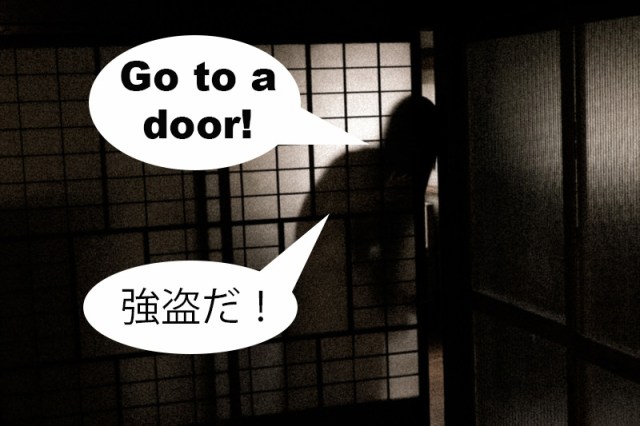
The “soramimi defense” fails to hold up in court.
We recently reported on the trial of an Australian man who was charged with attempted robbery resulting in injury after he climbed onto the second-floor balcony of a Shinjuku home and fought with the homeowner.
Each man had conflicting accounts of what happened that evening with the resident, a man in his 70s, claiming that the Australian shouted “Goto da!” (“This is a robbery!”) and “Kin wa doko da?!” (“Where is the money?!”).
According to the Australian, he had smelled gas while passing by and climbed to the window nearest the resident to warn him of a potential gas leak. He also claims that he was speaking English rather than Japanese and said “Go to a door!” and “Can you walk?” in an effort to get him to evacuate.
A struggle ensued and the resident was hit in the head with a spade the Australian had found on the balcony. The Australian then fled the scene.
▼ A news report with CG dramatizations of the incident
Afterward, in Tokyo District Court, the defense attorney compared the incident to the popular TV segment Soramimi Hour, named after the Japanese word “soramimi” which means “to mishear” and in which English song lyrics are completely misheard as Japanese phrases.
▼ In this Soramimi Hour segment, System of a Down’s lyric “I need to f*#k the sys” is heard in Japanese as “Okay, everyone is stupid.”
In online comments, this “soramimi defense” was widely met with disdain and people accused the lawyer of “playing games” and “coming up with the idea in a bar”.
It would appear the judges were not entirely swayed by the defense either. In a ruling on 18 October, presiding judge Jun Shimato said that the explanation that “Go to a door!” was misheard as “Goto da!” was not credible. On the other hand, the possibility that the resident automatically assumed that the Australian was a robber and misunderstood him somehow could not be ruled out.
As a result, there was reasonable doubt as to the Australian’s intent to steal and so he was found not guilty on the count of attempted robbery resulting in injury. However, the judge also ruled that the act of climbing onto the balcony was unreasonable when he could have just rang the doorbell first. For that, he was found guilty on the charges of trespassing and assault and sentenced to two years in prison for those crimes.
Two years in prison is no joke but more than a few comments online were highly critical of the judges for being too lenient in handing down his sentence.
“Sentences for foreigners are too lenient. I question the judge’s qualifications.”
“The judge is pretty wild for this.”
“Whether he said ‘Goto da!’ or ‘Go to a door!’ he’s still breaking in.”
“That judge is too lenient.”
“I don’t care what he said. He was climbing on balconies and swinging a shovel!”
“If you can speak Japanese, there’s no way you would speak to a Japanese person in English. It makes no sense.”
“This is impossible… ‘Go to a door’ is incorrect English a native speaker would never say. It’s an excuse that a foreigner that understands Japanese English habits would come up with.”
“This is terrible. Lock the judges and lawyers up too.”
“It must have been scary for the person whose home was broken into. I feel sorry they have to face such a lack of remorse.”
Having covered countless crimes over the years, I would have to disagree with these comments about this being a lenient sentence. Suspended sentences are fairly standard penalties for first-time offenders and there have even been cases of homicide where the defendant only received a suspended sentence. They can be seen as efficient since they minimize the burden on the penal system and less likely to tie up courts with appeals while also keeping conviction rates up.
However, when judges explain their rulings remorse is often cited as a factor in handing down suspended sentences. Regardless of whether the defendant in this case really said “Go to a door!” or not, arguing that in court may have conveyed a certain skirting of personal responsibility that caused the judges to opt for a real prison sentence.
All I know is, if I’m ever brought to trial in Japan my go-to move would be to throw myself on the mercy of court, say what they want me to say, do what they want me to do, and pay the victims what they want me to pay. It wouldn’t even matter if I’m guilty or not, I’d just be as remorseful as humanly possible.
Source: The Sankei Shimbun, YouTube/FNNプライムオンライン
Top image: Pakutaso (Edited by SoraNews24)
● Want to hear about SoraNews24’s latest articles as soon as they’re published? Follow us on Facebook and Twitter!