All in a day’s work.
Whenever major natural disasters hit Japan, I’m always amazed by the engineering feats that were set up in various places to minimize casualties and damage. It’s hard to feel a sense of joy or pride at times like the 7.1 magnitude earthquake that hit Kumamoto recently, but at the same time it feels like a lot of hard work and ingenuity that goes into damage prevention often gets overlooked.
One prime example I noticed in the immediate aftermath was scenes of elevated highways sheared into two completely disjoined sections. It was constantly played on a loop as a symbol of the catastrophic power of the earthquake without any explanation as to why the roads looked like that.
▼ It was basically the exploded AEON Mall, broken smokestack, and broken highway, over and over again for the first day.
The highways were designed to break like that in the event of an earthquake to prevent even bigger devastation. If the entire overpass was one solid unit, one weakened section would cause the entire structure to fall down, as happened in the 1995 Awaji-Hanshin earthquake.
▼ A news report in the aftermath of the Hanshin-Awaji Earthquake showing the massive destruction of elevated expressways. In the latter part, Prof. Fukuwa explains that the flaw in the design was using combinations of materials that vibrated at different frequencies together in a rigid structure.
The news footage seldom, if ever, showed what was going on underneath those detached segments, which is where the real magic happens. Systems can vary as needed, but often these cables, rods, and stoppers not only reduce overall damage but make repairs easier and faster.
▼ This video is in Japanese, but the images alone should demonstrate how well-thought-out these mechanisms are, built on lessons learned from past disasters.
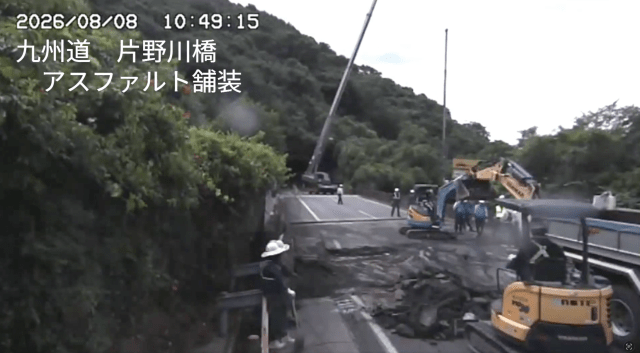
And speaking of fast repairs, with earthquakes an ever-present threat, crews are well-trained to react to damage quickly and thoroughly. A good example of this can be seen in a time-lapse video of a highway repair in Kumamoto done by workers for NEXCO, Japan’s privatized company that manages the nation’s expressways.
▼ “We are currently doing reconstruction work on the southbound/outbound lane of the Katanogawa Bridge along the Kyushu Expressway, after it was damaged in the 2026 Kumamoto Earthquake. This video shows the asphalt work in progress. The entire team is working in close coordination, prioritizing safety above all else. We will keep on working toward a fast recovery.”
令和8年熊本地震により損傷した九州自動車道 片野川橋(下り線)の復旧作業を行っております。
— 【公式】NEXCO西日本 (@w_nexco_news) August 9, 2026
動画は、アスファルト舗装の実施状況です。
工事関係者が一丸となり、緊密に連携を図りながら、安全を最優先に工事に取り組んでおります。
引き続き、早期復旧に向けて着実に工事を進めてまいります。… pic.twitter.com/RnlYfZX9aU
In the video, a stretch of collapsed and heavily crumpled road on the Katanogawa Bridge becomes a pristine sheet of asphalt in seconds, which in real time was about 10 hours, but still extremely efficient. Unfortunately, the speed also makes it hard to see all the work that goes into rebuilding the underlaying structure of the road in addition to repaving it.
It’s also worth noting that the date on the video is 8 August, the Saturday kicking off the national holiday period known as Obon, where a lot of people take off work and relax. That combined with the overall heat of a Japanese summer would make roadwork a particularly grueling experience. Comments online were full of respect for those workers, with wishes that they stay safe and get a fat paycheck at the end of all this.
“Seriously incredible! Thank you for your hard work in this intense heat and during the holidays.”
“They did that in 10 hours?!”
“That’s fantastic to see. Truly supporting the arteries of Japan, and you can sense the pride in their work.”
“I hope they’re all given big fat bonuses for that.”
“I used to work in asphalt, and I have a huge amount of respect for people who work under that heat and those tight safety conditions. I hope they stay safe.”
“It’s sad that politicians get paid more than those people.”
“I wish they could do normal road construction that fast.”
“But after doing it so fast, is it safe to use?”
I’m going to go out on a limb and say that if any corners were cut and safety regulations were ignored in this particular project, NEXCO wouldn’t post incriminating evidence of it for all the world to see online. Then again, I’m not a marketing expert. Maybe that’s the cool thing for companies to do on social media nowadays.
It’s just good to see things are getting better there bit by bit, and people’s ability to prepare for, prevent, and recover from disasters here remains something to be admired.
Source: Twitter/@w_nexco_news, My Game News Flash
Image: Twitter/@w_nexco_news
● Want to hear about SoraNews24’s latest articles as soon as they’re published? Follow us on Facebook and Twitter!