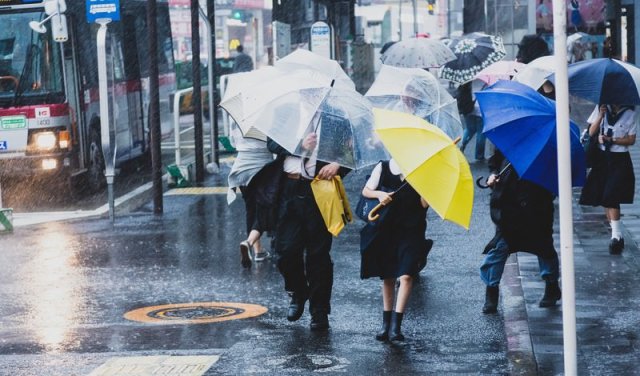
Here is essential advice for surviving sudden disaster in Japan.
On September 8, 2026, the regions of Chubu, the center of Japan, were struck by an aggressive autumn front that unleashed a sudden and immense downpour, resulting in one of the highest levels of rain the area has seen since records began. The streets of Nagoya and railways became rivers, and the subway stations became pools, halting any and all public transport, leaving commuters and travelers stranded with no way to return home. Thankfully, there were only minimal injuries and no fatalities.
Now, for those that may not have already guessed from my love of red miso, this is where I live and work, so I was personally affected by this upheaval. When I am not sequestering myself with my computer to write articles about dancing on noodles and crabs being used for burglaries, I engage in more traditional work and commuting. At 4:13 p.m., my phone started beeping at me, which in Japan is usually a sign of impending earthquakes, so preparing myself to take protective measures, I glanced at the alert to find that it was for a landslide (dosha saigai, 土砂詐害). “A peculiar alert for an urban city,” I thought, as I moved to the window, only to be surprised at how heavy the rain was.
▼ My phone’s alert history from September 8
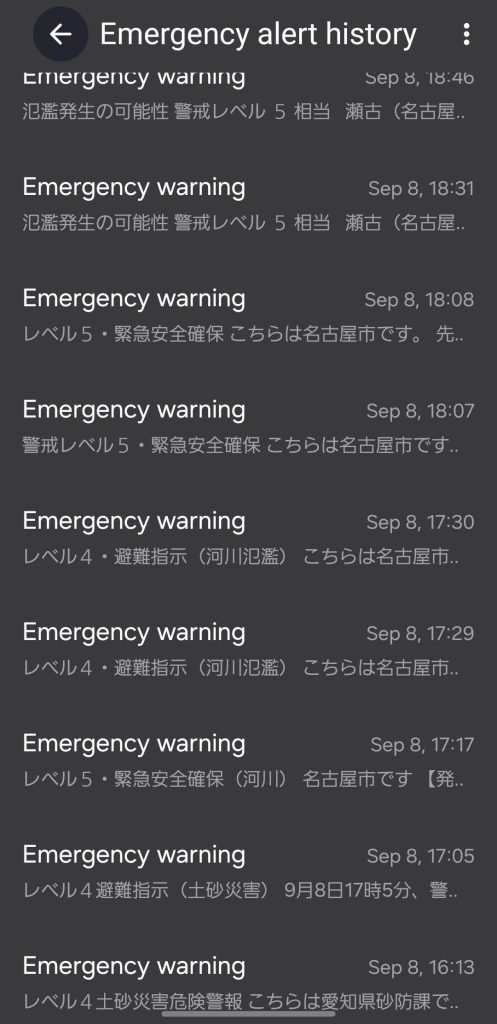
Soon, alerts bombarded my phone, updating me on the situation, and I soon saw something that I had never seen before: the highest “Level Five” warning (tokubetsu keiho, 特別警報). Level Five indicates that somewhere within the region a disaster is imminent or has already occurred, so evacuation is too late and people should take immediate life-saving action on site, such as evacuating to a higher floor. In the case of the Nagoya flooding, it was the Shonai River and Yada River that run through the city that were at risk of breaching their banks (hanran, 氾濫), as well as other smaller rivers.
▼ Shonai River
I checked the public transport, through the train line’s website, only to find that no trains were running for the rest of the day, meaning I could not get home. On the bright side, my workplace is fairly high up in the building, so I was pretty safe from my vantage point, where I could no longer see the streets I normally walked for the rivers flowing through them (submerged, kansui, 冠水).
However, that left me with a little conundrum of how to spend the night. There was still the option of getting a hotel near my company, but the prices had shot up and the company would not cover it (cheapskates). So, I could either go to an emergency shelter or hunker down at my workplace. Considering the possible crowdedness of the shelters, I opted for my workplace, so I procured some materials to make a temporary bed, spent the night, and was ready for work bright and early the next morning. Fortunately, by the time it was ready to clock off, the train lines had reopened, so I could finally get back home for a shower and decent sleep.
Considering my situation, I felt I was pretty lucky with how everything turned out, but it got me thinking about all the people who might have been traveling through Nagoya and suddenly found themselves without a home, hotel, or way to get to their destination, and how they fared.
If you find yourself in a situation like mine, the experience can be deeply disorienting for people not used to Japan’s sudden disasters, and even though the country routinely deals with natural crises, events such as this can instantly disrupt the status quo. It is necessary to understand local warning protocols and how to react when public transportation grounds to a halt, leaving you stranded and unable to go anywhere (kitaku konnan, 帰宅困難). Even if there are no impending typhoons or inclement weather, it is still useful to be aware of this information for any eventuality.
Remember that Level Five notification I received? Well, Japan’s Meteorological Agency uses a five-level disaster alert system that serves as the baseline for all official guidance. One and Two are just your routine news and weather checks, but once Level Three hits, seniors and vulnerable individuals are advised to evacuate, and Level Four commands an immediate evacuation for everyone in designated hazard zones. If your route to the official shelter is impeded due to rising floodwaters (kozui, 洪水), like how it was around my building, it is actually recommended to evacuate vertically, going to the second floor or higher of a concrete building rather than venturing outside.
▼ No matter how good you are at swimming, stay inside.

Earthquake evacuations are slightly different, in that you should try to avoid going to a building until it is confirmed safe. In the event you are already inside of a building, take cover under a sturdy desk, and only move outside if there is an active threat of building collapse, gas leaks or fire. If you are outside, instead make your way carefully to a large, open space, like a park or school grounds.
I was pretty fortunate to be stuck at my workplace, but had I been out exploring an unfamiliar neighborhood, the strategy I took would have been pretty different. If you find yourself caught out in the open during a storm, head toward a major train station, municipal building, or large shopping mall. These structures serve as community hubs and designated shelters during emergencies. If you are not sure where to go, asking “Hinanjo wa doko desu ka?” (“Where is the shelter?”) will direct you to the nearest shelter, and stating “Tasukete kudasai” (“Please help me”) in an urgent situation will clearly communicate that you require immediate assistance. Other helpful phrases can be printed off and made into cards from the Japan National Tourism Organization’s (JNTO) Safety Tips website here.
▼ “Don’t panic. The shelter is over here.”

My initial instinct when I saw the train suspensions (unten miawase, 運転見合わせ), was to figure out a way home anyway. Perhaps I could walk or rent a bicycle? But stepping out into flooded streets carries risks, be it from hidden manholes or blocking emergency vehicles. If you’re stuck at a station, look out for announcements of refuge shelters (taihi shisetsu, 退避施設) or temporary waiting facilities (ichiji taiki basho, 一時待機場所), which are safe indoor spaces in stations and commercial centers where staff distribute supplies and updates.
▼ Supplies can include: water, a blanket, a biscuit, and a portable toilet.
These temporary waiting facilities usually get announced once they are opened, so looking at a live map (like this one for Nagoya) is a great way to check the location and level of crowdedness of each facility, just search for information from the city or ward you are in. However, if you’re stranded in Tokyo, a service called Kitakon DX has recently started, allowing people to easily register for temporary accommodation and provide directions to that location.
Had I not been at work with its free but annoyingly intermittent Wi-Fi connection, I might have not had the ability to contact my family to let them know I was safe. However, Japan is no stranger to natural disasters, so the country activates a free emergency Wi-Fi network under the universal SSID “00000JAPAN”. Connecting to this network does not require a password, allowing stranded travelers to access emergency apps and let your loved ones know that you are safe. There is also the 24/7 multi-lingual tourist hotline operated by the JNTO (050-3816-2787), which is specifically designed for international travelers in accidents or emergencies, or you can contact the police emergency number 110, or the fire rescue and ambulance service on 119, both of which should have English-speaking staff available, just start the conversation with “English, please.”
If I met with a heavy storm in a foreign country, it would be a lie to say that I wouldn’t be panicking, so preparation is essential. Every resident and traveler should install key apps, such as the JNTO’s Safety Tips app, NERV Disaster Prevention, and NHK World-Japan, for multi-lingual real-time alerts. Additionally, carrying a lightweight emergency kit, containing a portable power bank, paper copies of your passport and other travel documents inside a sealed plastic bag, and physical cash in 1,000 yen bills and coins, ensures you remain less panicked even during a complete infrastructure shutdown and power outage.
Having extreme weather, or other natural disasters, pouncing on you unawares can feel daunting. They are an unpredictable reality of living in or visiting in Japan, but the country’s disaster response framework is well-oiled and designed to keep everyone safe, even if you do not speak the language. With a bit of awareness, a few apps, and a basic understanding of protocols, you can navigate even the stormiest of nights safely and calmly.
App Downloads: Safety Tips (Google Play/Apple), NERV Disaster Prevention (Google Play/Apple), NHK World-Japan (Google Play/Apple)
Related: JNTO Safety Tips, Japan Meteorological Agency Weather Warnings, Japan Safe Travel, Kitakon DX Tokyo Temporary Accommodation
Video Sources: YouTube/@Storm-HQ, YouTube/@cbctv_news, YouTube/@ntv_news
Top image: Pakutaso
Insert images: Pakutaso (1, 2), Android Phone Screenshot ©SoraNews24
● Want to hear about SoraNews24’s latest articles as soon as they’re published? Follow us on Facebook and Twitter!