No “ra-nuki” for you! No “ra-nuki” for you!
Language is an instinct. Humans acquire it without training or teaching, much the same way we eventually figure out how to walk. Barring some sort of disability or brain fart, a native speaker will almost never say something grammatically incorrect, much the same way that a healthy person walking at normal speed will never just suddenly fall over for no reason.
That’s why Grammar Nazis have always interested me. Here are people going around pointing out “mistakes” that people make when using language, which to me feels like pointing at people while they’re walking and saying they’re doing it all wrong.
What are often thought of as “mistakes” are simply dialect differences, accents, or even evolutions of the language itself. Nothing stays the same forever, not even language, no matter how many old professors and academics would like to sell you books outlining rules of grammar that say otherwise.
And it appears Grammar Nazis exist all over the world – even Japan. Japanese Twitter user @shoshokaki recently posted a tweet where they explained one of their favorite guilty pleasures – beating Japanese Grammar Nazis at their own game:
▼ “This is a horrible guilty pleasure of mine: finding examples of ‘ra-nuki’ from people who claim ‘I never use ra-nuki.’ I try not to use it either but sometimes what I write down is the same as if it’d come out of my mouth.”
本ッ当に自分でも趣味悪いと思うんだけど、「ら抜き使わない」って言ってる人の過去ツイートからら抜き見つける遊びしてしまった……。自分で使わないって思ってても文章に書いちゃってるってことは口頭では相当出てるんだよ……。 pic.twitter.com/CYPQT3xH11
— しょかき(山口翔平) (@shoshokaki) September 21, 2016
So first, a little explanation. “Ra-nuki” refers to the hiragana ra being dropped from verbs in their potential form. For example the verb taberu (“to eat”) would normally turn into taberareru (“can eat”), but in its “incorrect” ra-nuki form would turn into tabereru (“can eat”). Exact same meaning, but missing a ra… and a horrible abomination of language use according to Japanese Grammar Nazis.
What @shoshokaki does is find tweets by people proclaiming their hatred for “ra-nuki” and then subsequent tweets by them where they use it themselves.
While it’s basically impossible to translate “ra-nuki” perfectly into English, I’ve gone ahead and used a Grammar Nazi-hated English equivalent – ending a sentence in a preposition. Here are their examples: (The translations emphasize the grammar pattern and are not exact translations of the original tweets.)
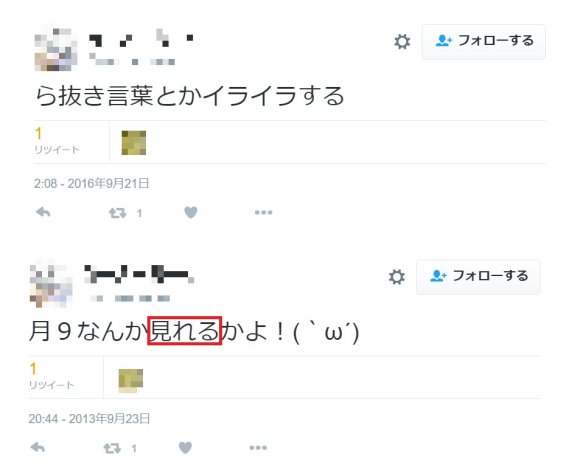
Grammar Nazi’s Tweet
“I am so irritated with people using ra-nuki.”
And Their Tweet of Shame
“Missing Monday’s primetime TV is something I’m not happy about!“
Grammar Nazi’s Tweet
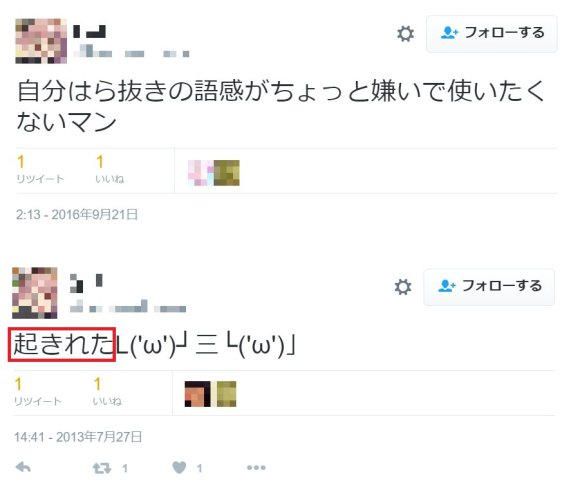
“I kind of hate how ra-nuki sounds, so I don’t use it.”
And Their Tweet of Shame
“Getting up this early is hard to get used to.”
Grammar Nazi’s Tweet
“Ra-nuki is becoming more and more accepted, but I don’t use it since it makes you sound stupid. I mean feel free to use it if you want, but you just sound like you’re lacking a brain. You’re only saving yourself one hiragana. It’s stupid.”
And Their Tweet of Shame
“I drew a hot bath, but I just fell asleep as soon as I got home. I still somehow woke up, makeup still on, even though I forgot to set my alarm which I usually wake up to.”

Here’s how Japanese netizens reacted to the Grammar Nazis being given a taste of their own medicine for once:
“Oh my god, this is now my new favorite hobby.”
“I love ra-nuki, I hope it becomes standard soon.”
“I mean, i-nuki (dropping the ‘i’ in words like ‘tabeteiru’) is pretty standard now.”
“Even this middle school textbook knows what’s up (see below).”
“Language is changing, even now. You can see it in changes like ‘ra-nuki’ and additions of new foreign words like ‘anime’ and ‘report.’ Since language is always changing, new ways of speaking do not need to be thought of as incorrect. However when communicating with those from a different generation, in order to properly convey your true feelings, it’s important to bear in mind generational gap differences that may exist in your language.”
今の中学の教科書の方が進んでますね😌✨
— sora (@i_rainy_) September 21, 2016
FF外から失礼しました pic.twitter.com/AgFUaY9RBH
There you have it folks, straight from a middle school Japanese textbook. Now let’s all just move on from this Grammar Nazi nonsense and get to the really important linguistic stuff: Japanese swear words.
And if you’re curious about “Ra-nuki” and other Japanese grammar facts, @shoshokaki released a helpful infographic you can check out below (Japanese only). There’s an adorable “Ra-nuki Tanuki” to help you on your way of mastering the art of dropping sounds when talking with friends.
みんなら抜き言葉について知らないし、ら抜き言葉についてのまとめも見当たらなかったので自分で作った。 pic.twitter.com/TcKyEVX5f1
— しょかき(山口翔平) (@shoshokaki) September 24, 2016
Source: Twitter/@shoshokaki via My Game News Flash
Featured/top image: KnowYourMeme