
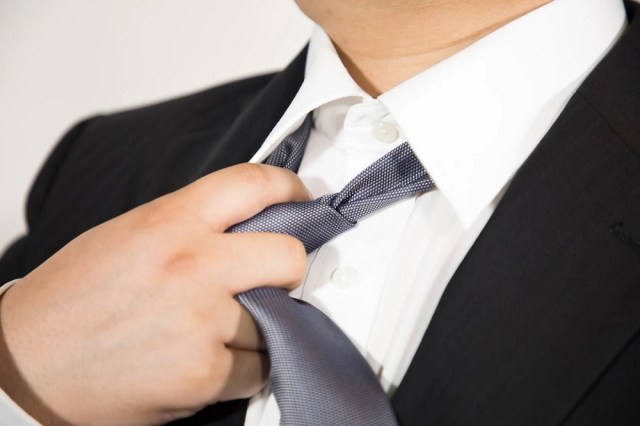
City council chairperson’s reverse of course on relaxed dress code sparks resolution of no confidence.
On September 7, the city council of Kanonji, a town of about 55,000 people in Kagawa Prefecture, was scheduled to convene its first session of the month. However, at the start time of 10 a.m. approached, only nine of the 17 members were present in the meeting chamber, one fewer than the quorum of 10 required to legally start the meeting. One member was in the waiting room, but refused to enter the meeting chamber, while the remaining 7 didn’t even show up to city hall.
The boycott of the day’s proceedings followed the issuing of a resolution of no confidence in city council chairwoman Kazuyo Shinohara, which passed by a vote of 8 to 6 on August 31. “We cannot entrust the council to a chairperson such as [Shinohara],” said council member Takatoshi Okubo, one of those absent, in regards to his voting to pass the no-confidence resolution.
So what’s causing the political schism? Misappropriation of government funds? Rigged election results? Nope, apparently it all stems from Shinohara telling members of the council they didn’t need to wear neckties at meeting during the summer, only to then tell three of them that they should when they showed up tie-less.
▼ Shinohara, tie-less herself, shows up at the 12-second mark of this video from the scheduled September 7 meeting.
Shinohara has been serving as chairwoman since December, and in April told the council that they would be switching to a relaxed dress code for the summer, waiving the normal requirement for men to wear a suit jacket and necktie. This has become an increasingly common policy for offices and government buildings in Japan over the last decade, with the logic that such “cool biz” initiatives are not only more comfortable for those who can go without the stifling formalwear during the hottest, most humid part of the year, but that the no-tie dress code is also good for the environment, as it allows the buildings to run their air conditioners at less powerful and energy-consuming settings.
The Kanonji council’s cool biz dress code was supposed to be in effect from May to October. However, in June, typically the most humid month of the Japanese summer, Shonohara told three members of the council that they should, in fact, wear neckties. “Wouldn’t it be better if you wore a tie?” Okubo recalls Shinohara saying to him, which he says was equivalent to “being coerced to wear [a tie].” “She broke her promise, which is an unforgivable act for the city council chairperson,” says Okubo, who reportedly initially expressed support for Shinohara when she first assumed the position. “The chairperson was pandering to the opinions of certain people outside the council by wanting us to wear neckties.” The resolution asserts that Shinohara has “violated [the council members’] personal freedoms and is not suitable to be chairperson.”
The incident upset Okubo so deeply that he resigned from his position as vice chair of the council. “It was a difficult decision to issue the resolution of no confidence. If the chairperson will not resign, I am prepared to boycott the council sessions, even if I am criticized for the decision.”
Shinohara, though, contests that her necktie-related statements to Okubo and the others were not coercive. “I only suggested that ‘Since the mayor is wearing a necktie and all, wouldn’t it be better for [the council members] to wear one too?’” She described the boycotting members’ actions as “a clear case of power harassment [against me].”
With an insufficient number of members to convene the council meeting on September 7, the morning proceedings were suspended while Shinohara hand-delivered formal request of attendance documents to the council member in the waiting room and to the remaining boycotting members at their homes. According to the council’s bylaws, doing so would allow the afternoon session to be held even if the boycotting members chose not to attend, and so the councilperson who had been in the waiting room joined those in the meeting chamber for the afternoon proceedings.
This month’s council sessions are scheduled to run through September 21. Shinohara apologized to Kanonji’s residents for the disruption to their government’s functions, saying “I sincerely accept that I am a cause of commotion, and feel painfully aware of my responsibility,” adding that she does not believe the boycotting council members will be satisfied with anything less than her resignation, though that is not legally required by the resolution of no confidence and Shinohara has not yet decided to step down.
Meanwhile, when local media conducted sidewalk interviews with local residents, one woman in her 60s said “It’s really a low-level thing [for our politicians to be arguing over], so I’d like them to amicably settle the matter and move on with their work.”
Source: KSB, Yomiuri Shimbun, Asahi Shimbun
Top image: Pakutaso
● Want to hear about SoraNews24’s latest articles as soon as they’re published? Follow us on Facebook and Twitter!
 No more neckties! Japanese prefecture abolishes necktie dress code for government employees
 Japanese town livestreams elected politicians faces to make sure they aren’t sleeping in meetings
 Solo travel in Japan: Hidden beer garden in Tokyo is a haven for single visitors
 One Piece Day 2026 brings new art, music, and new cast announcements
 Studio Ghibli unveils new anime calendars and diary planners for 2027
 Tamagotchi evolves into a ring for its 30th anniversary, preorders now open
 Family Mart releases Famima convenience store products nationwide, but which ones are worth buying?
 Flock to Tomarigi, the viral app that lets you perch in over 1,000 spots throughout Japan
 Japan’s birth rate rose for the first half of the year for the first time in over a decade
 Family Mart releases new Human Made Cup Noodle in Japan, with freebies for Nigo fans
 Hobonichi unveils new 2027 planners, diaries and stationery with One Piece, Suica Penguin, Hello Kitty and a must-buy Mini Techo
 7-Eleven Japan goes viral for chilled soba that’s “too salty to eat”
 Japan’s final Penguin Suica train cards have already shipped, and when they’re gone, they’re gone
 Japan approves foreign resident visa renewal fee increases of up to 967 percent, starts soon
 Japan tripled its departure tax to fund tourism but is using the money on cherry blossoms and bears
 Farewell Final Ceremony announced for Tokyo’s life-size Gundam statue, will stream live
 Hikaru Utada sings new song in Shinkansen commercial for Japan’s Supreme Class cabins
 Nike x One Piece collection brings Devil Fruits to sneakers and streetwear in Japan
 12-year-old British girl who went missing in Tokyo found safe after visiting anime sites around Yokohama
 7-year-old boy left behind on Mt. Fuji by his own dad
 Sushi Bus: Japan’s first conveyor-belt bus lets you eat sushi while sightseeing around Tokyo
 Pokémon Center Online designates first Pokémon items that will require Japanese ID card to buy
 Japanese toilet aims to attract foreign tourists but not everybody is happy about it
 New Japanese vending machine at Shinkansen station sells cups of ice on platform
 Study finds hundreds of people in Indonesia legally named after Naruto, Inuyasha, other anime stars
 Japan announces sudden 400-percent increase in visa fees for foreigners entering the country
 Japan’s human washing machines will go on sale to general public, demos to be held in Tokyo
 Studio Ghibli has a new anime out, and there’s only one place in the world where you can see it
 Starbucks Japan releases new drinkware and goods for Valentine’s Day
 Starbucks Japan releases new sakura goods and drinkware for cherry blossom season 2026
 Japan’s newest Shinkansen has no seats…or passengers [Video]
 Tokyo subway installing new ticket gates that don’t accept payment through Suica or other IC cards
 Japanese ninja certification exam attracts 131 candidates from Japan and abroad
 Salomon releases Japan-exclusive Mt. Fuji hiking gear that doubles as an amazing souvenir
 Put sesame oil in your coffee? Japanese maker says it’s the best way to start your day【Taste test】