
A dinner of boiled vegetables and 3.3 square meters of floor space for sleeping, those are the harsh conditions awaiting laborers who undertake government-mandated decontamination work necessitated by the nuclear accident at Tokyo Electric’s Daiichi Nuclear Power Plant in Fukushima Prefecture. In some cases workers are basically laboring for free when taxpayer-funded danger pay is excluded from their pay packets.
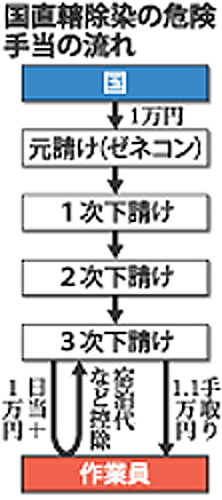
General contractors at the top of the pay pyramid and farthest from the dangers of the worksite reap the greatest benefits. They are the ones who directly contract with the government to take on the decontamination work. Once contracted, these firms subcontract work out to other companies, who in turn do the same. Onsite workers are employed by companies that are three or four steps removed from the source of funds. After each firm has taken its cut, not much money is left for paying workers. In the chart below, the national government, which is the source of the funds, is highlighted in blue. It is followed by the general contractor, and then three subcontractors. Highlighted in orange at the bottom of the food chain are the workers taking all the health risks associated with the cleanup.
“I wasn’t treated like a human being,” said a 59-year-old man from Aomori Prefecture who engaged in decontamination work in Tamura City for about two months from September of last year. He and three other workers were made to sleep in a tiny 13-square meter bungalow. He was also shocked when served his first dinner. “The only side dishes to go along with a bowl of rice were boiled eggplant, bean sprouts and bell peppers.” When he and other workers complained to the company, they were given “a couple of slices of packaged ham.”
His work consisted of cutting grass on steep slopes within 20 kilometers of the accident site. Of course there were no shops or restaurants operating nearby. For lunch, the company provided them with simple balls of rice. When questioned, the lady who made the meals said she was instructed by the company to use only 100 yen’s worth of ingredients (about US$1) for breakfast and 200 yen’s worth for dinner per serving.
“It was physically-demanding work, yet they treated us terribly,” the man said angrily.
In February, a 54-year-old worker collapsed and died of a heart attack while laboring in Kawauchi Village, Fukushima.
An acquaintance who introduced the man to the job told him, “You’ll be paid 11,000 yen (US$112) a day to cut roadside weeds. Accommodation and two meals a day are included.” Though that is the actual amount he received, workers are supposed to receive an additional 10,000 yen-a-day in danger pay for cleanup work contracted by the national government. If the amount of that danger pay is subtracted from the wage, it means the company itself was only paying the worker 1,000 yen (about US$10) a day. That works out to be less than one-fifth the prefecture’s minimum wage of 5,500 yen.
After he had been working for a month, the company asked the man to sign a “contract” in which the daily wage section had been left blank. He said he had seen a coworker’s contract which listed the gross wage to be paid as 15,700 yen and a deduction of 4,700 yen for food and lodging, resulting in net pay of 11,000 yen. When the subcontractor was contacted, it replied, “We added the extra government-mandated 10,000 yen danger benefit to the gross pay, however, since there is no agreement regarding deductions, we subtracted food and lodging expenses.”
The system is set up in such a way that multiple subcontractors are involved. A person from one subcontractor attested, “By the time funds reach us the amount needed to pay the danger benefit is no longer there.” The contractor said he had passed on the whole job to a company run by an acquaintance. He lamented, “If something is not shaved off the wages paid to the workers no profit can be made. In the end, only the general contractor is making a buck.”
Source: Otaku.com
 Paying Just $11 a Day, Subcontractors Ripping Off Fukushima Nuclear Accident Decontamination Workers
 Return to Fukushima: Decontaminated town reopens to residents, but is anybody living there?
 Foreign workers being hired for Fukushima nuclear power plant decommissioning project
 U.S. military personnel launch US$5 billion lawsuit against Tokyo Electrical Power Company
 Japan reportedly adding Japanese language skill requirement to most common foreigner work visa
 New picture book for the cat fanatic that loves furry balls
 Better know a train nerd: 36 different classifications for Japan’s “densha otaku”
 Make Tracks to Tokyo’s Train Bars
 New 7-Eleven sandwich goes viral in Japan, but is it everything it’s cracked up to be?
 Japanese manhole lid raises eyebrows with fertility god symbol that looks like… well, you know
 How to take your home ramen to the next level by making your own chashu pork in a frying pan
 Man bites woman at cherry blossom park in Japan, dies shortly after
 Why is Yoshinoya called Yoshinoya?
 Studio Ghibli displays The Boy and the Heron Academy Award Oscar in Japan for a limited time
 Pokémon and Ikea Japan cross over into each other’s worlds with collaboration events
 Starbucks Japan closing only Shinkansen platform branch for popularity-triggered renovations
 Two food hacks take Japan’s convenience store fried chicken to amazing new sandwich heights
 You can assemble a well-balanced team of Pokémon, them eat them, thanks to Japanese cake chain
 Fading Tokyo – Searching for signs of the Showa era as local neighborhoods evolve[Photos]
 Pokémon lacquerware series expands for Year of the Horse with new handcrafted design[Video]
 Tokyo turns its phone booths into free Wi-Fi hotspots, and here’s how to use them
 Tokyo teahouse serves up a sakura matcha dessert you won’t find anywhere else
 Totoro Fund line of beautiful artwork and apparel lets you help the real-world Totoro Forest
 Japan now has a special desk for people who work at home with a pet cat[Photos]
 Famous Tokyo cherry blossom spot installs view-blocking screens to fight overcrowding[Video]
 Uniqlo announces new T-shirts for One Piece, Naruto and more for manga publisher’s 100th birthday
 Train station platform ramen store closes its doors on half a century of history in Tokyo
 Starbucks Japan releases new My Fruit³ Frappuccino at only 34 stores around the country
 Studio Ghibli releases Catbus pullback keychain that runs like the anime character
 Krispy Kreme releases Super Mario doughnuts in Japan for a limited time
 Japanese onsen egg maker from 100-yen store Daiso needs to be on your shopping list
 Survey asks foreign tourists what bothered them in Japan, more than half gave same answer
 Japan’s human washing machines will go on sale to general public, demos to be held in Tokyo
 Starbucks Japan releases new drinkware and goods for Valentine’s Day
 We deeply regret going into this tunnel on our walk in the mountains of Japan
 Studio Ghibli releases Kodama forest spirits from Princess Mononoke to light up your home
 Starbucks Japan releases new sakura goods and drinkware for cherry blossom season 2026
 Japan’s newest Shinkansen has no seats…or passengers [Video]
 Major Japanese hotel chain says reservations via overseas booking sites may not be valid
 Put sesame oil in your coffee? Japanese maker says it’s the best way to start your day【Taste test】
 No more using real katana for tourism activities, Japan’s National Police Agency says