
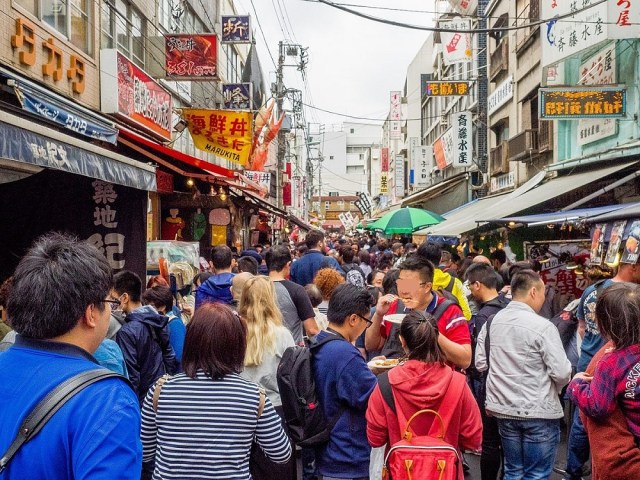
Inbound tourism boom and Japanese New Year’s traditions are too much for the world’s most famous sushi town to handle simultaneously, request says.
For those with an interest in Japanese cuisine, you can’t hear the name of Tokyo’s Tsukiji neighborhood without thinking about sushi, and it’s hard to think of sushi for very long without thinking about Tsukiji. Up until 2018, the Tsukiji fish market was the largest seafood wholesale market in the entire world, and in the late 1990s it slowly started building fame as a tourist destination, drawing visitors from around the globe as Japanese food became more and more popular internationally.
When the Tsukiji fish market relocated to the Toyosu neighborhood in 2018, there was a lot of talk about how this would affect tourism patterns. Seven years later, though, very little has changed. Toyosu is farther outside of the city center, and while its more modern facilities are definitely a plus for wholesale buyers and sellers in terms of auction spaces and distribution infrastructure, for tourists, the place is pretty pricey and decidedly lacking in the old-school charm that helped Tsukiji earn its international fame. What’s more, the part of the Tsukiji market that moved was the “inner market,” which primarily dealt in wholesale sales to restaurants and large-quantity sales to Japanese residential households. The “outer market,” the organic collection of restaurants, snack stands, and smaller-quantity seafood merchants, i.e. the places that tourists are going to be the most interested in, is still there, and as popular with tourists as ever…and maybe even, in some ways, too popular, at least in the eyes of the Tsukiji Food Town Development Council, which is asking tour guides and tour groups to refrain from visiting the neighborhood during the month of December.
A sign posted in the neighborhood by the council, shown at the point queued in the above video, says:
We have an important request for tour guides and operators. The Tsukiji Outer Market is a kitchen for customers who come from all over Japan in December to purchase delicious foods for the New Year’s holiday season. It serves as a place to support families. During this time, the streets become very crowded, and so it is unsafe to eat while walking, move in large groups, or conduct guided tours.
As such, we have the following request.
Please refrain from conducting guided tours (tours for sightseeing, eating strolls, group guidance). This is a rule so that ordinary people too may safely and enjoyably do their New Year’s shopping. If this is not abided by, we may be forced to contact the police. We ask for your understanding and cooperation in this matter.
There’s actually quite a bit to chew on here, so let’s start with the New Year’s part. Traditionally, New Year’s, or Oshogatsu, as it’s called in Japanese, is the biggest holiday of the year. The customary way to spend the season is to head back to your home town before the end of December, then spend the first three days of January relaxing and reconnecting with family and old friends, often while enjoying something luxurious to eat in each other’s homes. As such, Tsukiji sees a surge in shoppers in late December, since the market has long had a reputation for high quality at reasonable prices.
▼ It really is hard to think of a better way to start the new year than this.

It’s also worth bearing in mind that Tsukiji wasn’t always a tourist attraction, and so it wasn’t really designed with sightseeing capacity in mind. The outer market area is a group of shops and restaurants that organically clustered inside a handful of blocks near the former inner market. It doesn’t have wide sidewalks or pedestrian plazas, and lines for popular places often form on the same streets that trucks have to drive down to make deliveries. In the early days, this wasn’t a problem, but when you combine Tsukiji’s present-day sightseeing crowds with the New Year’s shopping crowds, there’s the potential for things to get dangerously packed.
▼ The point queued in this video shows the conditions at Tsukiji during late December of 2024.
However, the situation gets more complicated because of the blurred line between “shoppers” and “sightseers” in Tsukiji. Again, Tsukiji sightseeing is pretty much all about sushi (even a local shrine is sushi-related), and no tourist is going to put “Tokyo’s sushi neighborhood” on their itinerary if they’re not also keen to get something to eat while they’re there. There’s also the fact that the non-tourist shoppers aren’t all necessarily locals, either. Tsukiji’s reputation for quality means that it attracts Japan-resident shoppers even from outside the surrounding area, and while they may not be there as part of “traveling,” it’s not like Tsukiji’s outer market is some small enclave only meant to serve the immediately nearby community.
A key difference, though, is that non-tourist shoppers, whether locals or not, tend to show up in smaller, less obtrusive groups. They’re comparatively less likely to roll up with a dozen companions, hold up lines as they try to figure out what all of the unfamiliar-to-them items are, or unwittingly block pedestrians as they stop to snap selfies. Not that non-tourist shoppers never do those things, or that any of them, in isolated instances, are unforgivable faux pas. Guided tours, though, tend to intensify and concentrate such issues, and that’s what’s at the root of the request for them to stay away from Tsukiji this month.
Now, the counterpoint to all this is that a lot of Tsukiji’s present-day prosperity comes from the attention it’s received from foreign tourists. Tsukiji wasn’t really a major sightseeing destination until the late 1990s, when jetlagged overseas travelers in Tokyo found out that Tsukiji’s fish market was one of the few things open when they woke up long before museums, shopping centers, and amusement parks were ready to receive guests, and even before most restaurants were open (this was in the days before Japanese convenience stores really upped the quality of their food). Word gradually spread that Tsukiji was a unique, fun, and delicious place to visit which then resparked interest in the neighborhood among Japanese people too, who were curious to take another look at what was causing all the international buzz, even if they weren’t going to, for instance, buy an entire tuna while they were there.
▼ There is always room for at least this much sushi. Always.

With that background, it can be tempting to see the Tsukiji Food Town Development Council’s request as a case of biting the hand that feeds it (while Tsukiji itself has been feeding that hand delicious sushi). However, it’s important to keep in mind the focused nature of the request: it’s guided tours/tour groups that are being asked not to come in December. Individual/independent tourists aren’t being discouraged from visiting the neighborhood, and the organization’s official English-language website currently has a statement saying:
“Many shoppers will be coming to Tsukiji in December. To protect the traditional Japanese culture of New Year’s shopping, and for safety reasons, please refrain from sightseeing and group tours. Thank you for your cooperation.”
There’s a bit of vagueness in the phrasing of “refrain from sightseeing and group tours,” in that it could be taken to mean either “refrain from conducting both sightseeing tours and conducting group tours” or “refrain from the activity of sightseeing and also from conducting group tours,” Even if it’s the latter, though, that’s more a request to not come to Tsukiji just to gawk and shoot photos, but to also purchase something while you’re there. Masahiro Terade, a Tsukiji shop owner and vice-chairman of the Tsukiji Food Town Development Council, also offered a bit of clarification during an interview when he said:
“There really are a lot of people in December. From a safety standpoint, we are asking for self-restraint, but we are not at all saying [for everyone] not to come to Tsukiji.”
The warning on the sign posted by the council mentioning the possibility of getting the police involved is somewhat intimidating-sounding, though, but it may or may not be completely enforceable. The Tsukiji outer market isn’t a single, self-contained facility, and the shops and restaurants that make it up are connected by a network of public streets. As such, the council might not actually have the legal jurisdiction to prohibit tour groups from coming to the area. It’s not unusual for tour providers to operate in a sort of legal gray area, though, in terms of conducting a business activity in public spaces, so a scenario in which the council contacts the police about a tour group could actually be a case of simply enforcing an ordinance that tour operators are usually given a pass on.
All that said, with overtourism becoming an increasingly hot-button topic in Japan, if you are planning a visit to Tsukiji this month, the polite thing to do would be to stay aware of your surroundings, and to make sure you’re not blocking, bothering, or otherwise infringing upon other people’s ability to enjoy their time in the neighborhood too. Really, though, that’s the proper thing to do regardless of what month you visit in.
Source: Teleasa News via Yahoo! Japan News, TBS News Dig, YouTube/ANNnewsCH
Top image: Wikipedia/Epicsunwarrior
Insert images: Pakutaso (1, 2)
● Want to hear about SoraNews24’s latest articles as soon as they’re published? Follow us on Facebook and Twitter!































.jpg)