
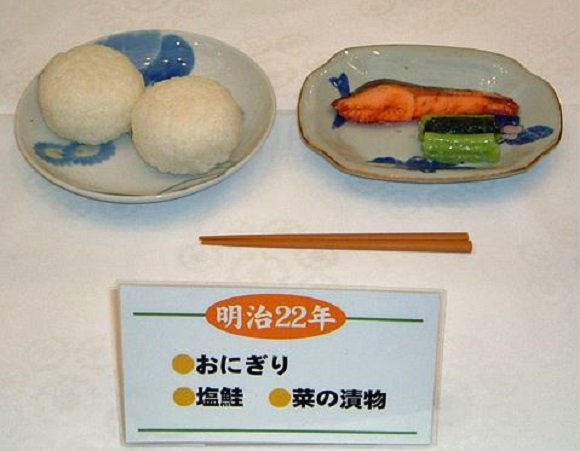
In the 22nd year of the Meiji era (aka 1889), the very first Japanese kyūshoku (school lunch) was served up at an elementary school in Tsuruoka City, Yamagata Prefecture. Although the first menu was very simply prepared, it provided the growing children with an important source of nourishment that not all of them could receive at home.
Fast-forward to 2015–Japanese schoolchildren (and their teachers!) continue to eat school lunches every day, as opposed to children in many other countries who bring their lunches from home. If you’re working in a Japanese school, you should already be familiar with the daily feeling of either excitement or disappointment when you see the lunch menu for the day. But just consider this–would you rather eat the types of lunches served today, or those that were served 100 years ago? Read on to learn about the evolution of Japanese school lunches and decide for yourself!
Love’em or hate’em, school lunches at Japanese schools are here to stay. Everyone, including the teachers and even the principal, sit down to eat the same lunch every day. Children are encouraged to be thankful for the food and finish every last bite, including any foods that they’re not particularly fond of. If you’re interested in learning more about the daily routine revolving around preparing and serving the food, please see our previous post here. Otherwise, let’s dive right into the history of Japanese school lunches!
The Gakkō Kyūshoku website has provided a concise history of the lunches, including pictures of sample meals from different time periods. The following pieces of information and images were taken from their website.
The first school lunch in Japan was started by a Buddhist monk who oversaw a school in Tsuruoka City, Yamagata Prefecture. The idea to provide lunch at school came about when he noticed that many of the disadvantaged children weren’t coming to school with packed lunches from home. These first simple lunches consisted of onigiri (rice balls), grilled fish, and pickled vegetables called tsukemono, as seen below:
▼A typical school lunch from year 22 of the Meiji era (1889)
Years later, the people of Yamagata erected a commemorative monument on the school grounds where the first school lunch was served. Here’s what it looks like today:
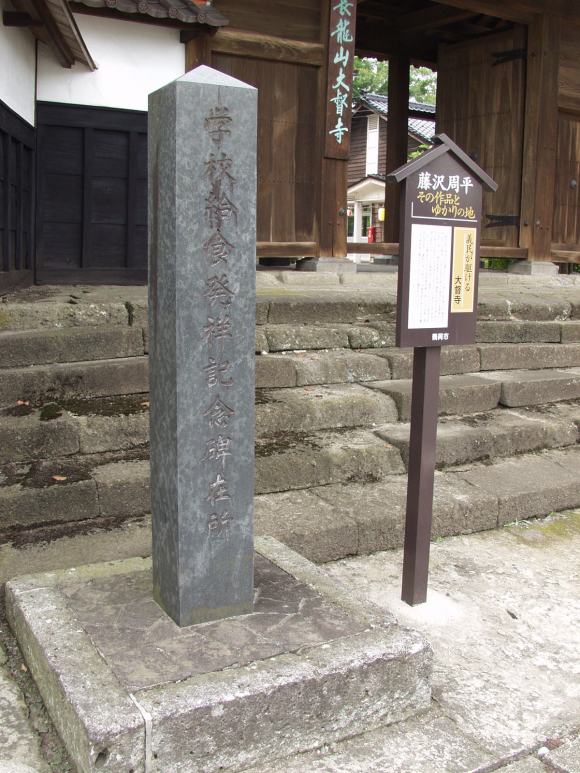
Word spread about the success of the monk’s school lunch program. Before long, schools around the country had embraced the idea and were beginning to offer lunches to their students as well. Rice mixed with meat and/or vegetables, fish, and varieties of miso soup became typical food items found on the menus.
During these early years, schools usually served the food in porcelain bowls and other dishware, making it feel more like a home-cooked meal than a school-provided lunch.
▼Year 12 of the Taishō era (1923)

▼Year 2 of the Shōwa era (1927)

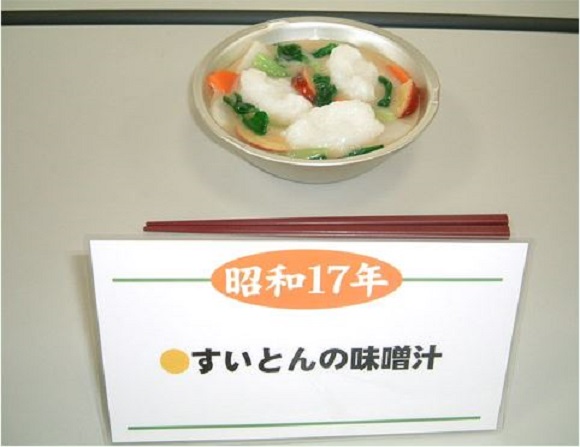
After the outbreak of WWII, school lunches were either cut or reduced in many parts of the country due to local wartime food shortages. The following image is an example of a dumpling miso soup eaten during the war years:
▼Year 17 of the Shōwa era (1942)
In 1944, approximately two million elementary school-aged children received school lunch in six major cities throughout Japan. Although the war ended in 1945, food shortages continued, and many children were left malnourished. It is estimated that elementary school sixth grade students at the time had bodies equivalent to those of fourth grade students of today due to stunted growth.
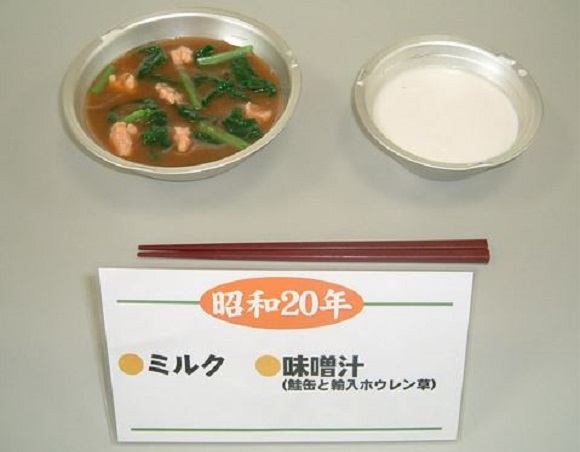
Note the inclusion of milk in the sample meal from 1945 below:
▼Year 20 of the Shōwa era (1945)
In 1946, the vice-minister of three governmental ministries released a decree to encourage the widespread implementation of school lunches throughout the country. Consequently, a school lunch system was implemented on December 24 of that year at all schools in Tokyo, Kanagawa, and Chiba prefectures. Today, some schools in those regions offer a special menu during the week of January 24-30 in commemoration (since holidays typically interfere with the final week of December and no school lunch is served then anyway).
In case you were wondering, that’s tomato stew in the picture below.
▼Year 22 of the Shōwa era (1947)
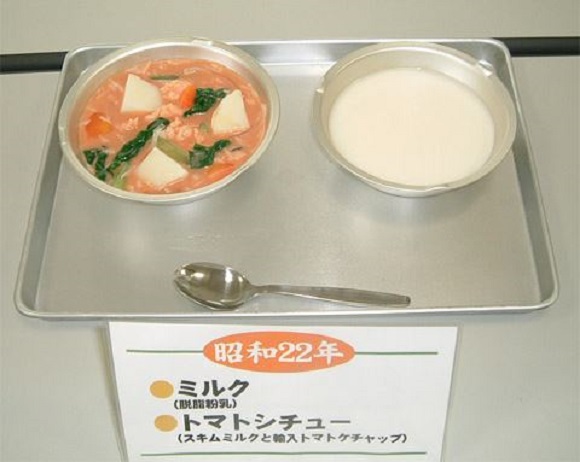
In 1947, approximately three million children around the country began receiving school lunch, including powdered non-fat milk donated from America. Two years later, UNICEF also donated free shipments of the powdered milk.
In 1950, elementary school-aged children in eight major Japanese cities received complete school lunches with the addition of bread made using wheat flour from America. A bread roll coupled with potato stew, croquette, sliced cabbage, and milk is an example of what a typical lunch served during this year would look like:
▼Year 25 of the Shōwa era (1950)
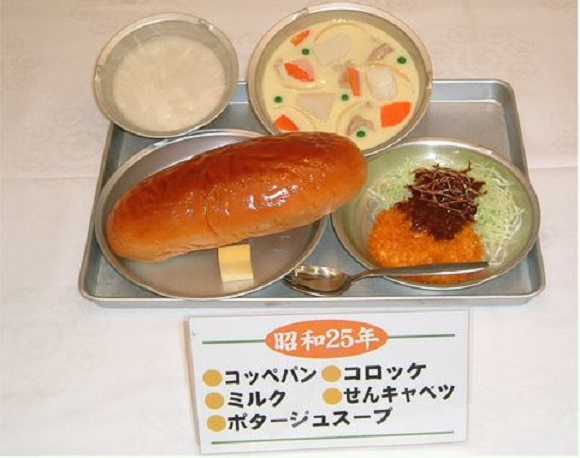
The year 1951 saw a movement unfold throughout the country for school lunches to be partially funded by government subsidies. By the following year, the government funded half the cost of the wheat flour used in school lunch bread. Starting in April, elementary school-aged children in all schools throughout the country received complete school lunches. Lunches over the following years tended to include a number of fried menu items.
▼Year 27 of the Shōwa era (1952)
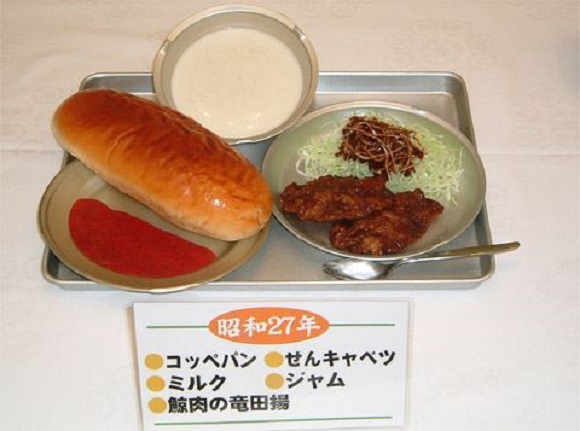
In 1954, the School Lunch Act was implemented. School lunch was recognized as a legitimate part of children’s education as a way to teach knowledge about how food is produced and important dining customs. It also encouraged healthy social interaction between classmates and within the school, a tenet which is still promoted to this day.
▼Year 30 of the Shōwa era (1955)
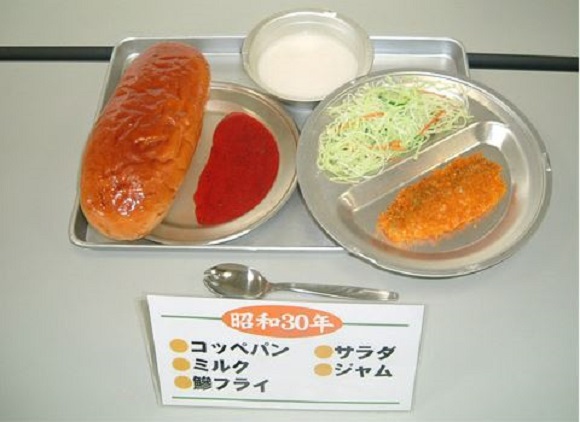
▼Year 32 of the Shōwa era (1957)
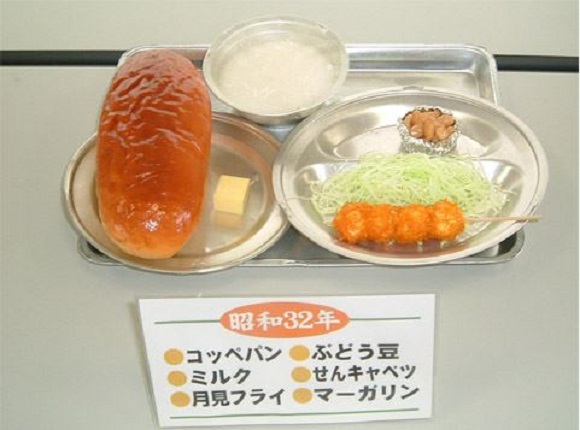
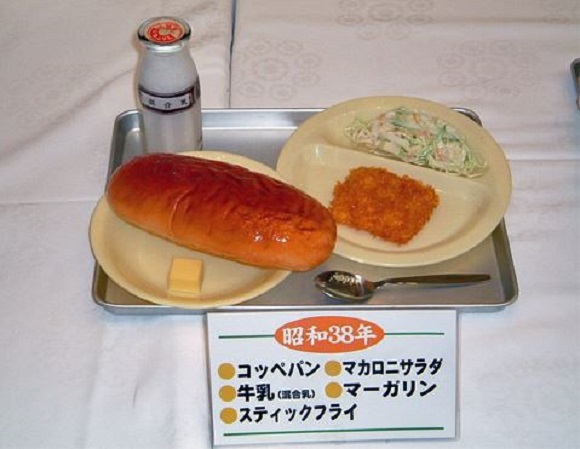
In 1958, the administrative director of the Ministry of Education, Culture, Sports, Science and Technology (MEXT) promoted an outline for the inclusion of milk in school lunches. Fresh cow’s milk gradually replaced powdered milk over the next several years.
▼Year 38 of the Shōwa era (1963)
The dish on the right-hand side of the tray below is oden, a Japanese favorite in the wintertime!
▼Year 39 of the Shōwa era (1964)
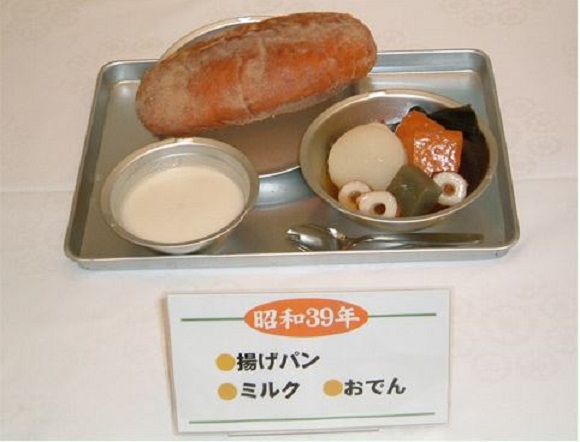
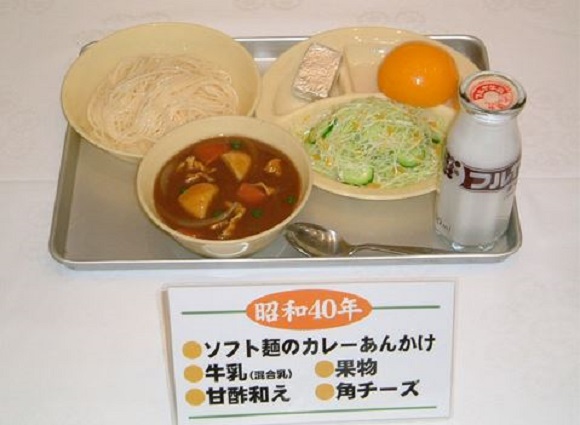
In addition, although bread rolls had been the norm for a long time, fried bread and other forms of cooked bread were being introduced into school lunches by the end of the 1950s (see the above photo). Soft noodles also began to appear in some school lunches in the central Kanto region of Japan.
▼Year 40 of the Shōwa era (1965)
▼Year 45 of the Shōwa era (1970)
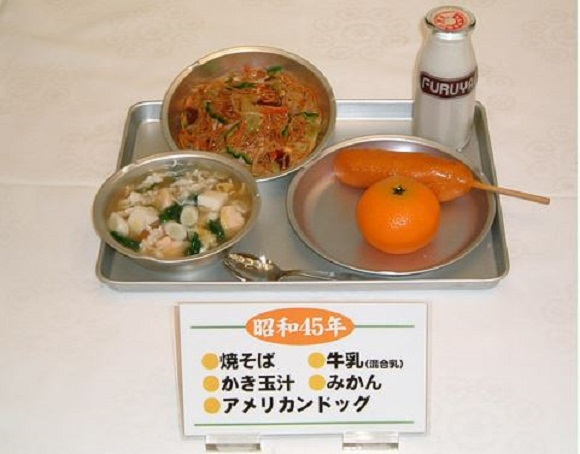
In 1971, the contents of school lunches were more or less standardized by governmental decree.
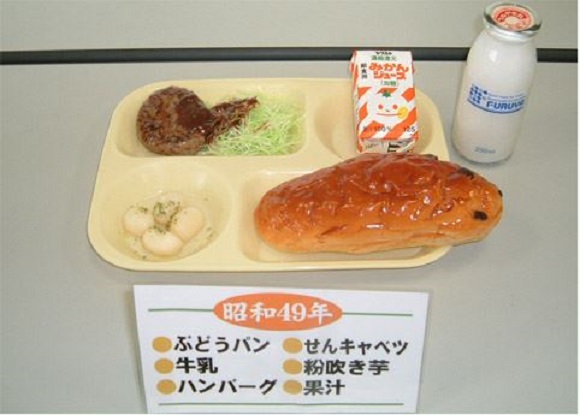
▼Year 49 of the Shōwa era (1974)
▼Year 50 of the Shōwa era (1975)
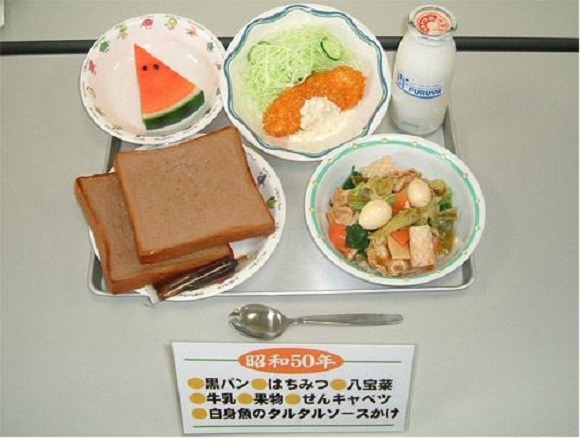
Meals with warm, freshly cooked rice began to be served in 1976. There was also an increase in the variety of foods served compared to the selection from just two decades before.
▼Year 52 of the Shōwa era (1977)
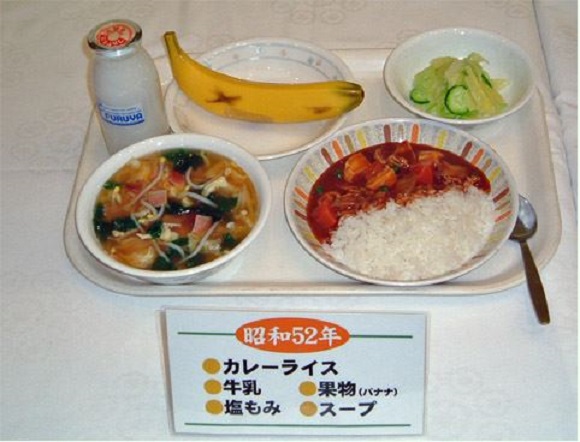
▼Year 54 of the Shōwa era (1979)
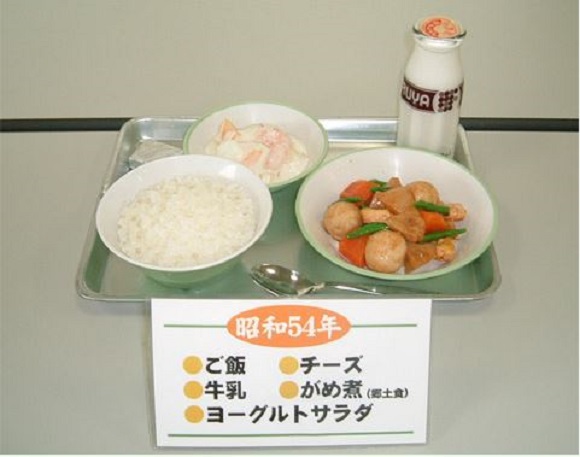
In this next photo, you can see that the previously bottled milk was finally replaced by milk cartons. Continue to track these subtle changes in the remaining images.
▼Year 56 of the Shōwa era (1981)
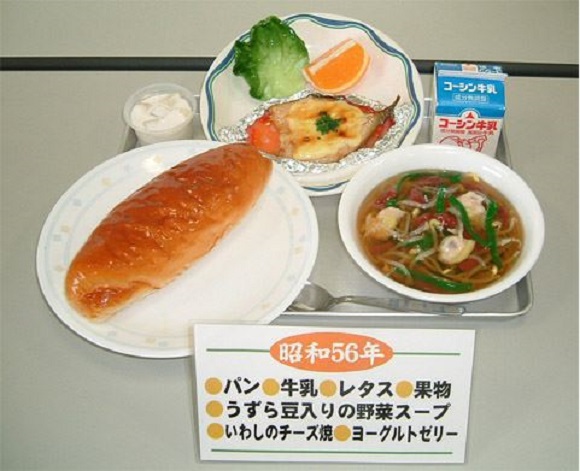
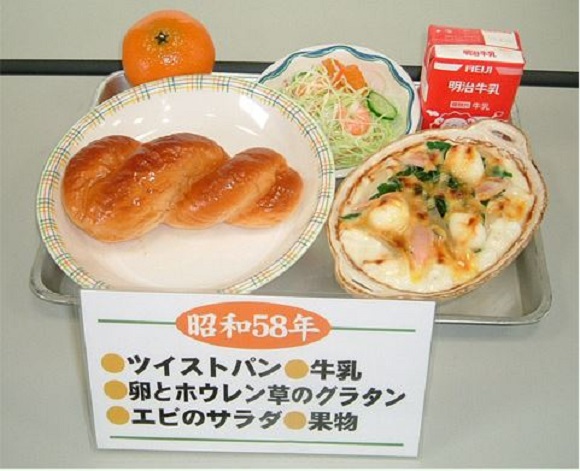
Egg and spinach gratin, along with shrimp salad and braided bread? How fancy!
▼Year 58 of the Shōwa era (1983)
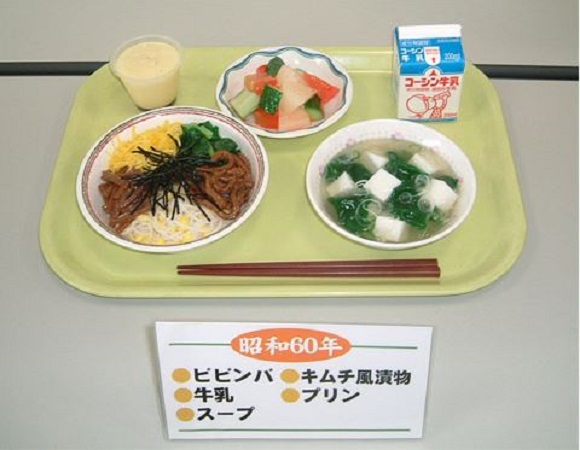
Even bibimbap, a Korean mixed rice dish, made its debut in 1985. Also, I spy some yummy-looking dessert pudding.
▼Year 60 of the Shōwa era (1985)
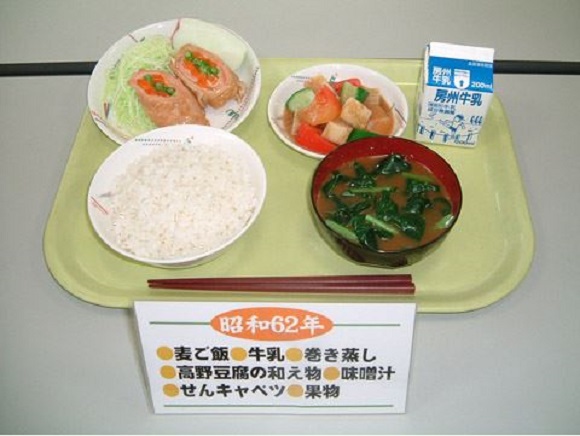
▼Year 62 of the Shōwa era (1987)
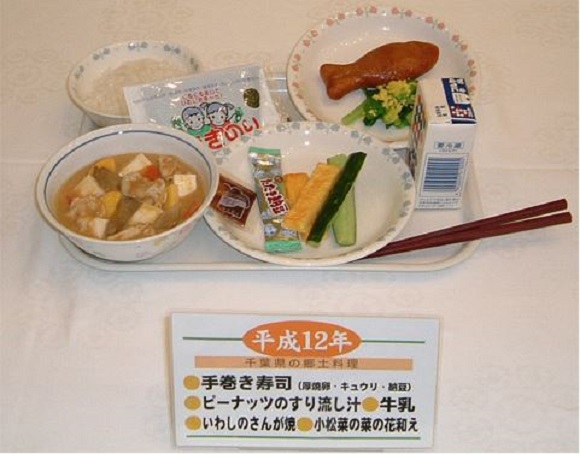
1993 and 1994 were bad years for rice crops, so school districts were singularly allowed to supplement their school lunches with rice not subject to governmental controls. By 2000, this type of rice became allowed for general usage.
▼Year 12 of the Heisei era (2000)
Japanese school lunches sure have come a long way over the past century. Menus are now more varied and nutritionally balanced to ensure the development of healthy school-aged children.
It’s worth noting that school lunches have also come under fire for issues regarding cleanliness and proper food preparation. In particular, a tragic incident in 1996 in Okayama Prefecture led to the deaths of two children caused by improper food preparation; an additional 468 showed symptoms of food poisoning. A subsequent investigation revealed the presence of E. coli bacteria in their school lunches.
I myself had the privilege to work for two years at a junior high school in Yamagata Prefecture, the original birthplace of Japanese school lunches. While the quality of the meals wasn’t always the greatest, I look back at them fondly for their convenience, low cost (less than 300 yen [US$2.49] per meal), and the opportunity to try a variety of foods that I wouldn’t normally have packed for myself. Plus, nothing beats a bowl of ready-to-eat, steaming rice in the middle of winter!
My school and other schools in the city operated on a rotating menu schedule, which always included a soup, some type of carb, a vegetable side dish, and milk. Bread was usually served on Mondays, noodles on Wednesdays (during cold months only), and rice on the rest of the days. I always looked forward to special holiday meals, which often included an extra special treat or a culturally relevant food.
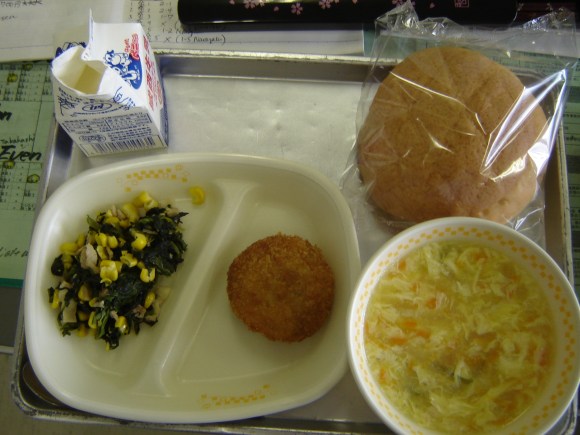
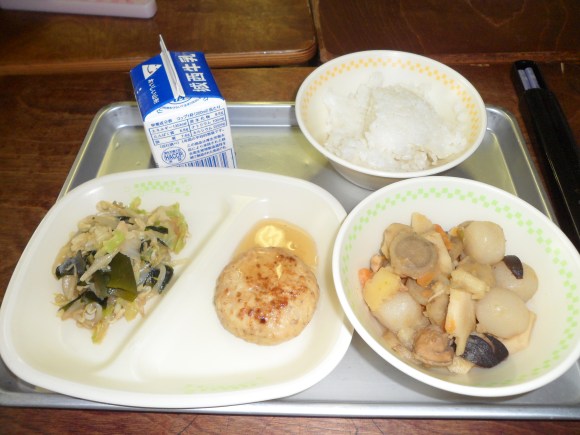
I think it’s fitting to end this piece with two photos of Yamagata junior high school lunches. Just look at how far they’ve come since 1889!
▼Circa 2012
Sources/Images: Gakkou Kyuushoku, Unilab Tsuruoka, RocketNews24
 School Lunch in Japan 【You, Me, And A Tanuki】
 Top 10 Japanese school lunch food items that adults miss the most
 Our Japanese reporter’s encounter with American school lunch
 Japanese survey takers go back to school to vote on their favorite school lunch menu items
 “How I learned to stop worrying and eat Japanese school lunches,” by P.K. Sanjun
 Studio Ghibli unveils new anime calendars and diary planners for 2027
 Family Mart releases new Human Made Cup Noodle in Japan, with freebies for Nigo fans
 Japan’s final Penguin Suica train cards have already shipped, and when they’re gone, they’re gone
 Hobonichi unveils new 2027 planners, diaries and stationery with One Piece, Suica Penguin, Hello Kitty and a must-buy Mini Techo
 Hikaru Utada sings new song in Shinkansen commercial for Japan’s Supreme Class cabins
 Mister Donut releases new doughnuts that look and taste like Japanese sweet potatoes
 This Japanese 7-Eleven has the most expensive drinks, and item, we’ve even seen at the chain
 Is Tokyo’s Odaiba, once one of its trendiest neighborhoods, becoming a ghost town? [Photos]
 Farewell Final Ceremony announced for Tokyo’s life-size Gundam statue, will stream live
 Foreign travelers arrested in Japan following smash-and-grab robbery in Tokyo shopping mall
 Japan approves foreign resident visa renewal fee increases of up to 967 percent, starts soon
 Japan tripled its departure tax to fund tourism but is using the money on cherry blossoms and bears
 Nike x One Piece collection brings Devil Fruits to sneakers and streetwear in Japan
 We recommend not buying one pack of Japan’s new convenience store corn soup-flavor fried chicken
 Police in Japan looking for who’s responsible for dumping 80 loaves of bread on side of road [Video]
 Japan’s double-decker portable rice cooker/bento maker is better than ever with new version
 Nephew of Studio Ghibli director Hayao Miyazaki serves up Totoro Shaved Ice in Tokyo
 12-year-old British girl who went missing in Tokyo found safe after visiting anime sites around Yokohama
 7-year-old boy left behind on Mt. Fuji by his own dad
 Air-conditioned dress shirts arrive in Japan to save working professionals from sweltering heat
 Sushi Bus: Japan’s first conveyor-belt bus lets you eat sushi while sightseeing around Tokyo
 Pokémon Center Online designates first Pokémon items that will require Japanese ID card to buy
 Japanese toilet aims to attract foreign tourists but not everybody is happy about it
 Tokyo’s newest viral dessert is like a Japanese parfait inside a bread bun [Taste test]
 New Japanese vending machine at Shinkansen station sells cups of ice on platform
 Study finds hundreds of people in Indonesia legally named after Naruto, Inuyasha, other anime stars
 Japan announces sudden 400-percent increase in visa fees for foreigners entering the country
 Japan’s human washing machines will go on sale to general public, demos to be held in Tokyo
 Studio Ghibli has a new anime out, and there’s only one place in the world where you can see it
 Starbucks Japan releases new drinkware and goods for Valentine’s Day
 Starbucks Japan releases new sakura goods and drinkware for cherry blossom season 2026
 Japan’s newest Shinkansen has no seats…or passengers [Video]
 Tokyo subway installing new ticket gates that don’t accept payment through Suica or other IC cards
 Japanese ninja certification exam attracts 131 candidates from Japan and abroad
 Salomon releases Japan-exclusive Mt. Fuji hiking gear that doubles as an amazing souvenir
 Put sesame oil in your coffee? Japanese maker says it’s the best way to start your day【Taste test】
 Japanese School Lunch Fail【You, Me, And A Tanuki】
 Tokyo government building serves local school lunch to public in Japanese cafeteria
 Japanese town axes milk from school lunches, debate likely to wage until cows come home
 Fukuoka schools struggling to get kids to switch from milk to tea in lunches
 Convenience store fried chicken going into school lunches in Japan for Family Mart anniversary
 “Let them eat furikake!” says Mayor Hashimoto as Osaka school lunch saga rumbles on
 Japanese school lunch noodles fried so hard that children and teachers chip teeth, go to hospital
 Hi-Chew releases new Japanese School Lunch flavor to stimulate appetites and nostalgia
 Aichi woman arrested for mixing human excrement into school lunch
 Why do kids in Japan use those large leathery “randoseru” school bags?
 Ghibli food brought to life for one week of amazing lunches at elementary school in Japan
 Okayama students! Ready yer breakfast and eat hearty, Fer lunch ye dine upon wild boar and deer!
 Short video looks at why Japanese students serve their own school lunches, clean their classrooms
 In Japanese elementary schools, lunchtime means serving classmates, cleaning the school 【Video】
 Foreign student’s comment leads to Japan’s favorite tonkotsu ramen being added to school lunch menu