
Global consumption of coal has declined significantly over the past year, driven by China, which makes up about half of the world’s demand for coal.
But the Asian giant’s break from one of the world’s dirtiest fuels is unlikely to be a clean one: While China seems to be reducing coal production and consumption domestically, political concerns suggest that Beijing will maintain support for coal production in North Korea.
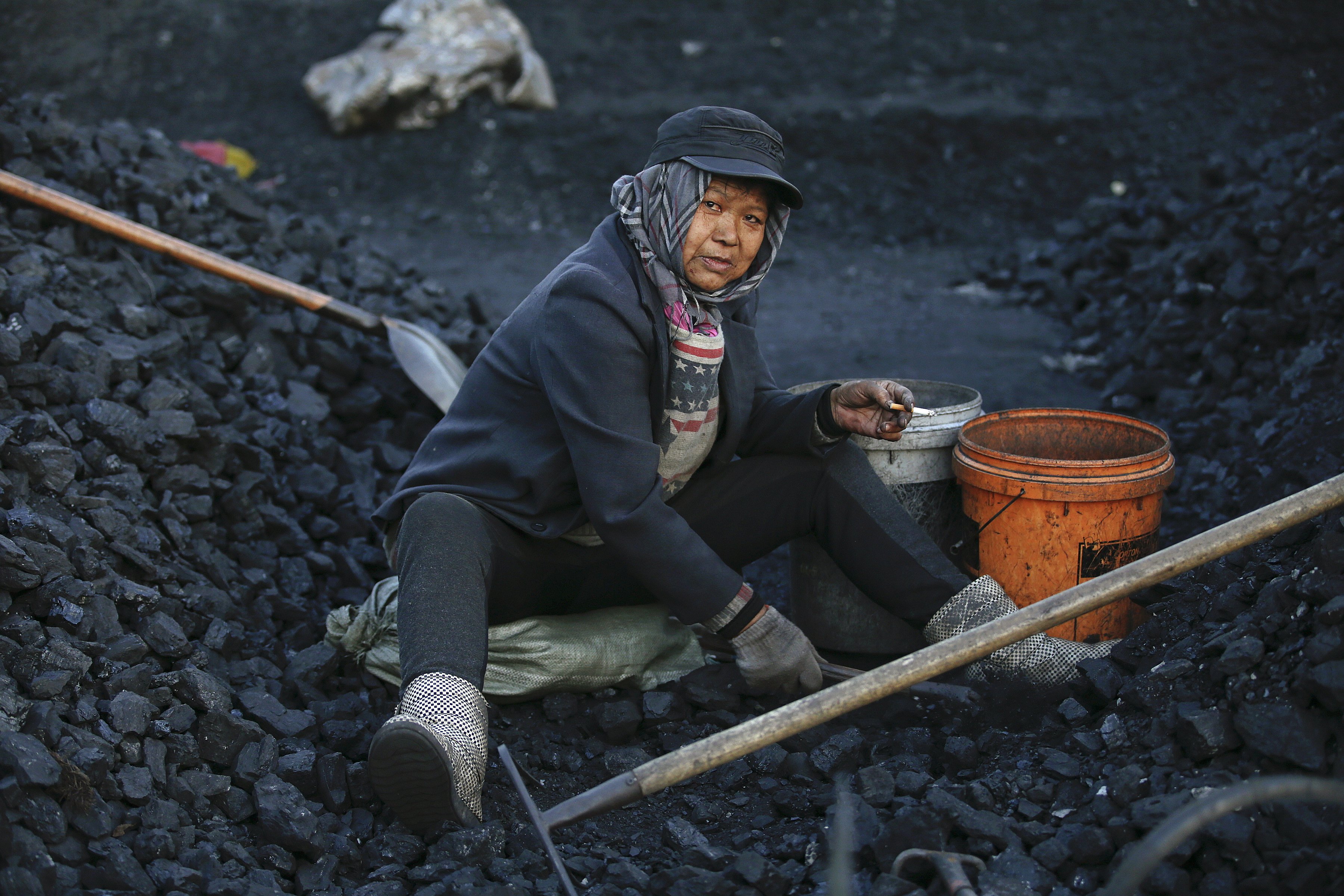
A villager selecting coal at a coal depot near a coal mine of the state-owned Longmay Group on the outskirts of Jixi, in Heilongjiang province, China, on October 23.
 REUTERS/Jason Lee
This relationship has led China to push for sanctions exemptions for its coal trade with the hermit kingdom, even as Beijing winds down its own coal production — the livelihood of an increasingly restive portion of the Chinese population.
‘There isn’t going to be change’
China’s economy grew 6.9% in 2015, the lowest rate in 25 years, and Reuters has reported that the government intends to lay off 5 million to 6 million state workers over the next two to three years, “as part of efforts to curb industrial overcapacity and pollution.”
In northeast China, a hub of industrial and coal production, those layoffs have already started.
Local economies in parts of Heilongjiang, in far northeast China, fell 10% in 2014. Coal prices in those areas have fallen by half since 2011, and the Chinese pullback from coal and heavy industry has left many workers without work and with few prospects.
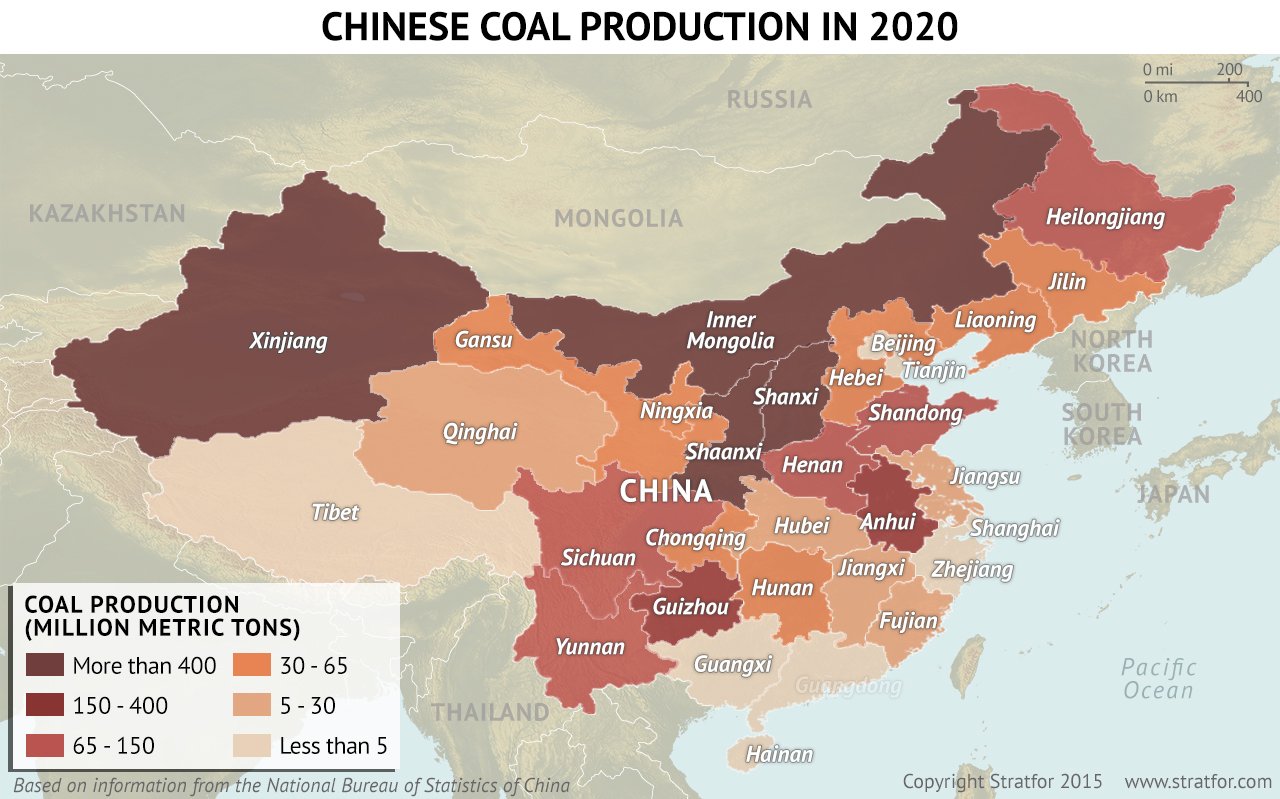
Projections for Chinese coal production in 2020, much of which will come from the country’s north.
Chinese leadership has promised that the 1.8 million workers who will be fired from government-run coal and steel firms (others will be laid off from private companies) will be retrained and rehired.
“The opportunities for middle-aged or even elderly former coal miners and steel plant workers are more limited in a province where the economy really has slowed to virtually zero,” Geoffrey Crothall of the nonprofit China Labor Bulletin, which has tracked a significant spike in labor strikes in China over the past six months, told the Associated Press.
Unrest has grown in the northeast, and large protests have taken place. Many workers, mostly young ones, have left the area for manufacturing centers in southern China, according to the AP.
Those who remain, and still have work, say they haven’t been paid in months.
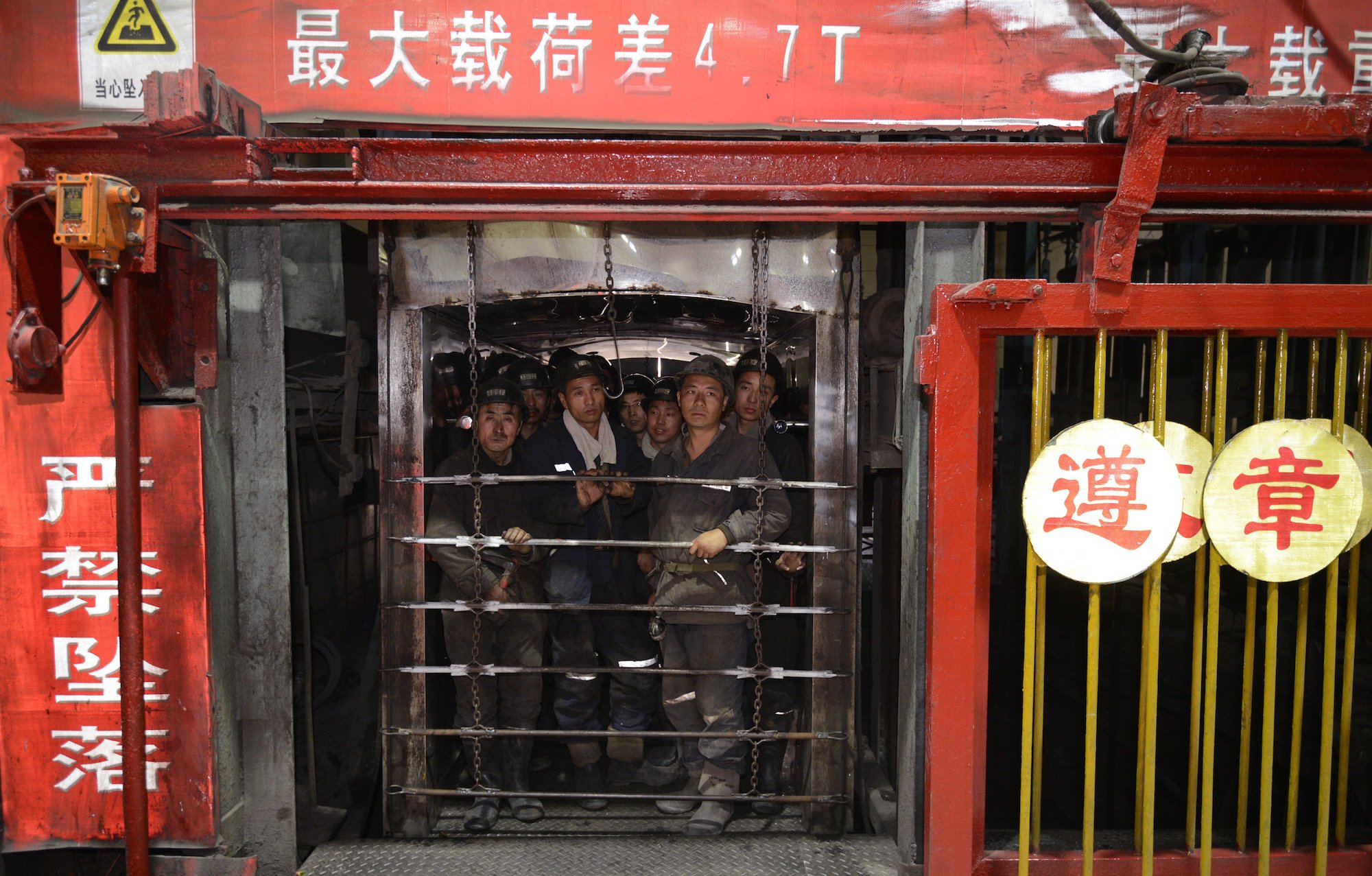
Miners waiting for an elevator to go down into a coal mine in Lvliang, Shanxi province, China, in 2012.
 REUTERS/Stringer
“I don’t even have anywhere left to borrow money from,” Li Jiuxian, a 51-year-old miner in Jundeshan, in northeast China’s Heilongjiang province, told the AP outside a dingy mahjong parlor. “There isn’t going to be change.”
‘The government hasn’t issued any notice’
Despite the domestic measures that have diminished coal production, China seems more reluctant to put checks on the coal it brings in from North Korea.
“Over two weeks after the United Nations slapped harsh new sanctions on North Korea, several Chinese shipping and trade sources say they have not been told of any curbs on the import of coal from the isolated nation,” Reuters reported in mid-March.
Coal is North Korea’s largest export and one of its only sources of hard currency.
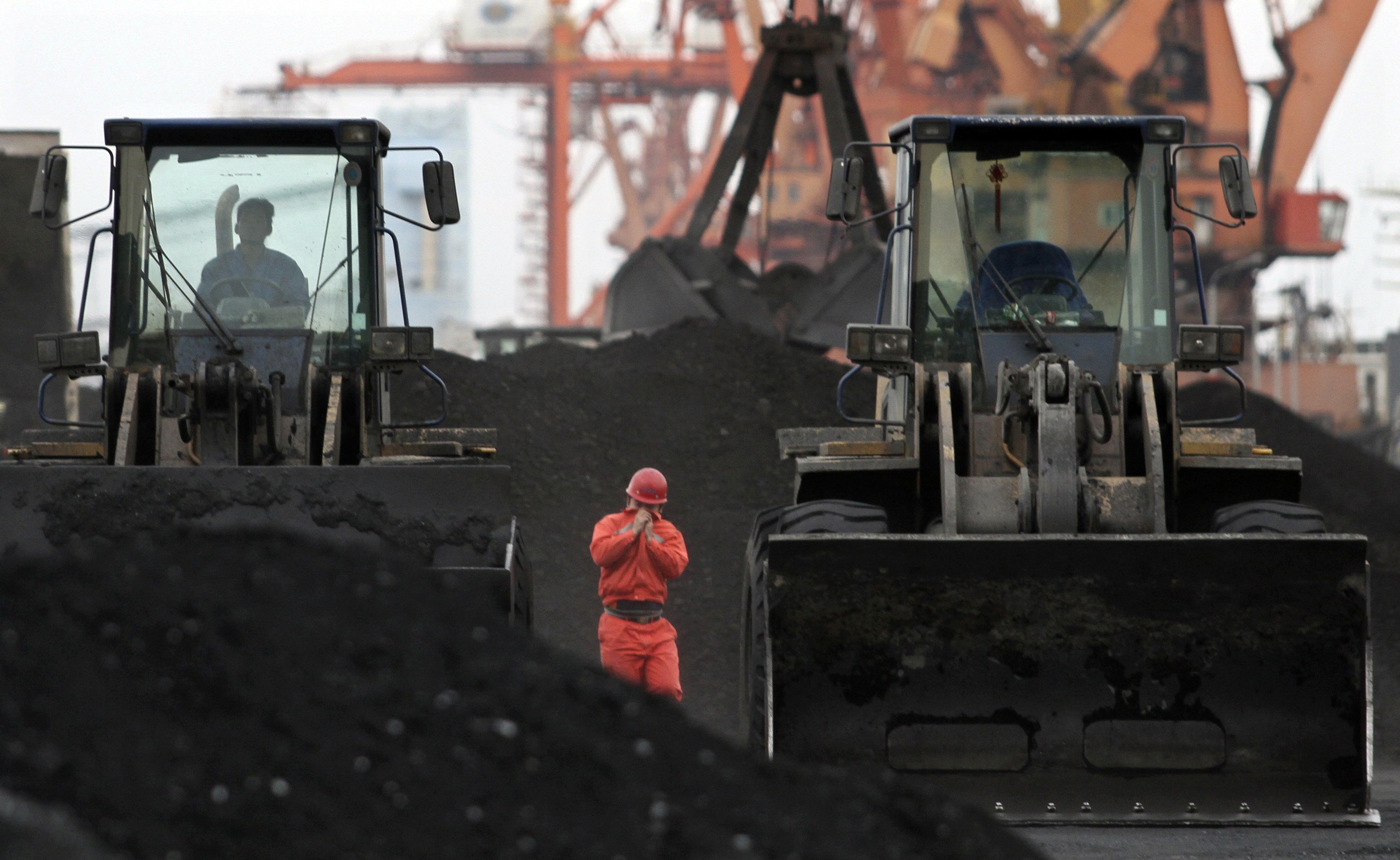
An employee walking between front-end loaders, which are used to move coal imported from North Korea at Dandong port, in the Chinese border city of Dandong, Liaoning province, in 2010. Dandong port, near the China-North Korea border, serves as an import center for coal and iron ore from North Korea.
 REUTERS/Stringer
“At this point, nobody has come to us and said you shouldn’t do it,” an official at a company in the port city of Dalian that imports North Korean coal and other goods told Reuters. “I’m not even clear on what the specific sanctions are.”
While China has taken action against some North Korean traders in line with sanctions on the North’s weapons programs, Chinese officials and other experts have cautioned that taking too hard a line against the pariah country could lead to economic disaster.
North Korean leader Kim Jong Un receiving a delegation of the Communist Party of China on an official goodwill visit on October 9, in this photo released by North Korea’s Korean Central News Agency.
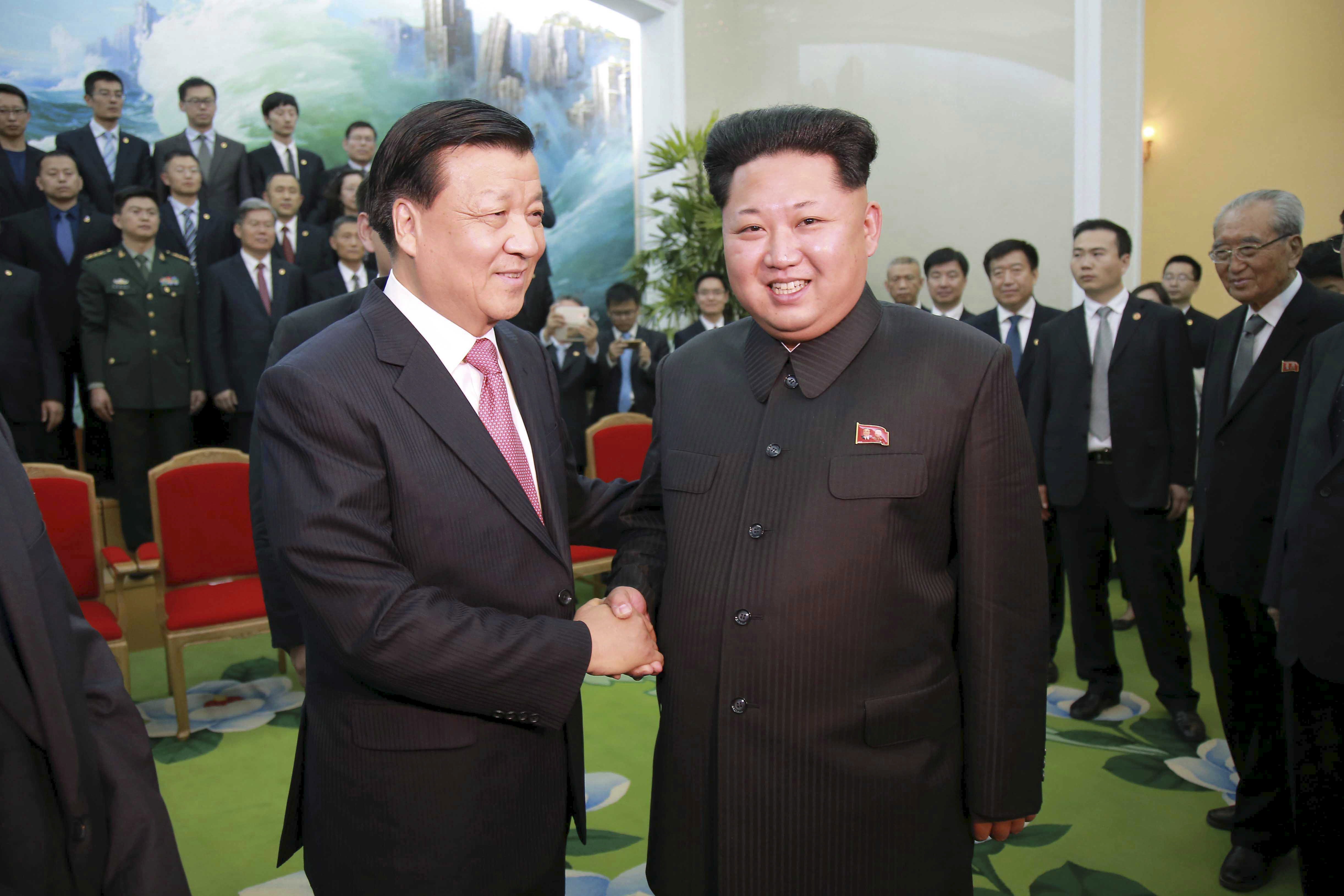 REUTERS/KCNA
“China regards stability on the Korean peninsula as its primary interest,” a report from the Council on Foreign Relations said earlier this year, citing China’s desire to maintain a strategic buffer between it and South Korea as well as Beijing’s fear of a wave of North Korean migrants heading north should their country collapse.
Moreover, keeping the North Korean regime in power accentuates Chinese authority in the region, prevents a pro-West government from coming to power, and forestalls the possibility of North Korea’s nuclear material falling into the wrong hands, according to Douglas Schoen and Melik Kaylan in “The Russia-China Axis.”
Coal deliveries to China from North Korea spiked by 26.9% in 2015, according to Reuters, to 21.7 tons with a value of $1 billion.
While Beijing, which is North Korea’s biggest trading partner, has become more willing to criticize and punish Pyongyang, it has also worked to carve out exceptions to sanctions imposed by the international community.
China is North Korea’s biggest trading partner and its source for many essential goods.
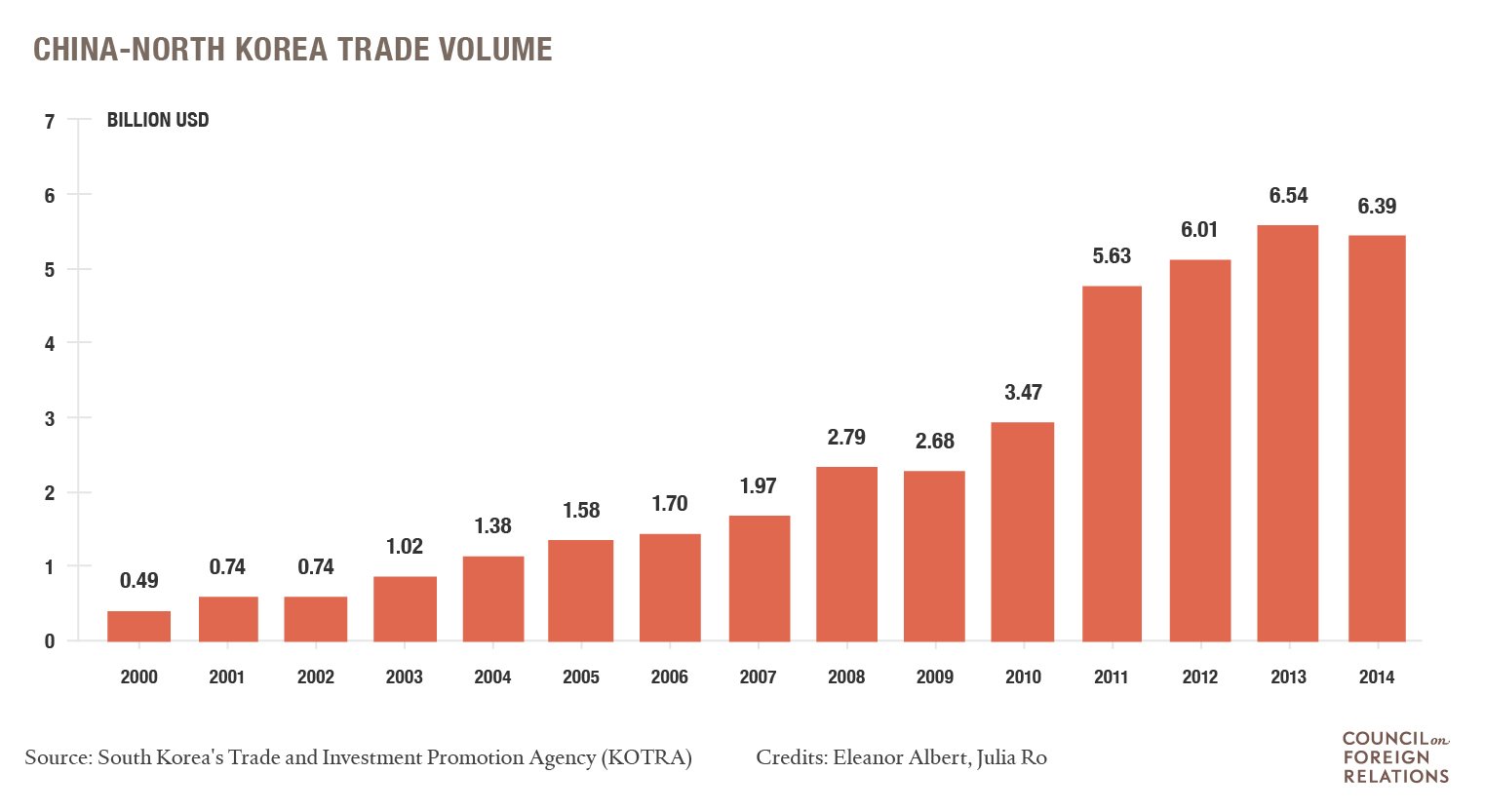 Eleanor Albert, Julia Ro/Council on Foreign Relations
“I think it’s an indication that the Chinese managed to negotiate a wide exemption for the coal trade,” Andrea Berger, deputy director of the proliferation and nuclear policy program at the Royal United Services Institute, told Reuters.
“Coal is a big lever for them,” Adam Cathcart, a North Korea-China specialist at the University of Leeds, said to Reuters. “They’re wise from the Chinese standpoint to keep some leeway (so) they’re not branded as sanctions violators if a train goes from China to North Korea (carrying resources).”
Rough neighborhood
Despite all its economic and military power, China’s continued willingness to take North Korean coal is likely a sign that it still can’t totally dictate its relations with Pyongyang — which has few other friends.
“It’s clear that the Chinese have enormous leverage over North Korea in many respects,” said Daniel Sneider of Stanford’s Asia-Pacific Research Center, according to the Council on Foreign Relations.
“But can China actually try to exercise that influence without destabilizing the regime? Probably not.”
Soldiers in front of portraits of North Korea founder Kim Il Sung and the late leader Kim Jong Il after a military parade to celebrate the centenary of the birth of Kim Il Sung in Pyongyang in 2012.
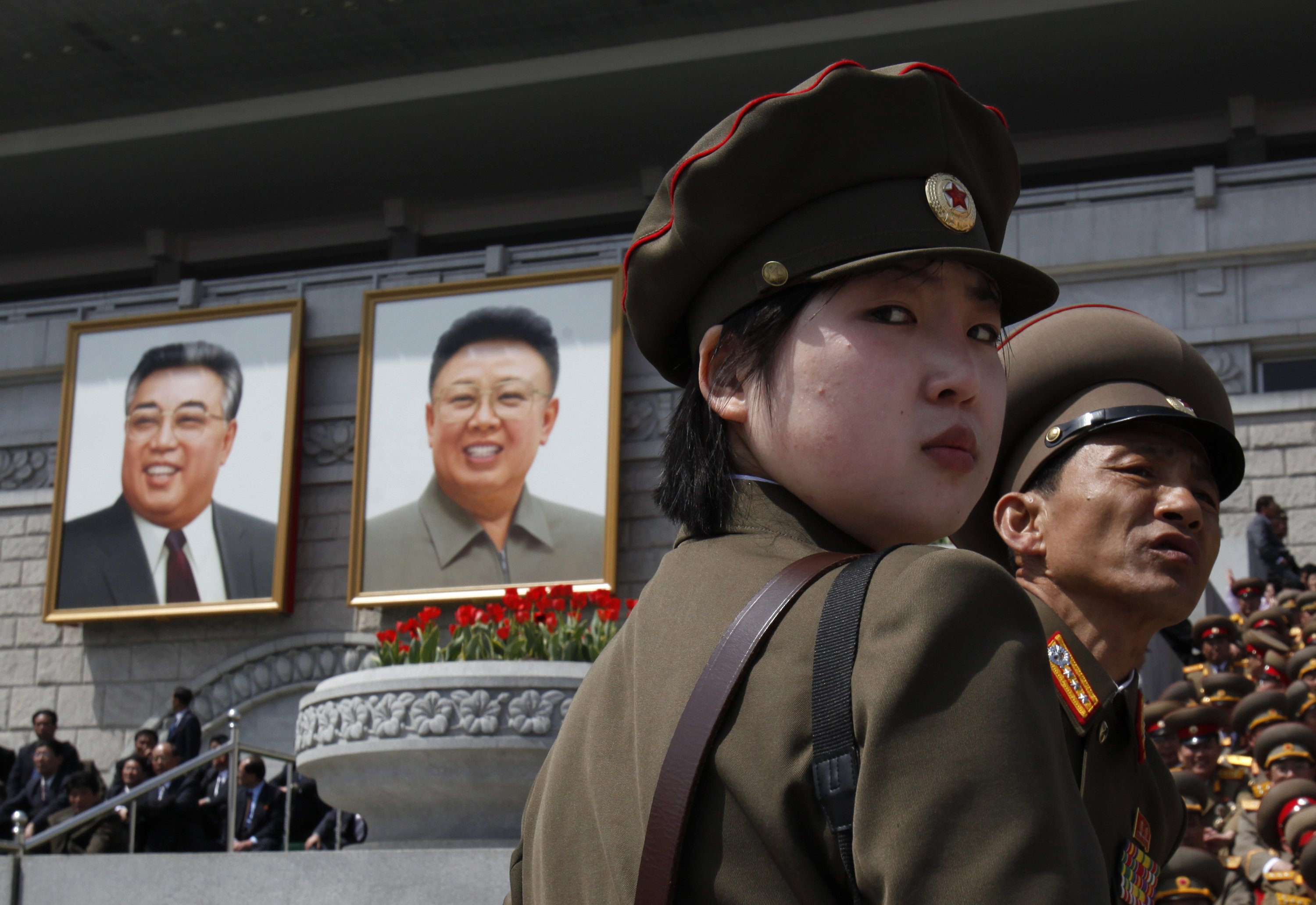 REUTERS/Bobby Yip
At a time when China is navigating its own domestic economic distortions (and the fraught political conditions they have wrought) as well as a contentious geopolitical scene in the South China Sea, a quiet North Korea is likely in its interest, even if that means shelling out for more dirty coal.
“There is no reason to think that political risks emanating from North Korea will lead China to withdraw its economic safety net for North Korea any time soon,” Council on Foreign Relations senior fellow Scott Snyder wrote in mid-2014.

 North Korea claims successful hydrogen bomb test, world very skeptical
 【Newsflash】 North Korea Launches “Long-Range Rocket” in Suspected Missile Technology Test
 What makes something “kawaii” to women from Japan, China, and South Korea? Survey investigates
 Studio Ghibli releases the My Neighbour Totoro tea caddy, with a magical self-closing lid
 A secluded British mansion in Chiba is a hidden holy land for afternoon tea lovers
 Starbucks Japan releases new My Fruit³ Frappuccino at only 34 stores around the country
 Fake police phone scam also highlights dumb stereotype about how foreigners speak Japanese[Video]
 Naomi Watanabe is moving to the U.S., switching base of operations to outside Japan
 Studio Ghibli now sells Ursula’s backpack from Kiki’s Delivery Service at its anime shop in Japan
 KFC offering all-you-can-eat fried chicken in Japan every Wednesday starting in mid-summer!
 Giant Clodsire Pokémon plushie comes with up to 32 Woopers in super size, super cute set【Pics】
 Pikachu-ear engagement rings and Pokémon wedding rings for him and her can now be yours【Photos】
 It’s illegal for yakuza to go to professional baseball games in Japan, Tokyo arrests remind us
 Japanese onsen egg maker from 100-yen store Daiso needs to be on your shopping list
 Cherry blossoms begin blooming in Japan with record-early starts for sakura season
 Tokyo government organizes food truck event to clear out delinquent/homeless teen gathering area
 The next time you’re feeling stressed out, you could relax on a Pokémon Psyduck chair from Japan
 Train station platform ramen store closes its doors on half a century of history in Tokyo
 Nine amazing off-the-beaten-path cherry blossom spots in Japan for yaezakura and shidarezakura
 Stunning central Japan wisteria festival is like a purple fantasy straight out of a Ghibli movie
 When will the cherry blossoms reach full bloom in Japan this year?[Forecast]
 Studio Ghibli adds new Mother’s Day gift sets to its anime collection in Japan
 Starbucks Japan unveils new sakura cherry blossom collection for hanami season 2026
 Studio Ghibli releases Catbus pullback keychain that runs like the anime character
 Nine great places to see spring flowers in Japan, as chosen by travelers (with almost no sakura)
 Starbucks Japan releases first-ever Hinamatsuri Girls’ Day Frappuccino
 Virtual idol Hatsune Miku redesigned with look that adds new elements and brings back old ones
 Survey asks foreign tourists what bothered them in Japan, more than half gave same answer
 Japan’s human washing machines will go on sale to general public, demos to be held in Tokyo
 Starbucks Japan releases new drinkware and goods for Valentine’s Day
 We deeply regret going into this tunnel on our walk in the mountains of Japan
 Studio Ghibli releases Kodama forest spirits from Princess Mononoke to light up your home
 Starbucks Japan releases new sakura goods and drinkware for cherry blossom season 2026
 Japan’s newest Shinkansen has no seats…or passengers [Video]
 Major Japanese hotel chain says reservations via overseas booking sites may not be valid
 Put sesame oil in your coffee? Japanese maker says it’s the best way to start your day【Taste test】
 No more using real katana for tourism activities, Japan’s National Police Agency says