I remember on my first day of computer programming class the first thing the teacher said was, “Computers are stupid.” It was a valuable fact that has served me well in my relationships with these ubiquitous machines.
For instance, if I show a four year old a can of Coke, they can quickly tell me what it is. Whereas for a computer, we have to print a series of lines and numbers on it just so the dumbass box can get up to speed.
It makes you wonder why we have to go through all the trouble of making up barcodes just so a machine can understand what you and I plainly see. It’s enough to make you think the barcode industry is some sort of insidious freemason plot. Recently, though, Toshiba has announced a scanner for supermarkets and other shops that will bring this evil syndicate of barcode charlatans to their knees.
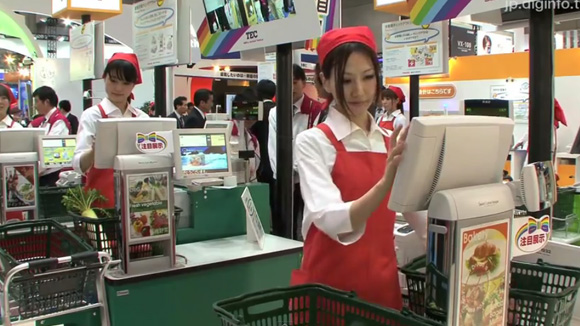
This next generation checkout scanner works in the same way as our current ones except there are no barcodes. This means cashiers would no longer type in by hand (or worse get on that little phone and ask someone about) produce items. Now they can simply be “seen” by the machine for what it is.
According to a demonstration video released by Toshiba, it appears to operate just as fast as barcode scanners. The cashier passes the item in front of a camera that can instantly understand what the item is. It does this perhaps better than a person.
In the video 3 test apples are set up for identification; a Fuji, a Jonagold, and a Mutsu. Whereas the average Joe wouldn’t be able to tell these apples apart even with a guidebook, the scanner could—and in record time. It could even tell the difference between the printing on a coupon and on a beer can both using similar fonts.
It works using state of the art pattern recognition technology. Traditionally computers couldn’t identify things well in a digital image, because they are too moronic to catch subtleties like lighting or juxtaposition efficiently. Toshiba has found a novel way of circumventing this problem by blacking out the background.
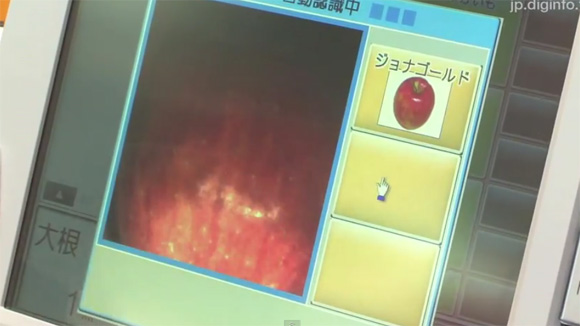
Since the background and cashier is always in the camera’s fixed field of vision it can learn to eliminate them from any images and only see “new” things in front of it. This way if your cashier has sausage fingers, you don’t accidentally get charged for a pack of Oscar Mayers.
So that’s how it sees the apples, but to be able to tell the difference between apples require some studying. And since computers aren’t exactly honor roll students, it took some serious cramming: It takes at least one year for a computer to understand how some produce looks in and out of season. On top of that it needs to understand the items at various angles, distances, and while moving.
This ongoing process needs to be done to achieve such a level of recognition beyond apples. Toshiba is hard at work cooperating with manufacturers and producers like farmers to teach this device not only the difference between an apple and an orange but between a block of cheddar and a block of Colby cheese, ideally at a speed of 50 km/h. This way when the machines are shipped to stores they will be ready to go with a database of products to work with.
It must be a painstakingly long process collecting data for every type of common supermarket product in every possible position and condition. However, judging by the release of this video, they are getting closer to a workable model and closer to a computer that might be deemed “smart.”
So it looks like I have some time before this rise of the machine comes and our new digital rulers smite me for calling them stupid (because computers will become more spiteful too) and tattoo barcodes on the back of our heads (also out of spite).
Source: DigInfo TV (English) via Jyohoya 3 (Japanese)