
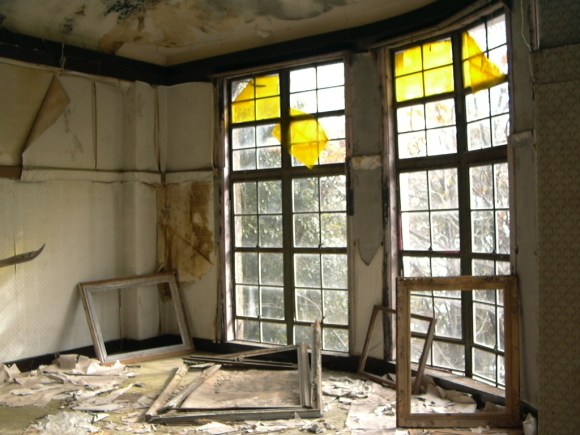
In Japan, places where people have died are considered bad luck, so unsurprisingly apartments where there has been a suicide, murder, or other death are rented at much cheaper prices than usual due to a lack of demand. However, real estate agencies are seeing a surge in people specifically seeking these kinds of ‘death rooms’. That may sound horribly morbid, but usually it’s not out of a desire to be close to death. Rather, for those who can put aside their culturally-ingrained reservations, it’s a way to save money during tough times.
- Incident buildings
Buildings where a death has occurred are called ‘jiko bukken‘ in Japanese or ‘incident buildings’, an ambiguous phrasing similar to the ‘jinshin jiko‘ or ‘human accident’ used when someone has jumped in front of a train.
People assume that there will be some damage to the room because of the corpse, but Chizuko, the owner of a real estate agency that deals exclusively with incident buildings, explained that ‘these days we have more advanced cleaning techniques, and after a while the smell and the stains will disappear.’ But it’s not just the nitty-gritty practical considerations that discourage Japanese people from living in such places – there is a cultural stigma which leads people to feel that the place is tainted and impure, and will invite unhappiness into the life of the next inhabitant. However, these days real estate agents are finding that people with less economic means are willing and even eager to live in these cheaper places.
- Tough times
A 40-year-old man, let’s call him Yamada, who used to work as a dispatch worker began living in his one-room apartment in June 2012. His apartment is located within Shinjuku ward in central Tokyo and is over 20 years old.
Yet for such a central area, his rent is astoundingly cheap at just 40,000 yen (US$391) per month, around half the local average. (Don’t even get me started on the average Tokyo rent!) The reason for this low rate is that the previous tenant was found dead in the room from illness. Yamada was aware of this when he moved in as in Japan there is a legal requirement to disclose any deaths that have occurred in the property within a certain time frame.
After graduating high school, Yamada worked part time at restaurants and call centers, and with various temping agencies, but after the collapse of the bubble economy his salary also nosedived from 4 million ($39,000) annually to around 2 million ($19,500). When searching for somewhere to live Yamada’s friend who worked as a real estate agent, and knew about his tough financial situation, suggested he specifically look for these ‘accident buildings’. His buddy told him that he had to move quickly if he found one of these buildings as they had become very popular, so he signed the contract right away. Yamada himself said ‘I’m not bothered by the previous tenant. I’m very satisfied with it as a place to live.” This is an attitude that is starting to become more prevalent, particularly among younger people.
- Gory details
It’s customary within the industry for incident buildings to be advertised for around half the average market rate for this area, and this precedent was set by the Urban Renaissance Agency (UR) which has around 750,000 rental properties around the country. Their incident properties are half the usual rent for the first one to two years, and as with UR’s other properties the rooms don’t require a deposit or a renewal fee. This is particularly appealing to those on housing benefits for whom the state subsidizes up to a certain amount of their rent. With the aging population there are unfortunately many cases of older people dying alone in their houses, so there are also an increasing number of these cheaper properties to meet their needs.
According to Mr. Morita, a lawyer specializing in real estate, there is a legal obligation to notify the renter or buyer 5 to 7 years after the accident (although there are now ways to find out if someone has died in your room even after the legal time frame is up). UR goes so far as to include the date the tenant died, the date the body was found, their age and gender, and what kind of incident it was. And yet even with all those gory details they still have enough demand so that ‘around half of rooms are filled within one month of advertising’. Incidentally, it can be vital to the fate of a property whether a person is declared dead at the scene, or in the ambulance or hospital. It’s only if they are pronounced to have died in the room that the owner is legally obliged to disclose the death.
- Social problems
A reason for why so many people who are hard up economically are so eager to move into these undesirable rooms is due to a lack of social housing for low income households. As of 2011 there were 2.2 million properties in the scheme, but this was barely any change from 2003. When asked about why so little new social housing had been created over the last eight years, the Ministry of Land, Infrastructure, Transport and Tourism responded that ‘many buildings that were erected during the high growth period are being replaced. Local governments are having financial difficulties, and they have not got around to building new buildings.’ There are also fears for the future regarding the effect of the Olympics, which could see older wooden apartments in central Tokyo being demolished, driving low earners out of the city and even further from the jobs.
—
In modern Japan, the certainty of cheap rent and a place to live today wins out against the chance of possible karmic repercussions in the future. So, dear readers, would you be comfortable with living in an ‘incident building’? Would the cheaper rent be enough to offset the knowledge that someone had died in that room, possibly right under where you’d put your bed? Do you believe that a room where someone has died will bring bad luck, or does it make no difference as long as all traces of death have been bleached away?
Source: Yahoo! Japan
Image: Wikimedia Commons
 Apartment for rent in Tokyo: bath, toilet, ghost, and kitchen space all included
 What to do if you want to lower your apartment rent or avoid paying key money in Japan
 Open-air toilets, showers for every room among offerings from crazy Tokyo apartment agency
 What would convince Japanese people to live in a home where there’d been a death or “accident?”
 House hunting? Here are some tips that might prevent headaches and frustrations
 Pokémon and Ikea Japan cross over into each other’s worlds with collaboration events
 Starbucks Japan closing only Shinkansen platform branch for popularity-triggered renovations
 Licca-chan dolls released in North America for first time in nearly 60 years
 Two food hacks take Japan’s convenience store fried chicken to amazing new sandwich heights
 Can a downtown Tokyo super sento bathhouse beat a hotel for a one-night stay?
 Free fried chicken for using free Wi-Fi?!? Tokyo restaurant offers irresistible karaage freebie
 Highly Suggestive Cow Milking Game Appears on Japanese Google Play Store
 Man buys and remodels trashed home, astounds us with before and after pictures
 Yanmar reveals state-of-the-art tractor – You may never look at farm equipment the same
 Pokémon lacquerware series expands for Year of the Horse with new handcrafted design[Video]
 Tokyo’s best museum for foreign travelers finally reopens after being closed for four years
 Famous Tokyo cherry blossom spot installs view-blocking screens to fight overcrowding[Video]
 Tokyo subway and almost all Tokyo train lines now accepting credit card tap payments
 Fading Tokyo – Searching for signs of the Showa era as local neighborhoods evolve[Photos]
 Totoro Fund line of beautiful artwork and apparel lets you help the real-world Totoro Forest
 Tokyo turns its phone booths into free Wi-Fi hotspots, and here’s how to use them
 Studio Ghibli adds new My Neighbour Totoro 2026 Corn Gift to its anime store for Mother’s Day
 Japan now has a special desk for people who work at home with a pet cat[Photos]
 Uniqlo announces new T-shirts for One Piece, Naruto and more for manga publisher’s 100th birthday
 Train station platform ramen store closes its doors on half a century of history in Tokyo
 Starbucks Japan releases new My Fruit³ Frappuccino at only 34 stores around the country
 Studio Ghibli releases Catbus pullback keychain that runs like the anime character
 Krispy Kreme releases Super Mario doughnuts in Japan for a limited time
 Japanese onsen egg maker from 100-yen store Daiso needs to be on your shopping list
 Nine great places to see spring flowers in Japan, as chosen by travelers (with almost no sakura)
 Survey asks foreign tourists what bothered them in Japan, more than half gave same answer
 Japan’s human washing machines will go on sale to general public, demos to be held in Tokyo
 Starbucks Japan releases new drinkware and goods for Valentine’s Day
 We deeply regret going into this tunnel on our walk in the mountains of Japan
 Studio Ghibli releases Kodama forest spirits from Princess Mononoke to light up your home
 Starbucks Japan releases new sakura goods and drinkware for cherry blossom season 2026
 Japan’s newest Shinkansen has no seats…or passengers [Video]
 Major Japanese hotel chain says reservations via overseas booking sites may not be valid
 Put sesame oil in your coffee? Japanese maker says it’s the best way to start your day【Taste test】
 No more using real katana for tourism activities, Japan’s National Police Agency says
 Website Lets You Check if Anyone Was Murdered or Committed Suicide in Your Home
 Before and After: Renovating a rundown rental property in Japan
 Burger King opens a rental site to help fast food lovers find an apartment in Japan
 Ikea Japan offering fully furnished apartment to rent for less than a dollar a month
 Japan has a cat real estate agency, where every apartment lets you and your kitty live together!
 10 things Japan gets horribly wrong