
When you think of the multinational electronics producer Panasonic, “sand” probably doesn’t immediately come to mind. However, if a new product they are looking to release meets its full potential, this new kind of sand may completely change the face of the Earth as we know it.
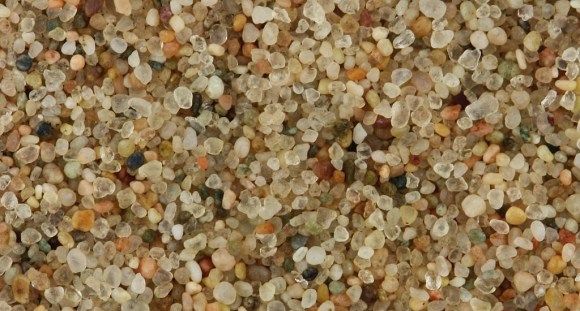
The picture above is not Panasonic sand, but you wouldn’t be able to tell just by looking at it anyways. Actually even if you examine their grains of soil under a microscope you wouldn’t see a difference. So let’s start by looking at what makes this dirt so special and how it could help everyone in one way or another.
■ What is it?
Just so everyone’s on the same page, “sand” is simply soil defined by grain-sizes between 0.0625mm and 2mm. The actual material is largely irrelevant to be classified as sand. Panasonic sand is no different in this regard. What sets it apart, however, is that each grain has a special film around it to a thickness on the order of nanometers.
This substance effectively makes volumes of the sand waterproof by using the water’s surface tension to hold it together in a large mass rather than have it break down and seep through like it does with regular sand. Because this surface tension is unique to water, other substances like oxygen can still pass through freely. That might not sound like a lot, but the potential is huge.
■ What can it do?
In a test farm done by Panasonic with the help of the Kyoto University Graduate School of Agricultural Science they were able to increase the yield of a tomato crop by 40 percent. They did this by first creating a layer of waterproof sand between the ground water and topsoil. As water is added to the field it seeps down into the ground but is caught by the Panasonic sand before going too deep.
Since the waterproof sand layer was created on an incline, the water could be easily funneled into a reservoir to be used again on the same field. This process had an added benefit of recycling fertilizer rather than applying more thus cutting costs.
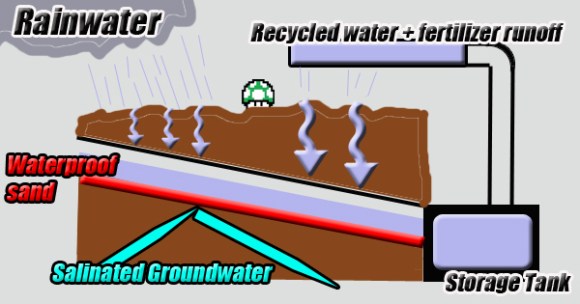
While this is great in a small field in Japan, the effects could really become something special in the ever-growing arid regions of the world. With little rainfall, it’s hard to grow anything of use, and in many places the groundwater is so high in salt that it acts like a sponge pulling away any water added from the surface before it can be used.
Panasonic sand not only blocks the fresh water from getting absorbed into the salt water but it can prevent the salt water from contaminating the fresh water allowing it to be reused for long periods of time. As a result the widespread usage of this sand could conceivably reverse the desertification of the world.
■ What’s the catch?
We don’t know, honestly. According to Panasonic this sand can be produced without any specialized equipment and cheaply. They say if produced locally, an area can get it for only a few thousand yen (a few dozen US dollars) per ton.
In addition, further applications have only just begun to come up. For example, senior researcher Norihisa Mino speculates it could be used to hold quantities of water under paved roads keeping them cool during the summer months and helping to curb urban heat islands.
The porous nature of Panasonic sand allows it to have less impact on the environment than other materials like concrete but also gives it potential in filtration systems. For example a desalinization plant could use it to process fresh water during times of shortage.
■ Why Panasonic?
An equally impressive thing about Panasonic sand is the example it sets for thinking outside the box. After all, from a company more known for its appliances and a head researcher who specializes in semiconductor manufacturing techniques, you’d hardly expect an agricultural game-changer.
The main ingredient of Panasonic sand was actually developed way back in 1994. Back then it was used as a protective film on the inside of rice cookers to prevent staining. Its success led to use on other products like microwave and toaster oven doors, but not much else from there. Still, Mino continued searching for something else that this stuff could be used on.
Years of looking came to a head when Mino consulted with Kyoto University and discovered its potential for agricultural use. The substance’s ability to both hold water and prevent salt damage piqued the interest of those in agronomy and work was underway.
We would say that the rest is history but really it’s the future. There is still testing to be done but if everything checks out we may see the once famous electronics company change to a completely different field after Panasonic celebrates its 100th anniversary in 2018.
Source: Sankei Biz (Japanese)
Top Image: Wikipedia – Siim Sepp
 Panasonic Developing 24-Fingered Hair-Washing Robot
 Panasonic says to stop wearing socks while you sleep
 Japan’s ‘agri-tech’ farming revolution
 We try a skincare device that’s supposed to improve the effectiveness of our beauty products
 Kyoto professor makes petroleum easily using only water and carbon dioxide…we think
 New Japanese vending machine at Shinkansen station sells cups of ice on platform
 Japan’s new beer glass is designed to force you to drink…water [Video]
 This beautiful rural Japan river is a great alternative to touristy summer retreats [Photos]
 Japanese convenience store food gets turned into hyper-realistic stationery you can peel open
 Kumamoto earthquake may have created Japan’s newest hot spring inside flooded restaurant [Video]
 Studio Ghibli releases new Kiki’s Delivery Service Jiji music box for anime fans
 Beautiful Totoro bonsai figure needs no watering, makes soothing rain showers whenever you want
 End of a manga era as Weekly Shonen Jump’s circulation drops under one million
 Are Japan’s room-temperature curry packets the boxed lunch heroes we’ve been looking for? [Taste test]
 Tokyo is getting a branch of famous Los Angeles hot dog chain Pink’s with Japan-exclusive items
 Pokémon Center Online designates first Pokémon items that will require Japanese ID card to buy
 Japanese toilet aims to attract foreign tourists but not everybody is happy about it
 Anime fan in Japan arrested for ordering and cancelling over 4.3 billion yen in anime merch
 Starbucks Japan teams up with Traveler’s Company for new stationery and goods collection
 Japanese vending machine sells freshly squeezed lemon juice with a futuristic light show
 Kochia calling: Right now is a great off-season season to visit this beautiful Japanese park
 Tokyo subway installing new ticket gates that don’t accept payment through Suica or other IC cards
 Japan now has human refrigerators inspired by Japanese vending machines
 Hatsune Miku collaborates with Hokusai’s art in new Vocaloid ukiyo-e illustration series [Pics]
 New Shinkansen luggage drop-off system begins in Japan, making train travel even easier
 Studio Ghibli releases anime T-shirts that pay homage to one of Hayao Miyazaki’s most personal films
 Air-conditioned dress shirts arrive in Japan to save working professionals from sweltering heat
 Japanese Shinkansen becomes an overnight hotel for three nights this summer
 Cup Noodle unveils first-ever cold-water instant ramen in Japan
 99-year-old woman rescued while attempting to climb Mt. Fuji
 Japan announces sudden 400-percent increase in visa fees for foreigners entering the country
 Japan’s human washing machines will go on sale to general public, demos to be held in Tokyo
 Studio Ghibli has a new anime out, and there’s only one place in the world where you can see it
 Starbucks Japan releases new drinkware and goods for Valentine’s Day
 Starbucks Japan releases new sakura goods and drinkware for cherry blossom season 2026
 Japan’s newest Shinkansen has no seats…or passengers [Video]
 Japanese ninja certification exam attracts 131 candidates from Japan and abroad
 Salomon releases Japan-exclusive Mt. Fuji hiking gear that doubles as an amazing souvenir
 Put sesame oil in your coffee? Japanese maker says it’s the best way to start your day【Taste test】
 Efficient electricity made from water flowing from rivers to oceans found by Yamanashi University
 Nagoya University develops rice plant that grows pure sugar
 Anti-insect laser gun turrets designed by Osaka University, expected to work on roaches too
 Real Fullmetal Alchemists: Kyoto University team fuses all 8 precious metals into single alloy
 Better than mosquito repellent – The most eco-friendly (and spiritual) way to repel pests in Japan
 Celebrating washoku and rice — an evening with master chefs and sushi roll creators (Part 1)