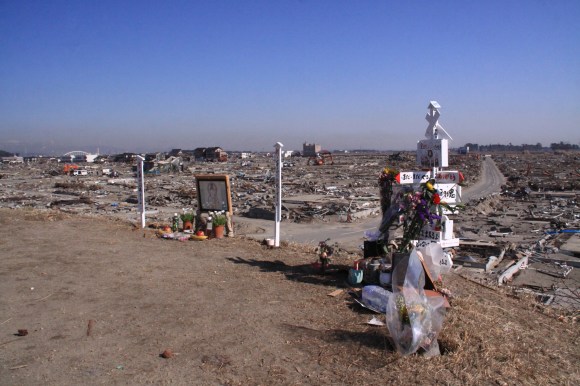
What happens after we die? Is it possible to communicate with loved ones after they are gone? And if not, how can we explain the stories of those who claim to have done so? These questions are pertinent to the work of journalist Shuji Okuno, who researches the yūrei banashi, or ghost stories, of relatives bereaved by the 2011 Tohoku earthquake and tsunami.
Over 18,000 people were killed in the disaster in March 2011, most by drowning; including 2,601 bodies that were never recovered. Okuno has been researching and recording the stories of Tohoku people bereaved by the disaster who say they were visited by the spirits of their deceased family members, often at the exact moment of their passing.
But reporting on ghost sightings in a disaster zone is controversial work. In an interview with Tohoku-area newspaper Kahoku Shimpo this week, Okuno spoke about the stories he has uncovered and the criticism he continues to face.
The journalist and non-fiction writer told the Kahoku Shimpo that he began to research these kind of ghost stories after hearing the accounts of doctors in Natori, a city in Miyagi Prefecture affected by the disaster:
“I heard that there were many people in the disaster zone who had seen spirits. Some doctors said 20 percent of their patients saw them [the spirits or ghosts of dead relatives]. I felt that this was a special phenomenon.”
Asked what kind of stories he has heard, Okuno tells the story of a woman who had lost her much-loved husband in the tsunami. Suffering from severe depression after his death, she had become suicidal, until one day, she saw a vision of her husband, and began to believe that he was watching over her. She became filled with new determination, he says, and decided to live.
There were many other stories like this, according to Okuno: people who gained the strength to live after seeing their loved one’s ghost.
In recording these stories, for which there can be no concrete evidence, Okuno has been condemned as “unscientific”; and he is not the only outlet to be criticised for giving airtime to supernatural stories about the Tohoku disaster. In 2013, NHK broadcast the TV special Nakihito to no “saikai” – hisaichi sandome no natsu ni (‘”Reunions” with the deceased – the [Tohoku] disaster area three summers on’), which told the stories of bereaved family members who say they saw their relatives’ spirits.
These included one woman who felt the presence of her son, killed in the disaster at three years old, playing next to her; she said one of his musical toys started to move on its own. The show also featured an interview with a man who had lost two sons, who saw them both appear before him, and said he heard his older son speak to him. National broadcaster NHK was criticised for the broadcast, which was condemned as an “occult show,” although others applauded the programme, saying it was sensitively made.
For Okuno, the question of whether we believe in ghosts or not is beside the point:
“[It’s not about] whether ghosts are real or not. I tried to accept people’s accounts for what they were, and to tell the stories of those who died, and those left behind.”
He argues that when we encounter things that we can’t explain scientifically, we tend to condemn them “as delusion or fantasy, or we treat them as [mental] health problems.”
Even if these visions are essentially tricks of the mind, Okuno says he has yet to encounter a single negative story, and that his research suggests a “reunion” with a lost loved one is overwhelmingly a positive experience. He stresses the importance of maintaining an open mind: “As long as these ghostly experiences aren’t having any negative effects, I think it’s fine. I want to create an environment where people can talk freely about it.”
Sources: Kahoku Shimpo, Naver Matome, Reisei shinka no michi, NHK, Live Science
Featured image: Wikipedia/ChiefHira