Yamagata dialect can be very different from the Japanese you learned in school, but this illustrated guide will have people telling you “Jondagodo!” in no time.
Today’s the big day! You’ve finally made it to Japan and starting your new life in Yamagata Prefecture. After months, or maybe years, of studying Japanese, you show up for work, excited to put your language skills to use.
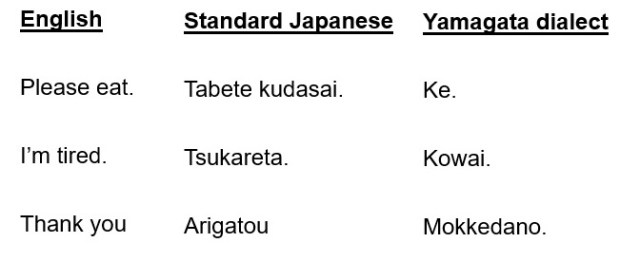
However, while self-study and classroom instruction are great ways to build up a foundation of knowledge in a foreign language, they can’t prepare you for every possible scenario and vocabulary word. At one point during the day, someone comes up to you holding a box of sweet dumplings and saying “Ke,” which, as far as you know, is the word for “hair.” Did they find a hair in the box? Do they think it’s one of yours? Then, at the end of the day, someone lets out a long sigh and mutters “Kowai,” which most people studying Japanese learn means “Scary.” Did you commit some cultural blunder that made you seem intimidating and belligerent? As you clock out of your shift, you try to apologize, even though you’re not sure what you did, and the other person responds with “Mokkedano.” That’s one you’ve never heard before, and it’s not in your dictionary either…so did you just get fired?
Relax. That ke? The person was offering you something to eat. Kowai, in this case, actually just meant “I’m tired,” And mokkedano? That’s just “thank you.” But while those phrases are easily understood among Yamagata natives, they’ll quickly confuse native Japanese speakers from other parts of the country, let alone a new arrival from overseas.
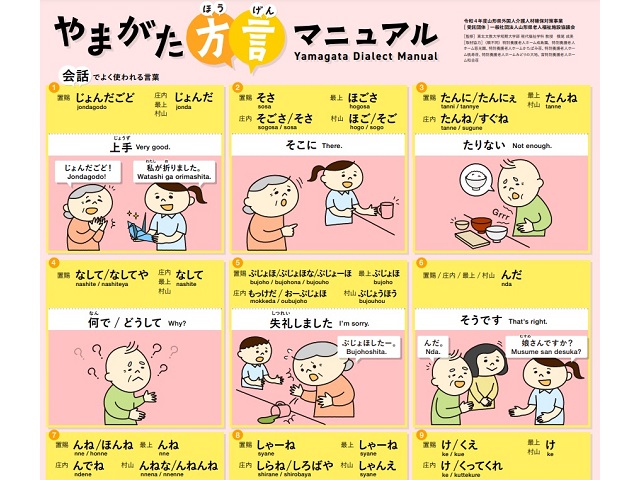
Thankfully, the Yamagata Prefectural government realizes that the local dialect can be tricky for newcomers to understand, so they’ve created an official Yamagata Dialect Manual, posted to the government’s website, to clear up some of the biggest potential confusions.
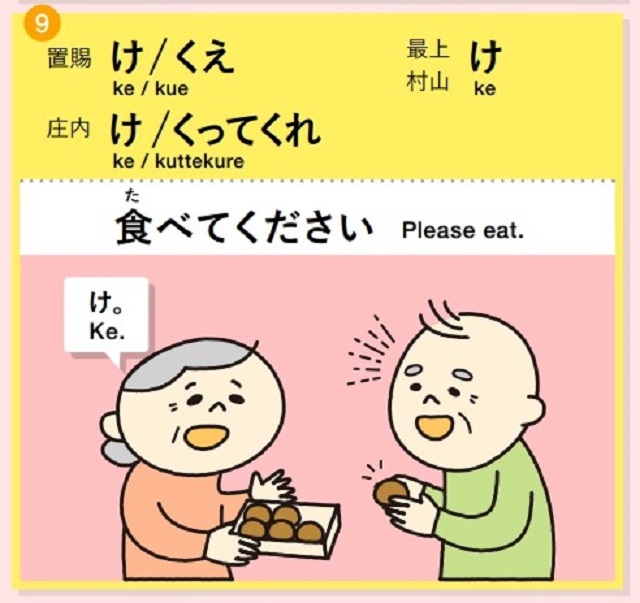
You’ll notice a lot of senior citizens in the guide’s illustrations. That’s because the guide’s creation was prompted by talks with some of the 124 foreign-born workers at nursing homes in Yamagata, who said that one of the biggest challenges they faced was understanding patients and residents when they were speaking in the local dialect.
Even among native Japanese speakers, the way of speaking in the country’s northeastern Tohoku region, of which Yamagata is a part, is considered especially difficult to understand. The especially mountainous topography kept Tohoku communities comparatively isolated while more southern parts of Japan became more rapidly connected by modern transportation infrastructure. Tohoku’s bitterly cold winters are thought to have influenced language too, by subconsciously conditioning people living in the region to shorten words and blend syllables so as to cut down how much they have to move their chilled mouth muscles when talking.
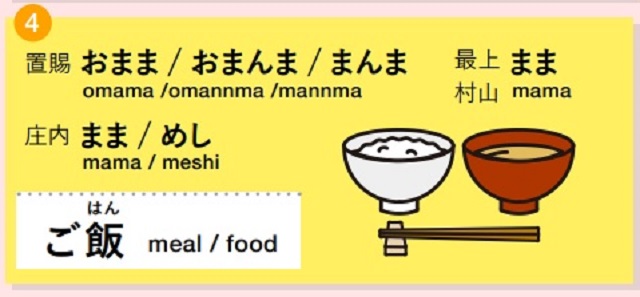
▼ Usually mama means “current condition” or is the English mama (i.e. mother) being used as a loanword, but in Yamagata it can also mean “meal” or “food,” (gohan in standard Japanese).
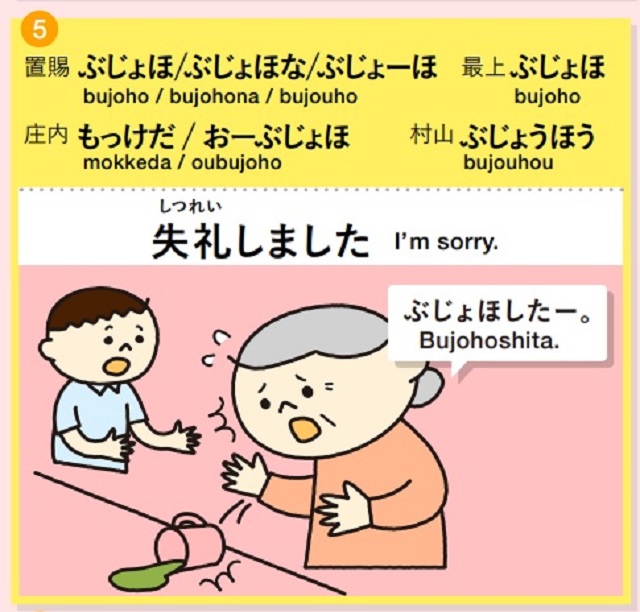
Even within Yamagata, different parts of the prefecture sometimes speak differently, so the guide features notations for whether a phrase is primarily associated with the Okitama (置賜), Mogami (最上), Shonai (庄内), or Murayama (村山) districts.
▼ Just spilled a cup of green tea in Mogami? A quick “Bujoho,” will help smooth things over, but that same spill in Shonai would more likely warrant a “Mokkeda.”
Between the extension of rapid rail lines into Tohoku and the increase in nationwide media outlets, younger Yamagata generations’ Japanese is getting closer to standard Japanese, and a thick Yamagata dialect is something you’re more likely to encounter when speaking with elderly people, which is another reason why the topic came up when speaking with nursing care workers.
▼ Yamagata granny is likely to worry about the neighborhood oboko going outside to play without taking an uwappari with them.
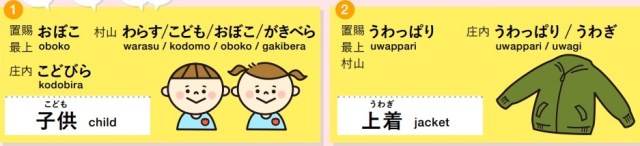
The full guide can be found online, for free, here, and its designers say “We hope this will be a way of showing that Yamagata thinks kindly of people from other countries.” It’s worth noting that as unique as the dialect is, people in Yamagata still understand standard Japanese, so you won’t run into any problems using textbook vocabulary when you’re speaking. The alternate versions are things you’re likely to hear, though, so knowing what they mean will make foreign residents’ and visitors’ time in the prefecture easier and more enjoyable. Plus few things make Japanese people happier than a foreigner showing an interest in the community culture by trying out the local dialect themselves, so give it a try and you might just get a smile and a “Jondagodo!” (“Very good!”) for your efforts.
Source: Yamagata Prefectural Government via Kahoku Shimpo via Yahoo! Japan News
Top image: Yamagata Prefectural Government
Insert images: SoraNews24, Yamagata Prefectural Government
● Want to hear about SoraNews24’s latest articles as soon as they’re published? Follow us on Facebook and Twitter!
Follow Casey on Twitter, where Southern Calfornia dialect compels him to say “dude” as often as possible.