
It was Saturday, October 3 when a hearing-impaired woman and her service dog, a hearing dog for the deaf, attended an event promoting the awareness of service dogs at the Hankyu department store at Hankyu-Umeda Station in Osaka. After the event, the unnamed woman, her dog, and a friend went for a bite to eat at one of the restaurants located inside the same department store on the same floor as the event. Ironically enough, and much to the surprise of the woman, a member of staff stopped her from entering the restaurant, stating that animals were not allowed inside.
The woman’s friend pulled out a guidebook about hearing dogs for the deaf, trying to explain that the dog wasn’t a pet but an animal trained to assist its owner. The staff still refused, however, and the pair finally gave up and went elsewhere, thinking that it must have just been an unfortunate misunderstanding. Perhaps this was just one uninformed staff member who didn’t realize service animals are actually allowed in public places, they thought.
But even at the next restaurant they were turned away yet again…
Just like in numerous other countries, Japan has laws which state that individuals with guide, hearing, or mobility dogs may not be denied access to any facility open to the general public such as hotels, public transportation, and yes, even restaurants. The Access Law for Service Dogs was passed in Japan in 2002, just over a decade after the United States’ Americans with Disabilities Act of 1990, which included laws protecting access rights for people with assistance dogs.
▼ Hearing dogs are trained to alert their owners to a number of sounds, including doorbells, alarm clocks, ringing phones, crying children, and more.
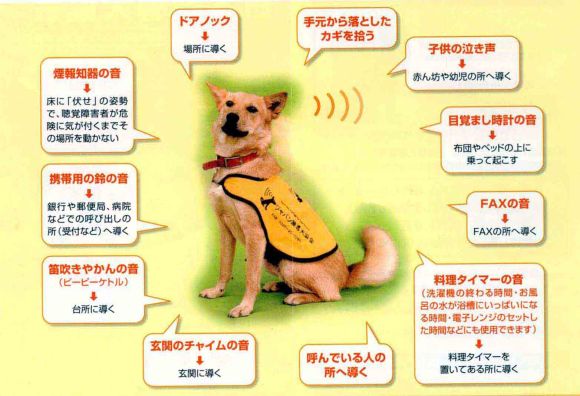 Image: Japan Hearing Dogs for Deaf People
Still, more than 10 years after the legislation was passed, there are many who are still unaware of the law’s existence (or who possibly deny access to service dogs in spite of the law).
The woman with her hearing dog and friend were finally allowed into the third restaurant they tried. This wasn’t the first occasion she had been turned away from a public establishment because of her service dog, yet it was particularly crushing for her as the service dog awareness event had just been held in the same department store and on the very same floor where the restaurants were located. It seems that maybe a couple of people who didn’t attend the event should have.
Unfortunately, this kind of thing is far more common than it should be. According to an article by ZENOAQ:
“The Japan Guide Dog Association conducted a survey in 2004 asking random members of the public about legal access rights for service dog users.
Of approximately 500 people who replied, nearly half were unaware of the law passed to protect these rights. Under the current access law, public buildings, public transportation, and facilities open to the general public, such as stores and hotels, may not deny access to people with guide dogs, hearing dogs, and mobility dogs.
Recently, 100 guide dog users were interviewed to assess the current situation. 52 stated that they had experienced denial of access at some time even after the passing of the aforementioned law. Of those facilities that refused entry, restaurants ranked the highest at 32, followed by taxis, hotels (mainly Japanese-style inns), and privately owned hospitals…”
Yes, the survey was conducted only two years after the law had passed, but the fact that it is still happening more than 10 years later is rather disconcerting.
In addition to apologizing directly to the woman concerned, on October 7, the Hankyu Department Store posted an official apology on their homepage, promising to retrain their staff and take other necessary measures to ensure the same thing does not happen again.
The woman says even though she was hurt by the experience, she will continue to spread the word in order to ensure others with service dogs will not have to go through the same thing.
In addition, I personally feel that companies should be required to properly train their employees and inform them of the laws, and the government should be more proactive in establishing ways for people to file claims when they are discriminated against, and take appropriate action against the offending party to ensure that its disabled citizens are given the same treatment and accessibility as every other citizen.
Now, tell us what you think. What other ways can Japan raise awareness to ensure situations like this don’t continue to happen?
Source: grape
Top image: AWDSA homepage, Hokkaido Prefecture homepage (edited by RocketNews24)
 Dogs now allowed on Catbus! Ghibli Park vehicles revise service animal policy
 Japan’s vaunted taxi service to be offered to dogs and cats with new Pet Taxis
 Stunning central Japan wisteria festival is like a purple fantasy straight out of a Ghibli movie
 10 awesome Tokyo cherry blossom festivals and experiences for this year’s sakura season
 Nine amazing off-the-beaten-path cherry blossom spots in Japan for yaezakura and shidarezakura
 Godiva now makes tofu in Japan, and sakura chocolate tofu too![Taste test]
 Umamusume food and drinks dash into real world at Family Mart convenience stores[Taste test]
 Universal Studios’ Sailor Moon theme park attraction is finally coming to America
 Sega’s Like a Dragon yakuza teaches “useless” English, let’s use it to learn some useful Japanese
 The Place Where Totoro Was Born: New Studio Ghibli book includes art by Hayao Miyazaki’s wife
 Studio Ghibli unveils new Rollbahn notebook in honour of Howl’s Moving Castle
 “Denki Anma”: The Japanese traditional torment that you’ll be glad stays in Japan
 Train station platform ramen store closes its doors on half a century of history in Tokyo
 Japanese onsen egg maker from 100-yen store Daiso needs to be on your shopping list
 Starbucks Japan releases new My Fruit³ Frappuccino at only 34 stores around the country
 Cherry blossoms begin blooming in Japan with record-early starts for sakura season
 Studio Ghibli adds new Mother’s Day gift sets to its anime collection in Japan
 Tokyo government organizes food truck event to clear out delinquent/homeless teen gathering area
 The next time you’re feeling stressed out, you could relax on a Pokémon Psyduck chair from Japan
 When will the cherry blossoms reach full bloom in Japan this year?[Forecast]
 7-Eleven Japan’s giant fried chicken skewer would be too big to eat, so it’s really for cuddling
 Starbucks Japan unveils new sakura cherry blossom collection for hanami season 2026
 Studio Ghibli releases Catbus pullback keychain that runs like the anime character
 Nine great places to see spring flowers in Japan, as chosen by travelers (with almost no sakura)
 Starbucks Japan releases first-ever Hinamatsuri Girls’ Day Frappuccino
 Japan’s cherry blossom season predicted to start earlier than we’d thought, especially in Tokyo
 Survey asks foreign tourists what bothered them in Japan, more than half gave same answer
 Japan’s human washing machines will go on sale to general public, demos to be held in Tokyo
 Starbucks Japan releases new drinkware and goods for Valentine’s Day
 We deeply regret going into this tunnel on our walk in the mountains of Japan
 Studio Ghibli releases Kodama forest spirits from Princess Mononoke to light up your home
 Starbucks Japan releases new sakura goods and drinkware for cherry blossom season 2026
 Japan’s newest Shinkansen has no seats…or passengers [Video]
 Major Japanese hotel chain says reservations via overseas booking sites may not be valid
 Put sesame oil in your coffee? Japanese maker says it’s the best way to start your day【Taste test】
 No more using real katana for tourism activities, Japan’s National Police Agency says