
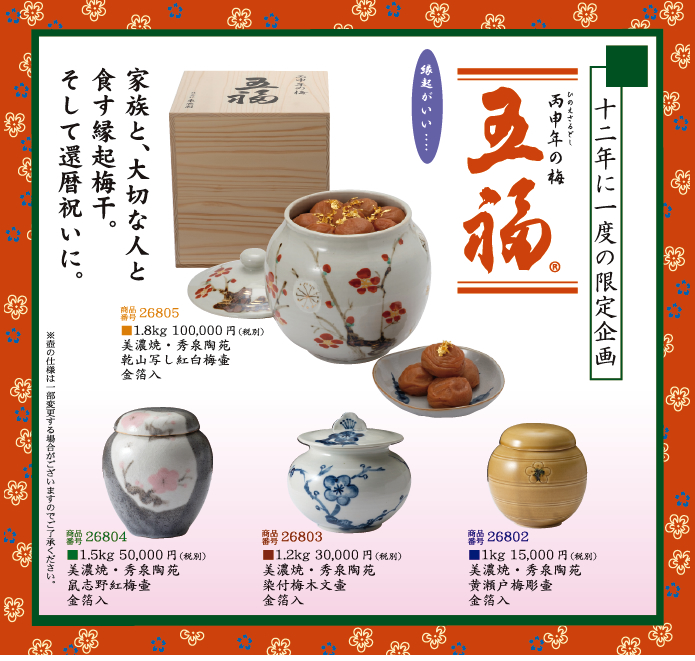
The pickled umeboshi plum is a common food in Japan, but can you guess what makes these plums special enough to warrant a US$850 price tag?
If you’ve ever had Japanese umeboshi, you’re not likely to forget how sour they are—just thinking about them is enough to make you salivate! The pickled fruit can be found at any supermarket in Japan and is commonly eaten with rice as a side dish or used as a rice-ball filling.
But as we’ve already hinted, the umeboshi we’re talking about here are no ordinary pickled plums. These are particularly “lucky” umeboshi that will be harvested and pickled in 2016, which happens to be the year of the monkey!
Before we go further, though, here’s a little more information on what exactly umeboshi is, for those of you unfamiliar with the food. Umeboshi, which literally means dried ume, is made from the fruit of the ume tree (Prunus mume), and while usually called a plum in English, the tree is actually more closely related to the apricot than the plum. Traditionally, the ripe ume fruit is picked in late May or early June each year, after which they’re packed in a barrel in layers of salt, and then weighed down with stones for one to two months while the juices are squeezed out of the fruit. The ume is then dried out in the sun for a few days, typically around July 20, when the weather is usually good and plenty of sun can be expected. Once the drying is complete, the ume is usually left to “mature” for periods ranging from a few months up to a few years, in order to let the flavor settle in. That’s a lot of time and effort for pickled plums!
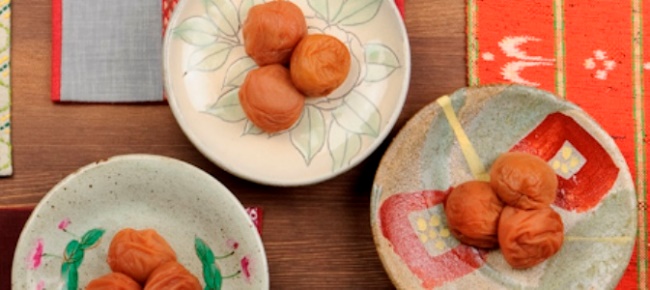
▼ The process results in very sour-tasting, salty plums with a soft texture that goes surprisingly well with white rice:
But enough about plain regular umeboshi. The special umeboshi that we’re introducing here, called the “Plum from the year of the Fire Monkey — Five Luck (Hinoe Saru-doshi no Ume Gofuku)” is the masterful creation of Azuma Noen, a ume farm and producer of various ume products with a history of over 180 years, based in Wakayama Prefecture, which is located in the central main island and is also an area famous for quality umeboshi. In fact, umeboshi from present-day Wakayama used to be presented annually as a gift from the feudal lords of the area to the Tokugawa Shogunate, which ruled Japan during the Edo period (1603-1868).
Not only does the Five Luck umeboshi come from such an area, the fact that this year’s umeboshi will be made from ume harvested in the year of the monkey apparently makes them extra lucky, hence the 100,000 yen ($850) price tag for 1.8 kilograms (4 pounds) of pickled plum! According to ancient Japanese history/folklore, Emperor Murakami, who reigned as the 62nd Emperor in the 10th century, was cured of an illness when he drank tea mixed with umeboshi made in the year of the monkey, and since then it has become a custom to have umeoboshi mixed in tea, calling it Fukucha (lucky tea), at times of important celebrations including the New Year.
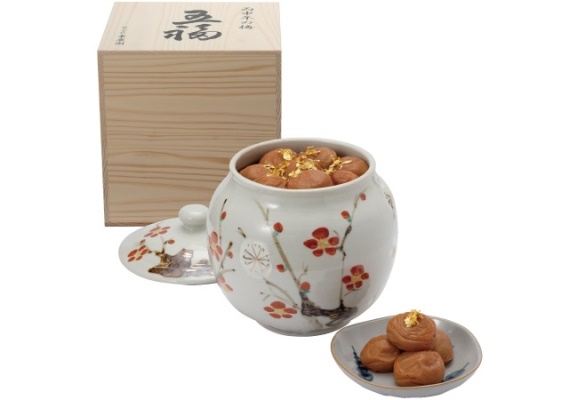
▼ The special umeboshi comes in a beautiful Mino ware ceramic pot decorated with ume flower patterns. And yes, that’s real gold leaf you see sprinkled on top!
The year of the monkey comes only every 12 years, so that’s how long you’re going to have to wait for this lucky product to become available again. And in case you were wondering, yes, 2016 is the year of the monkey, but in the Chinese sexagenary cycle, where each specific year is assigned a combination of one of the 10 heavenly stems (representing the five elements) and one of the 12 earthly branches (the animal years) in a rotation that comes around every 60 years, 2016 is also the year of the Fire Monkey, which is why “Fire” is included in the name of the umeboshi. The last part of the product name, “Five Luck”, refers to the five types of good luck mentioned in the ancient Chinese books Shu Jing and Hong Fan, namely: longevity, wealth, health and peace, good morals, and good death. Yup, they’ve certainly put a lot of thought into making these plums sound lucky.
You’ll need to be based in Japan, but if you’re interested in getting your hands on some of these special umeboshi from Azuma Noen, they’re now taking pre-orders on their online shop, Godaian. The actual umeboshi are expected to become available for shipping in November this year.
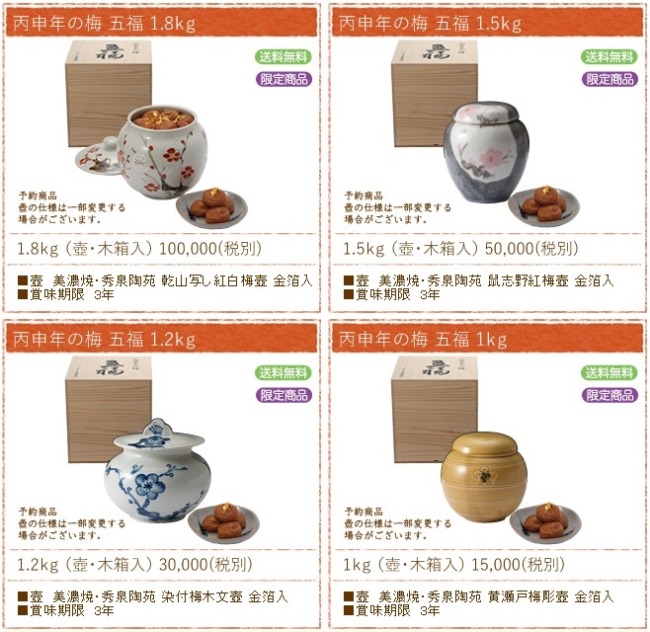
▼ In addition to the 1.8 kilogram package (shown on the upper left), the Five Luck umeboshi is also available in smaller amounts: 1.5 kilograms (3.3 pounds) for 50,000 yen ($425), 1.2 kilograms (2.6 pounds) for 30,000 yen ($255) and 1 kilogram (2.2 pounds) for 15,000 yen ($127).
May the lucky plums bring you lots of good fortune in 2016!
Source: Azuma Noen website, Azuma Noen online shop (Godaian) and @Press press release via Entabe
Photos: Azuma Noen online shop (Godaian)
 How to make pickled plums like the Japanese grandparents you may or may not have【Part 1】
 Pizza Hut Japan’s pickled plum pizza is mercilessly aware of what it is【Taste test】
 How to make epic umeboshi like a Japanese grandpa
 Studio Ghibli releases the My Neighbour Totoro tea caddy, with a magical self-closing lid
 Create a tiny Ghibli anime world on your bookshelf with new miniature papercraft art kits
 A secluded British mansion in Chiba is a hidden holy land for afternoon tea lovers
 Japan now has a “for foreign tourists only” Mt. Fuji sightseeing train[Video]
 Fake police phone scam also highlights dumb stereotype about how foreigners speak Japanese[Video]
 Starbucks Japan releases new My Fruit³ Frappuccino at only 34 stores around the country
 Nine amazing off-the-beaten-path cherry blossom spots in Japan for yaezakura and shidarezakura
 Stunning central Japan wisteria festival is like a purple fantasy straight out of a Ghibli movie
 Nephew receives SD card after his uncle passes away, finds treasure trove of gems from the past
 Peach Coca-Cola coming to Japan in a world-first for the company
 Japanese onsen egg maker from 100-yen store Daiso needs to be on your shopping list
 Cherry blossoms begin blooming in Japan with record-early starts for sakura season
 Tokyo government organizes food truck event to clear out delinquent/homeless teen gathering area
 The next time you’re feeling stressed out, you could relax on a Pokémon Psyduck chair from Japan
 Train station platform ramen store closes its doors on half a century of history in Tokyo
 When will the cherry blossoms reach full bloom in Japan this year?[Forecast]
 Studio Ghibli adds new Mother’s Day gift sets to its anime collection in Japan
 Starbucks Japan unveils new sakura cherry blossom collection for hanami season 2026
 Studio Ghibli releases Catbus pullback keychain that runs like the anime character
 Nine great places to see spring flowers in Japan, as chosen by travelers (with almost no sakura)
 Starbucks Japan releases first-ever Hinamatsuri Girls’ Day Frappuccino
 Virtual idol Hatsune Miku redesigned with look that adds new elements and brings back old ones
 Survey asks foreign tourists what bothered them in Japan, more than half gave same answer
 Japan’s human washing machines will go on sale to general public, demos to be held in Tokyo
 Starbucks Japan releases new drinkware and goods for Valentine’s Day
 We deeply regret going into this tunnel on our walk in the mountains of Japan
 Studio Ghibli releases Kodama forest spirits from Princess Mononoke to light up your home
 Starbucks Japan releases new sakura goods and drinkware for cherry blossom season 2026
 Japan’s newest Shinkansen has no seats…or passengers [Video]
 Major Japanese hotel chain says reservations via overseas booking sites may not be valid
 Put sesame oil in your coffee? Japanese maker says it’s the best way to start your day【Taste test】
 No more using real katana for tourism activities, Japan’s National Police Agency says