

Free online translation programs have come a long way, but they’re still far from perfect.
Online translation programs can be pretty handy tools. But while they can be useful when looking for how to say a specific vocabulary word in a foreign language, they’re often not so good at handling full sentences, and even short idioms can throw a serious wrench into their operation.
Recently, we were playing around with Google Translate and decided to see how it would handle converting a selection of Japanese idioms into English. These are all commonly used Japanesephrases, but even with slow-pitch requests, it was sometime a swing and a very big miss for Google Translate, and gave us some baffling, hilarious results.
1. Good on the floor…?
▼ Master-level

Let’s start with toko jouzu (床上手). Toko literally means “floor,” and jouzu means “skilled” or “talented,” so Google Translate gave us:
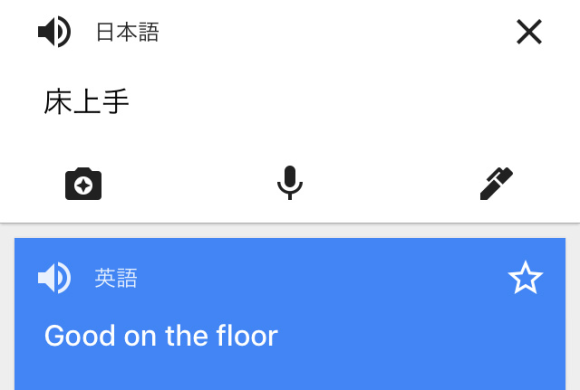
But the problem with this straight translation is that it’s, well, too straight-laced. Toko jouzu actually means “to be good at sex,” sort of like the English “good in the sack.” So why is the Japanese expression version “floor?” Because before the introduction of Western-style beds, everyone in Japan slept, and made love in, futons laid out on the floor,
2. Bugs are nice…?
▼ “I-am-AWESOME!”

Next up: mushi ga ii (虫がいい). Once again, Google goes with the direct approach, utilizing the simple logic that mushi means “bugs” and ii is the adjective “good.”
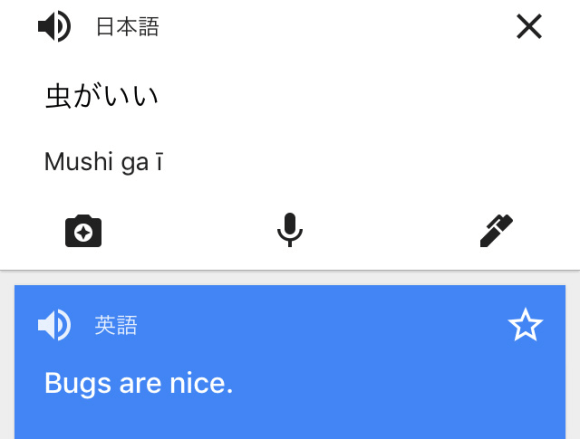
But wait, bugs are as hated in Japan as they are in other countries, so why would Japanese need a phrase to express admiration for the creatures? The answer is it doesn’t, and mushi ga ii actually means “selfish” or “greedy.”
Back in the Edo period (1603-1868), there was a folk belief that bugs living inside of peoples’ bodies caused them to feel emotions, impulses, and desires. Therefore a particularly avaricious person’s bugs must be particularly powerful.
3. Skin use of unattached tanuki…?
▼ They look like a couple, so are these attached, and therefore unusable, tanuki?

Tanuki, Japan’s lovable, large-testicled raccoon dogs, show up in the proverb toranu tanuki no kawazanyou (取らぬ狸の皮算用). Unfortunately, the wisdom of this phrase is lost on anyone who relies on Google Translate’s English rendering.
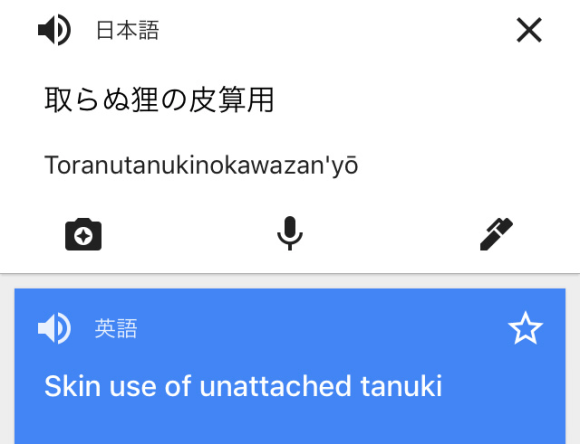
Cleaning that up is going to take a couple steps. First, for some reason Google Translate converted toranu to “unattached.” Really, though, toranu is a negative form of toru, which means, among other things, “catch,” “capture,” or “successfully hunt.”
The “skin” Google Translate mentions is an animal skin/pelt. As for “use,” it somehow chopped off the first half of zanyou, which means to “use as a means of calculation,” and by extension for calculating economic exchanges.
In other words, toranu tanuki no kawazanyou means to use the pelts from tanuki you haven’t caught yet as currency to buy something else, or, in its English equivalent, “to count your chickens before they’re hatched.”
4. I will not sing and fly…?
▼ Drop the mike and no one (including whoever’s listening) gets hurt.

Google Translate isn’t exactly wrong in its translation for nakazu tobazu (鳴かず飛ばず). Nakazu and tobazu really are the negative versons of the verbs naku and tobu, which mean “sing” and “fly” respectively.
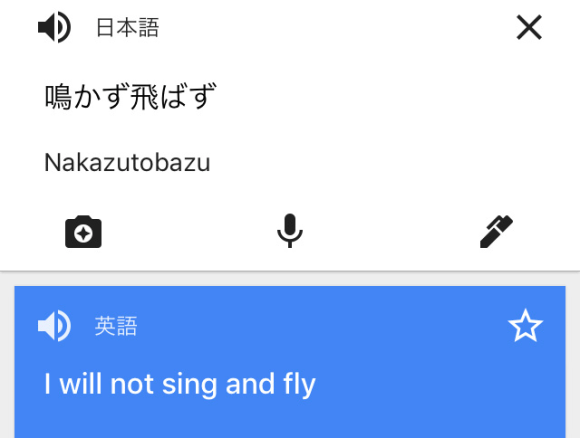
But nakazu tobazu is, in fact, not a warning against the very specific combined undertaking of singing karaoke while testing out a homemade wingsuit, even though that can be a danger to yourself and the ears of others (the “I” in Google Translate’s translation is simply it trying to shoehorn a grammatical subject into the phrase). Naku/nakazu isn’t for singing songs, but for animals, like birds, singing or calling. Imagine a bird that neither sings nor flies, and it shouldn’t be too hard to see that nakazu tobazu means “to lay low” or otherwise conduct yourself in a way that won’t draw attention to you.
5. Cat to small size…?
▼ That’s the biggest box we’ve got, so we guess we’ll just have to make the cat smaller.

Okay, it’s common knowledge that living spaces are smaller in Japan than most other countries, but does the country really need to micronize its cats, as Google Translate’s result for neko ni koban, implies?
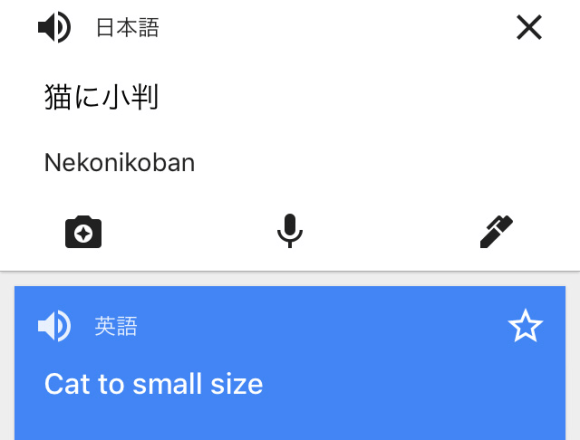
But if you remember our previous article on cat-based Japanese phrases, you’ll know that a koban, even though its component kanji characters mean “small” and “oval,” is actually an oval-shaped gold coin from Japan’s feudal era, and that neko ni koban actually means “[to give] a gold coin to a cat.”
That might sound like the Japanese version of “pearls before swine,” but it’s actually a little softer in meaning (and besides, Japanese also has the phrase buta ni shinju (豚に真珠), which literally means “pearls before swine”). Neko ni koban is used not necessarily when you give someone something they don’t deserve or appreciate, but just something they don’t really understand the value of.
Now we should mention, what with Google’s corporate culture of constant tinkering and improvements, it might be straightening out these twisted translations as we speak. But these five flubbed transitions from Japanese to English also serve as a reminder that as far as machine translation has come, when it comes to linguistics there’s no substitute for good old-fashioned human knowledge.
Top image: Pakutaso
Insert images: Pakutaso, SoraNews24 (via Google Translate), Pakutaso (2), Wikipedia/663highland, Pakutaso (3, 4)
[ Read in Japanese ]
Follow Casey on Twitter, where he could talk about linguistics all day.
 Japanese pronunciation of “……” in Google Translate gives us a laugh
 Nose songs, bug teeth and dirt sticks: 10 Japanese words translated way too literally
 Japanese Twitter users make Osaka Metro’s English translation mistakes into running joke, memes
 YouTube’s AI Japanese translation calls for Jimmy Kimmel’s death on his own show【Video】
 Starbucks Japan reveals new Tsukimi Moon-Viewing drinkware and gifts for autumn 2026
 A real-world Pokémon Poké Ball hotel is opening in Japan at a still-secret location [Video]
 Japan’s first fall color forecast for 2026 is here!
 Japan’s revolving sushi restaurant king Sushiro coming to U.S. this fall with high prices, no tipping
 The mystery of Port Store, the Japanese convenience store that looks like a Lawson rip-off
 Tamagotchi evolves into a ring for its 30th anniversary, preorders now open
 Elderly couple donates 400 million yen to erect Myaku-Myaku statue in Osaka
 Japan Railways announces unlimited-ride train pass for fall travel
 Lawson convenience store opens its first mobile, trailer-style location in Japan
 Mini CRT-lookalike Final Fantasy figurines are awesome pixel art music boxes [Video]
 Japan’s final Penguin Suica train cards have already shipped, and when they’re gone, they’re gone
 Studio Ghibli unveils new anime calendars and diary planners for 2027
 Solo travel in Japan: Hidden beer garden in Tokyo is a haven for single visitors
 Japan approves foreign resident visa renewal fee increases of up to 967 percent, starts soon
 Farewell Final Ceremony announced for Tokyo’s life-size Gundam statue, will stream live
 Hobonichi unveils new 2027 planners, diaries and stationery with One Piece, Suica Penguin, Hello Kitty and a must-buy Mini Techo
 Family Mart releases new Human Made Cup Noodle in Japan, with freebies for Nigo fans
 One Piece Day 2026 brings new art, music, and new cast announcements
 Hikaru Utada sings new song in Shinkansen commercial for Japan’s Supreme Class cabins
 Mister Donut releases new doughnuts that look and taste like Japanese sweet potatoes
 12-year-old British girl who went missing in Tokyo found safe after visiting anime sites around Yokohama
 7-year-old boy left behind on Mt. Fuji by his own dad
 Sushi Bus: Japan’s first conveyor-belt bus lets you eat sushi while sightseeing around Tokyo
 Pokémon Center Online designates first Pokémon items that will require Japanese ID card to buy
 Japanese toilet aims to attract foreign tourists but not everybody is happy about it
 New Japanese vending machine at Shinkansen station sells cups of ice on platform
 Study finds hundreds of people in Indonesia legally named after Naruto, Inuyasha, other anime stars
 Japan announces sudden 400-percent increase in visa fees for foreigners entering the country
 Japan’s human washing machines will go on sale to general public, demos to be held in Tokyo
 Studio Ghibli has a new anime out, and there’s only one place in the world where you can see it
 Starbucks Japan releases new drinkware and goods for Valentine’s Day
 Starbucks Japan releases new sakura goods and drinkware for cherry blossom season 2026
 Japan’s newest Shinkansen has no seats…or passengers [Video]
 Tokyo subway installing new ticket gates that don’t accept payment through Suica or other IC cards
 Japanese ninja certification exam attracts 131 candidates from Japan and abroad
 Salomon releases Japan-exclusive Mt. Fuji hiking gear that doubles as an amazing souvenir
 Put sesame oil in your coffee? Japanese maker says it’s the best way to start your day【Taste test】
 Shohei Ohtani called liar after saying he met fan who caught home run ball, but it might be a Japanese translation error
 Fake police phone scam also highlights dumb stereotype about how foreigners speak Japanese[Video]
