As handy as online Japanese-to-English dictionaries are for looking up individual vocabulary words, automated translation programs tend to spit out much spottier results. A big part of the problem is how much more Japanese relies on context for meaning, which in turn means speakers can, and often do, abbreviate and omit whole words and phrases which human listeners can easily understand implicitly.
Automated programs, though, lack this ability, which means their translations are often missing vital elements needed for the sentence to make sense in English. It’s a problem software engineers and linguists are trying to address, but adding such soft logic to machines is a difficult endeavor.
In at least one case, though, the Google Translate team seems to have been too effective, as trying to convert a Japanese phrase meaning, “Goodbye, my beloved” into English produces a result that seems to have roughly 38 hours of backstory behind it.
Recently, a native Japanese writer with AOL News Japan wanted to know how to say “Sayonara daisuki na hito” in English. Sayonara shouldn’t be too much of a problem, as even most people who don’t speak Japanese understand that it means “goodbye,” so you’d figure Google Translate would be able to handle it.
Daisuki na hito, though, is a little trickier. Daisuki na is an adjective meaning “which is loved” or “beloved.” Hito means “person,” but since Japanese doesn’t differentiate between singular and plural nouns, it can also mean “people.”
“No, no, I didn’t say I’ve been sleeping with other women, I said I’ve been sleeping with another woman! You’re blowing this way out of proportion!”
Most problematic of all, the original Japanese doesn’t say who loves the person or people. A lot of translation programs will default to either “I” or “you” when the subject isn’t expressly stated (a pretty common occurrence in Japanese sentence structure), but sometimes they just get lazy and omit the subject in the English sentence, too.
So, taking into account all the variables, there’s a pretty lengthy list of English translations that, technically speaking, wouldn’t be wrong for Sayonara, daisuki na hito:
Goodbye, person I love.
Goodbye, person you love.
Goodbye, people I love.
Goodbye, people you love.
Goodbye, loved person.
Goodbye, loved people.
Google Translate, though, decides to answer “none of the above,” as we confirmed ourselves. First, we typed in Sayonara daisuki na hito in Japanese text in the left box.
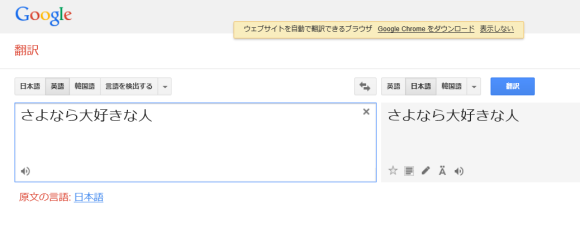
Now all we have to do is click the button to translate into English, and…
▼ …huh?!
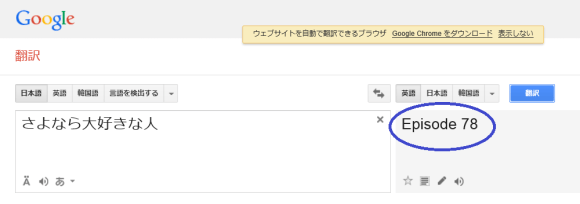
In case you’ve forgotten, we’ll save you the trouble of scrolling back up to double-check the list of possible accurate translations. “Episode 78” isn’t one of them.
Japanese Internet users are just as puzzled as we are.
“What the heck is that supposed to mean?”
“Now I wanna know what happened in Episodes 1 through 77!”
“No way! And after Episode 77’s subtitle was “A New Love!’”
“I bet there’s some dark mystery we’re better off not knowing about.”
Granted, the way AOL News Japan typed sayonara, and the protocol we followed in duplicating their results, is missing the long vowel-marking hiragana う of the 100-percent grammatically correct way to render the word in Japanese text. Still, dropping that hiragana and making the word さよなら instead of さようなら is far from uncommon in colloquial Japanese writing, as shown by the dozens of song titles which feature the word written that way.
▼ Plus the 14.9 million hits Google’s search engine brings up for さよなら

Because RocketNews24 will stop at nothing to deliver the truth to our readers, we went digging a little deeper, and we think we’ve pieced together what caused the breakup using Yahoo! Japan’s translation service.
▼ Okay, one more time, Sayonara daisuki na hito, click the translate button, and…
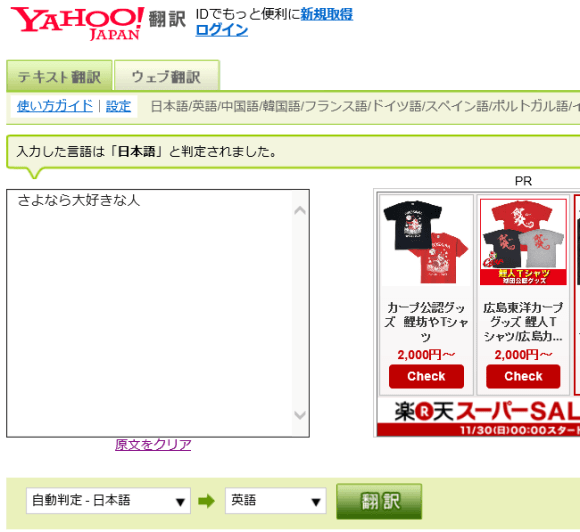
▼ The person who loves Sayo?
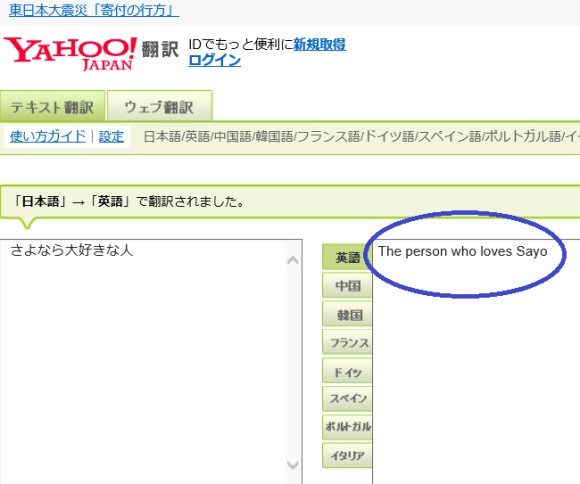
Since that “loves” is in the present tense, we’re going to guess that no one is saying good-bye to Sayo. From that, we can deduce that the person saying “Goodbye, my beloved” is the women who was dating Sayo’s enthralled beau before she broke up the relationship between the speaker and her unnamed ex. Really, based on the evidence presented by both Google and Yahoo! Japan, there’s no other conclusion we can arrive at.
Well, except that maybe you can’t rely on automated translation programs. Keep studying, everybody!
Source: AOL Japan
Insert images: RocketNews24