
But it’s not just women who feel that way; a majority of men think so, too.
It’s no secret that Japan hasn’t quite mastered gender equality. Like the rest of the world, the society continues to struggle with closing the gender gap. In many cases, women are often still expected to take on roles serving men, whether at home or at work, while men are expected to provide for their families, and those who play an active role in their children’s lives might find themselves treated with suspicion.
As it turns out, both men and women acutely feel the differences in how the genders are treated. According to a survey done by information technology service Biglobe, more than 70 percent of men and women across the country believed that gender inequality still exists within Japanese society.
Biglobe conducted a digital survey with 1,000 smart phone users from across the country at the end of November last year, asking them about their perceptions of gender equality. Respondents were both men and women, and ranged in age from 20 years old to 69. From each age group, divided into decades, 100 men and 100 women were surveyed to get an even assessment.
The biggest takeaway from the survey was that a majority percentage of participants believe that the genders are not treated equally. When asked, “In everyday life, do you feel that men and women are not treated equally?”, out of the 1,000 respondents, 23.1 percent said “Often”, while 49.9 percent said “Sometimes,” meaning that 73 percent of respondents had such perceptions of gender inequality. By gender, 76.4 percent of women and 69.6 percent of men responded with either “Often” or “Sometimes”, with the most common response for both genders being “Sometimes”.
▼ “In everyday life, do you feel that men and women are not treated equally?” The top row is all respondents, the middle is men, and the bottom women. Key: Red – “Often”; orange – “Sometimes”; green – “Not very often”; blue – “Never.”
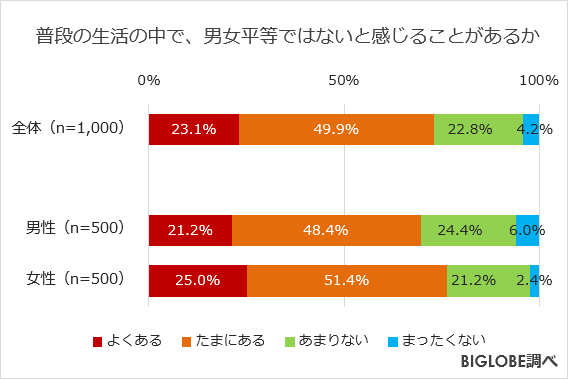
, which indicates that either both men and women perceive themselves as unequal in some aspects of their lives, or they perceive the other gender as receiving the brunt of discriminatory behavior, or both. Either way, the implication is clear: Japanese people believe that not everyone is being treated equally in Japanese society.
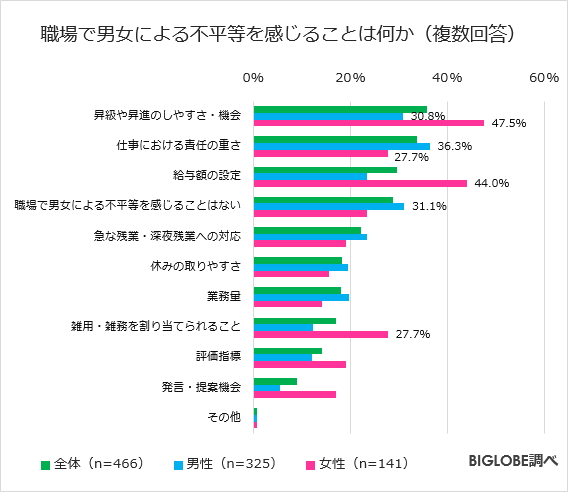
466 respondents work to earn a living, so they were asked which aspects of their workplace were unequal. 36.3 percent of men said “Weight of work responsibilities” and 30.8 percent said “Ease of and opportunities for promotion and advancement”. Interestingly, the second highest bracket, at 31.1 percent, said “I don’t feel the work place is unequal.”
The women’s chief concern, on the other hand, was “Ease of and opportunities for promotion and advancement” (47.5 percent), followed by “Pay” (44 percent), then “Weight of work responsibilities” and “The assignment of odd jobs and routine duties” (both 27.7 percent).
Other responses, from most to least for both men and women, include “Treatment of sudden overtime or work late at night”, “Ease of taking holidays”, “Work load”, “The assignment of odd jobs and routine duties”, ”Evaluation criteria”, “Opportunities to share ideas and express thoughts”, and “Other”.
▼ “What aspects of the workplace do you feel are unequal?” Green represents everyone; blue, men; and pink, women.
When the 466 working respondents answered the question, “What do you think about male employees at your workplace receiving childcare leave?”, only 36 percent said “I’m in favor of it”, while 52.4 percent said “I’m somewhat in favor of it.” Still, that means nearly 86 percent of respondents believed men should receive some form of parental leave. There was only a four percent difference between men and women’s responses, though, but interestingly, more women voiced their support for the idea than men.
▼ “What do you think about male employees at your workplace receiving childcare leave?” From top to bottom: everyone, men, women. Key: Blue – in favor; green – somewhat in favor; orange – somewhat against; red – against.

However, when asked whether they felt any reluctance to take parental leave, 18.2 percent of men said “Yes”, while 35.2 percent said they felt some reluctance, for a total of 55.4 percent. Compared to the women, men overall felt more reluctant to take parental leave.
▼ “Do you feel reluctant to take parental leave?” The patterning to this chart is the same as above, with purple being “Yes” and blue being “No”.

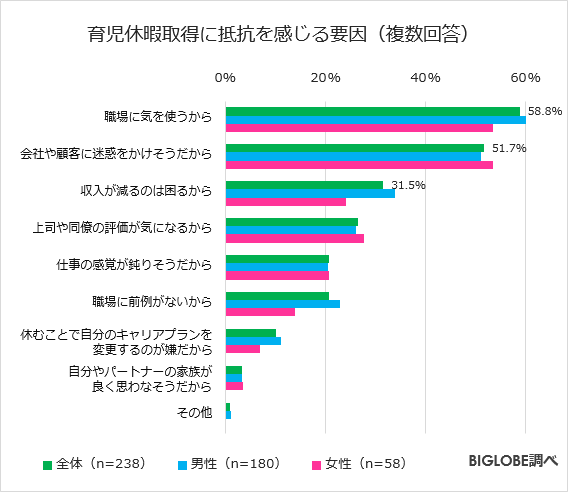
Between both men and women, however, the reasons behind feeling that reluctance were similar: “I’d feel bad for the company” (58.8 percent), “It would be inconvenient for the company and the clients” (51.7 percent), and “I can’t go without the salary” (31.5 percent) (participants were given the option to choose multiple responses).
Other responses were, in order of most to least: “I worry about what my boss and coworkers will think”, ”My job senses will grow dull”, “It’s unprecedented at my workplace”, “By taking time off I’ll ruin my career plan”, “My partner’s family will think badly of it”, and “Other”.
▼ “What is the reason you feel reluctant to take parental leave?”
Though participants weren’t asked who exactly was on the receiving end of these inequalities, what is clear is that men and women still don’t see themselves or each other as being treated equal, especially in the workplace. It’s a complex problem that has multiple repercussions, including, some experts say, contributing to the declining population of Japan. Biglobe says this is the first wave of results from this survey, so maybe the statistics that will be unveiled later on will help shed light on the issues that the people of Japan are facing every day, and we can come closer to a solution.
Source: BIGLOBE via Nico Nico News via My Game News Flash
Top image: Pakutaso
Insert images: Pakutaso, BIGLOBE
 What’s the best way to close the gender gap in Japan? Japanese women weigh in
 34 percent of Japanese men are afraid of their female colleagues, according to recent poll
 Japanese husbands in survey say they do half the housework and childcare, wives say “Nope!”
 Majority of Japanese men in their 20s say they want men-only train cars in survey
 What Japanese women really think about the gender gap in Japan【Video】
 Mt. Fuji decorated with a 500,000-flower pink carpet is Japan’s ultimate spring view
 30 Pikachus want to share a Tokyo hotel room with you that has separate Grass, Water, Fire spaces
 New Travelling Bento pouches turn your luggage into a Japanese lunch box
 Peanuts and Coke becomes a viral hit in Japan, but is it a trend worth joining?
 Krispy Kreme Japan giving free donuts with morning drink purchases at all branches, maybe forever
 Crazy pigeon dating simulator Hatoful Boyfriend being delisted for PlayStation, iOS, and Android
 Beautiful Starbucks in Kyoto blends into its traditional landscape in more ways than one
 McDonald’s Japan adds new Hello Kitty and Pompompurin drinks to the menu for a limited time
 Kura Sushi adding premium tier pricing for better chance at capsule machine game
 New Japanese KitKats come in sakura flavour, with poetic symbolism for success
 Japan reportedly adding Japanese language skill requirement to most common foreigner work visa
 Pokémon and Ikea Japan cross over into each other’s worlds with collaboration events
 Starbucks Japan closing only Shinkansen platform branch for popularity-triggered renovations
 You can assemble a well-balanced team of Pokémon, them eat them, thanks to Japanese cake chain
 Two food hacks take Japan’s convenience store fried chicken to amazing new sandwich heights
 7-Eleven Japan’s new baked-in-store sweet treat is only available in three parts of the country
 Man bites woman at cherry blossom park in Japan, dies shortly after
 Can a downtown Tokyo super sento bathhouse beat a hotel for a one-night stay?
 Japan now has a special desk for people who work at home with a pet cat[Photos]
 Famous Tokyo cherry blossom spot installs view-blocking screens to fight overcrowding[Video]
 Uniqlo announces new T-shirts for One Piece, Naruto and more for manga publisher’s 100th birthday
 Train station platform ramen store closes its doors on half a century of history in Tokyo
 Starbucks Japan releases new My Fruit³ Frappuccino at only 34 stores around the country
 Krispy Kreme releases Super Mario doughnuts in Japan for a limited time
 Studio Ghibli releases Catbus pullback keychain that runs like the anime character
 Japanese onsen egg maker from 100-yen store Daiso needs to be on your shopping list
 Survey asks foreign tourists what bothered them in Japan, more than half gave same answer
 Japan’s human washing machines will go on sale to general public, demos to be held in Tokyo
 Starbucks Japan releases new drinkware and goods for Valentine’s Day
 We deeply regret going into this tunnel on our walk in the mountains of Japan
 Starbucks Japan releases new sakura goods and drinkware for cherry blossom season 2026
 Studio Ghibli releases Kodama forest spirits from Princess Mononoke to light up your home
 Japan’s newest Shinkansen has no seats…or passengers [Video]
 Major Japanese hotel chain says reservations via overseas booking sites may not be valid
 Put sesame oil in your coffee? Japanese maker says it’s the best way to start your day【Taste test】
 No more using real katana for tourism activities, Japan’s National Police Agency says
 Roughly 40 percent of single Japanese men in their 20s have never been on a date, survey says
 Japan’s workplace drinking party communication is unnecessary, says majority of workers in survey
 Majority of surveyed Japanese workers have dated a coworker, over 20 percent their boss or senpai
 Nearly half of young Japanese women say they “hate” the company they work for in survey
 Majority of younger Japanese people in survey respect less than 30 percent of their old coworkers
 Foreign workers respond to survey about changes they’d like to see in the Japanese workplace
 Young Japanese women like alcohol more than any other age group, almost as much as old men【Survey】
 More than one in three Japanese working women in survey would rather be housewives
 What makes a good boss in Japan? Workers sound off in survey
 More than half of young anime workers live with their parents or receive money from them【Survey】
 Japanese guys way more enthusiastic about moving in with girlfriends than vice-versa, survey says
 Nearly 70 percent of young Japanese women self-identify as otaku in survey
 How many married people with children in Japan admit to cheating on their spouse? Survey says…
 Japan: one of the few countries in the world where married couples must have the same surname
 Survey reveals that secretaries in Japan say ‘no’ to these types of husband