The recent tragedy of Malaysia Airlines flight MH17 has capture the attention and sympathy of people across the world, leaving many wondering how such a horrible accident could have occurred. While fingers are being pointed and world leaders are looking for someone to blame, many in Japan are also wondering why a flight from Amsterdam to Malaysia was going through Ukrainian airspace in the first place.
To begin, it might help to have a geographical concept of where the three major points of interest are. Below, we’ve marked the approximate locations of Amsterdam, the crash site in Ukraine, and the flight’s final destination Kuala Lumpur, Malaysia on the map below. As you can see, the three points make an almost perfect straight line.
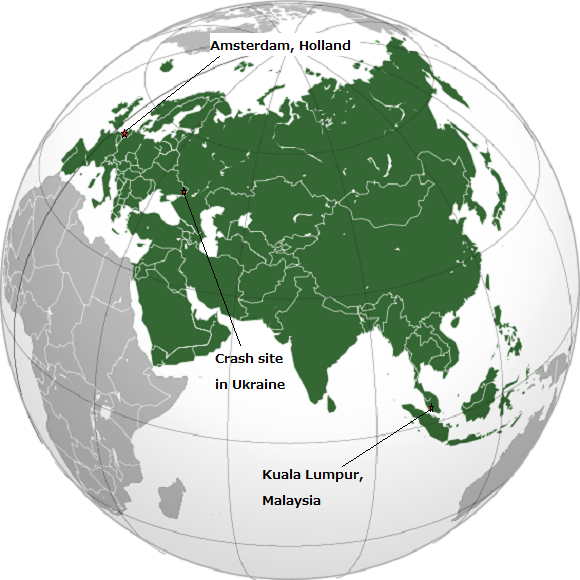
As pointed out by NHK, this is hardly a coincidence. If you spend most of your time traveling by ground, you probably don’t think about the shortest direct route to your destination–you can’t just walk through buildings or drive through mountains. However, when planning flight paths, airlines will generally choose the shortest distance–after all, a jumbo jet has no problem flying through a cumulonimbus cloud.
This was, apparently, exactly what flight number MH17 was doing: Taking the most direct route to Malaysia. Of course, not every flight always travels the shortest path, and diversions due to weather or emergencies are hardly uncommon, as anyone who’s ever flown probably knows. And this has left some wondering why the plane was flying over what could be described as an active war zone.
To answer that question, NHK, or the Japan Broadcasting Corporation to use its English name, talked to Hiroyuki Kobayashi, a famed Japanese airline pilot who flew all of JAL’s international routes and nearly all of the company’s domestic routes by the time he retired in 2003. According to Kobayashi, who currently works as an adviser and critic for airline safety, there was nothing abnormal about the flight path.
As the retired pilot explained, passenger flights frequently pass over war zones when it has been deemed that the areas are safe for high-altitude flights. Kobayashi mentioned that he himself had experience flying over Vietnam, Iran, and Iraq when the countries were at war. As long as the planes stay over an altitude of 10,000 meters in such areas, they are supposed to be safe, especially if it has been determined that weapons capable of hitting airline jets are not in use. Though planes and helicopters have been attacked in the current Ukrainian conflict, there was no indication that surface-to-air missiles capable of targeting and reaching airline jets were in use. Kobayashi also emphasized that this route is an incredibly common route for flights between South-East Asia and Europe.
You can watch NHK’s video explaining the flight path below. Though it’s quite low-tech, the string-on-a-globe technique makes things surprisingly easy to grasp.
Kobayashi also added that, based on the videos he’d seen of the crash site, the only likely explanation for the wide-ranging spread of debris was an in-air explosion. He agreed with the assessment that the plane was, indeed, shot down and added that the crash will have a huge impact on the many airlines that have routes traveling through the region.
This is a truly horrendous event and our hearts go out to all the victims’ families at this time. The best we can hope for now is a rapid, accurate investigation into the cause and some sense of closure for those grieving.