Every year, almost every company in Japan takes about a week off in August. And while some people use this time to travel, attend firework festivals, or just hang out at the beach, the real purpose is Obon, the Japanese holiday during which people go back to their hometown to visit their family grave and offer a prayer to their ancestors, whether distant or recently deceased.
In general, relatives pay their respects all together at the same time, and the associated family reunion keeps the atmosphere from being too somber. Still, in general, the tone is retrained and reserved, as the family prays silently, lights some incense, and leaves a bouquet of flowers.
Unless, that is, they’re in one of the parts of Japan where Obon means bringing a supply of fireworks or seaweed to the grave.
For much of its history, civil war and a lack of infrastructure severely limited the amount of contact different regions of Japan had with each other. As a result, a few places in the country have developed some very unique traditions, with Nagasaki’s being perhaps the liveliest.
Most cemeteries in Japan are attached to temples, many of which close their gates at night. Add in the fact that summer is the prime ghost story season in Japan, and it’s not hard to see why most people do their Obon visits during the daytime. Not in Nagasaki Prefecture, though, where the locals see nothing wrong with going in the evening.
After all, the fireworks will be prettier that way.
There are conflicting theories about how this custom got started, with some saying its done to ward off evil spirits, and others claiming it helps the departed let go of any regrets that might be preventing them from resting in peace. Kids don’t seem overly concerned about the exact logic behind the practice, as they’re too busy enjoying themselves among the tombstones.
“Until I moved to Tokyo,” recalls, one Nagasaki native, “I thought visiting the grave was a fun, exciting thing to do.”
Firecrackers are also a must-have for Obon in Nagasaki, likely a result of the prefecture’s Chinese cultural influences. “My mom’s family is from Nagasaki,” explains another Internet commenter, “and between the firecrackers and rockets going off at Obon, it’s like a battlefield.”
We have to stress that as much as we’d like our descendants to honor our memories with aerial pyrotechnics, this is by no mean the norm in Japan, as illustrated by one white-collar worker’s story. “One of my coworkers is from Nagasaki, and before he went to visit his wife’s family grave in Saitama, he bought a bunch of firecrackers and pinwheel fireworks. She was pretty upset.”
Meanwhile, western Hiroshima Prefecture’s tradition may not be as noisy as Nagasaki’s, but it’s every bit as colorful.
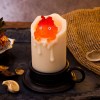
The proper Obon decoration in this sector of Japan is a paper lantern that looks more like something you’d find hanging from the ceiling of a kid’s bedroom than adorning a tombstone. Still, the practice is so widespread that the lanterns are sold in convenience stores, and their arrival is a sure sign to the locals that summer is here.
While this seems to be an enlightened way of celebrating the positive aspects of life rather than the sadness of death, it’s not hard to imagine those who’ve recently suffered a loss in the family not being in such a festive mood. Perhaps for this reason, if the family has suffered the loss of one of its member within the past 12 months, the lantern is white, with the multi-colored versions being used again the next year.
In Japan’s northeastern Tohoku area, though, the regional decoration is always the same color, the deep brownish green of kombu, or kelp.
The edible seaweed is placed on top of the gravestone, and then water is poured over both. Things are a little more upscale in Iwate, one of the prefectures that makes up Tohoku. There, the custom is to spread the kombu atop the stone, then douse it with sake.
Apparently, this helps create a connection between the world of the living and the realm beyond. The exact mechanics of this seem to be hazily defined, but in any case, we think it’s a nice gesture to say thanks to your ancestors by buying them a drink once a year.
Source: Naver Matome