
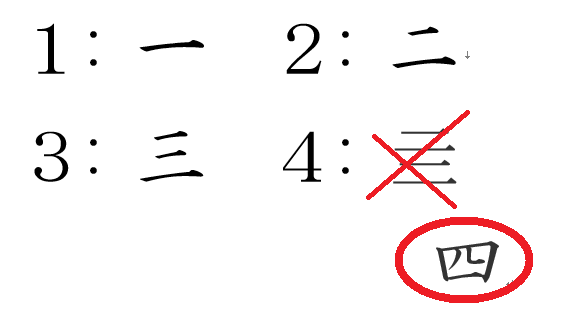
The history of the first kanji that makes many learners of Japanese want to pull their hair out, and why their initial guess isn’t entirely wrong.
One of the most intimidating things about learning Japanese is the writing system. There are three different sets of characters you’ll need to become proficient in, and while two of them, hiragana and katakana, aren’t too difficult to master, kanji, the set originally imported from China, is a high hurdle.
Japan’s Ministry of Education has designated 2,136 characters as “general-use kanji,” and while you may not need to know each and every one to function in Japanese society, you’ll need a firm mental grip on several hundred if you really want to integrate yourself into the cultural or professional spheres. With so many to learn, most structured courses, and self-studiers as well, start with the easiest kanji, ichi, which means one.
▼ Ichi

While you could possibly interpret a horizontal line in a few different ways, it’s not too hard to wrap your head around the fact that in Japan, a single sideways stroke represents the concept, and thus the word for, “one.” After inputting that in their brains, most learners will turn the page of their textbook and find the kanji for ni, or “two.”
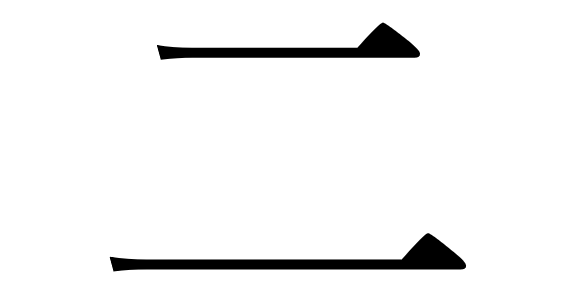
This seems like a pretty logical progression, right? One horizontal line means one, two horizontal lines means two. The next on the kanji study list is generally san, or “three,” and you can probably guess where this is going.
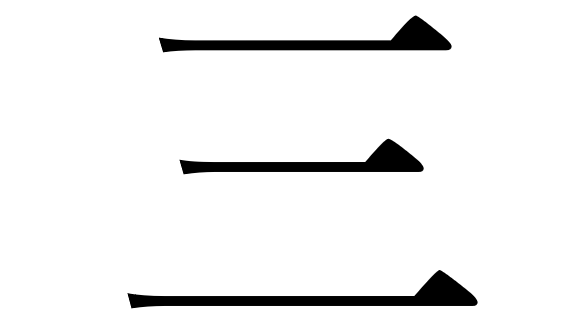
Wow, if all kanji are this straightforward, you’ll have those 2,136 general-use ones memorized in no time, right? Okay, let’s move on to yon, or “four,” although at this point it seems like just a formality, since in keeping with the established pattern it’ll probably be-
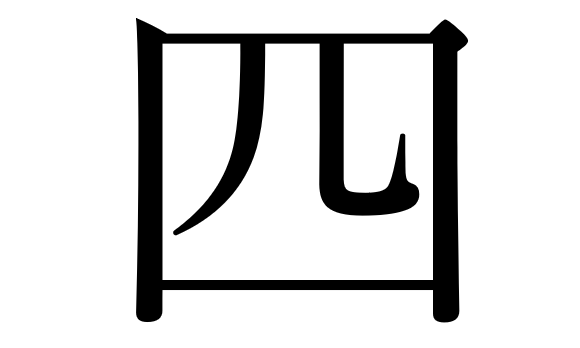
Whoa, hold up there. Is this some kind of joke? And if it is, don’t the people who developed kanji know that comedy is supposed to follow the rule of three, not the rule of four?
If there were any justice in the world, the kanji for “four” should be written like this, right?

But try writing that on your kanji test, and your teacher is likely to strain a forehead muscle from cocking an eyebrow harder than he would if you referred to yourself with the macho pronoun ore when speaking in class. However, history would be on your side, even if your instructor probably wouldn’t, since long, long ago the kanji 亖 actually was an acceptable way of writing “four.”
▼ Take that, Teach!

However, 亖 never shows up in contemporary usage, and it takes a fair bit of wrangling to even get it to appear when typing in Japanese (it’s literally easier to summon a dragon with a Japanese word processor than to produce the kanji 亖). So how did it get replaced, and why?
Let’s start with the “how” part of that question. As mentioned above, while Japan has developed some kanji of its own over the years, the writing system originally came from China. There, too, 亖 was once an acceptable way of writing “four.” However, somewhere along the line, people started using the kanji 四 to represent “four” as well.
四 seems like a strange choice at first. Originally, it meant “breath” and was meant to be a visual representation of teeth or a tongue inside a mouth (“mouth” by itself being written with the kanji 口). However, the Chinese pronunciations of 四 and 亖 were identical, and so some people started using 四 to represent “four.” Eventually, 四 became the preferred rendering for “four,” which then prompted the development of a new kanji for “breath,” 息 (a compound of the kanji for “self,” 自, and “heart,” 心).
But what turned popular opinion, and eventually society as a whole, against 亖? There was no official changeover decree, owing to language’s nature as a gradually and constantly evolving thing. However, the common-sense explanation is that while 一, 二, and 三 are all pretty easy to identify with a momentary glance, 亖 had moved beyond, or at least approached, the tipping point where the eye and mind can instantaneously process the information without requiring conscious counting.
From a practical standpoint, a line had to be drawn somewhere in stacking horizontal lines increasingly higher. After all, while the meaning of 八, the kanji for “eight,” may not be intrinsically understandable, it saves people from having to squint at small-font text to see if there are eight or nine strokes crammed together in a small vertical space. Others have pointed out that this concept that four repeating visual elements is too many appears in Roman numerals as well, which capped its vertical lines at three after Ⅰ, Ⅱ, and Ⅲ and then started mixing things up with Ⅳ.
So once again, yes, Japanese can be a difficult language to learn, sometimes frustratingly so. However, there’s often a reason for things being done the way they are.
Sources: IT Media, Okijiten (1, 2)
Top image ©SoraNews24
Insert images: SoraNews24, Pakutaso
Follow Casey on Twitter, where he’d like to thank Sakamoto-sensei for not getting too upset when he used “ore” during a heated in-class debate with another student.