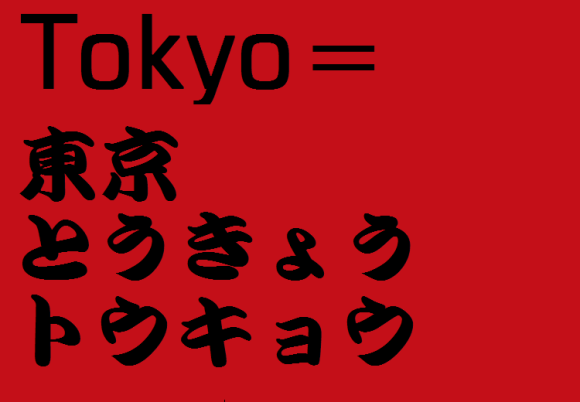
No, it’s not because the Japanese language hates you.
So if you wanted to write, say, Tokyo, in Japanese, you’d write it like this.

Oh, wait, you could also write it like this.

And, finally, this, too, is an option.

Yes, it’s true. Japanese has three completely separate sets of characters, called kanji, hiragana, and katakana, that are used in reading and writing. That first rendering of “Tokyo” is in kanji, with the hiragana version next, and the katakana one at the bottom.
The reason for this triple threat to language learners’ sanity isn’t that teachers of Japanese want to lessen their workload by convincing you to study Spanish instead. There’s actually a fairly logical, slightly lengthy explanation for using all three, so pour yourself a cup of green tea and let’s dive right in.
▼ Into the explanation, of course (unless you’ve got a very big teacup).
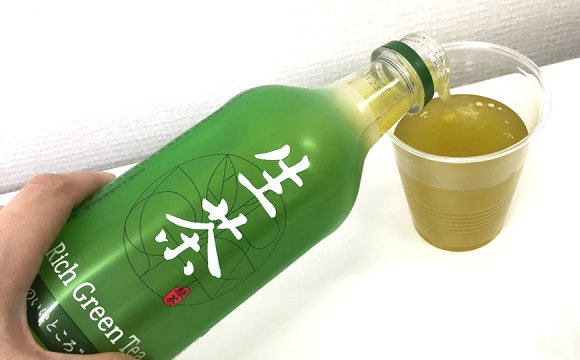
First, let’s take a look at kanji, which are complex characters, originally coming from Chinese, that represent a concept. For example, kuruma, the Japanese word for “car,” is written in kanji as 車.
▼ 車!
Hiragana, though, are much simpler in both form and function. They take fewer strokes to write than all but the simplest kanji, and instead of representing concepts, hiragana are used for writing phonetically. In other words, hiragana characters function like English letters, in that they don’t have any intrinsic meaning. They just represent sounds.
Because of this, any Japanese word that can be written in kanji can also be written in hiragana. Kuruma, which we saw written in kanji as 車, can also be written in hiragana as くるま, with those three hiragana correlating to the sounds ku, ru, and ma.
▼ くるま!
So why do sentences have a mixture of kanji and hiragana? Because hiragana gets used for grammatical particles and modifiers. Remember, each kanji represents a concept. So when writing a verb, you use a kanji for the base concept, then hiragana to alter the pronunciation and add more meaning, such as the tense.
For instance, the verb miru, meaning “see,” is written 見る, combining the kanji 見 (read mi) with the hiragana る (ru). If you wanted to change that to the past tense, mita/saw, you’d leave the kanji as-is and replace the る with the hiragana た (ta) to get 見た/mita, which means “saw.”.
But wait, if anything that can be written in kanji can also be written in hiragana, why not use only hiragana? After all, while the complete set of 46 hiragana is bigger than the 26-letter English alphabet, it’s still way more manageable than the 2,000 or so regular-use kanji, the collected group that serves as the litmus test for full adult Japanese literacy.
Actually, there are three pretty solid arguments against writing exclusively in hiragana.
1. Because kanji were developed before hiragana, writing with kanji generally imparts a more educated and mature feeling. Sure, you could write kuruma as くるま and be understood, but it’ll look childish to Japanese readers, so adults are expected to go with 車.
2. Still, if everyone in Japan did it, eventually the childish stigma of using only hiragana would fade away, just like if humanity collectively decides that, starting tomorrow, chocolate milk is a perfectly acceptable beverage to serve/request at formal business meetings.
▼ Come on, people, together we can do this!
But Japanese has a very limited number of sounds. Aside from famously having no L, very few consonants can be blended together, and every syllable has to end in a vowel or N. Because of this, the Japanese language is filled with words that are pronounced the same but have different meanings.
As a matter of fact, there are so many homonyms that without kanji, it can be confusing to tell which one is being written about. Sure you could write koutai in hiragana as こうたい, but koutai can mean “replacement,” “antibody,” or “retreat.” Because of that, if you want to get your point across, you’re much better off using kanji, 交代, 抗体, or 後退, to clarify which koutai you’re writing about.
3. Japanese writing doesn’t put spaces, at all, between different words. This sounds like it would have the potential to turn every sentence into a confusing mass of congealed language bits, but written Japanese tends to fall into patterns where kanji and hiragana alternate, with the kanji forming base vocabulary and the hiragana giving them grammatical context.
For example, here’s Watashi ha kuruma wo mita, or “I saw the car,” written with the customary mix of kanji and hiragana.

Right away, we can see the pattern of kanji-hiragana-kanji-hiragana-kanji-hiragana, which quickly tells us we have three basic ideas in the sentence.
1. 私は: Watashi (I) and ha (the subject marker)
2. 車を: kuruma (the car) and wo (the object marker)
3. 見た: mi– (the verb “see”) and -ta (marking the verb as past tense)
Without the mix of kanji and hiragana, those breaks would be a lot harder to spot. Here’s how it would look in all hiragana
▼ Writing everything in hiragana also takes a lot more space.
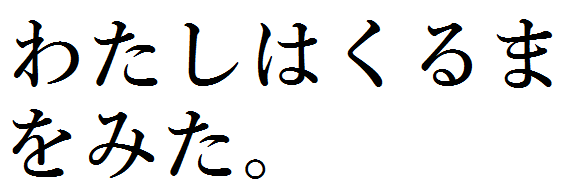
Suddenly, it’s a lot more difficult to tell where one idea stops and another starts, since it’s all one unbroken string of hiragana. Trying to read something written only in hiragana is kind of like tryingtoreadEnglishsentenceswrittenlikethis. The rhythm that comes from having a mix of kanji and hiragana, though, makes written Japanese an intelligible way of conveying ideas instead of a mad dash to the finish line.
Speaking of finish lines, we’ll be back again soon with this topic’s thrilling conclusion, in which we tackle the mysterious lone wolf outsider of Japanese writing: katakana, the third and final form of Japanese text.
▼ ウォーン!

Follow Casey on Twitter, where he sometimes tweets about how much he misses his 車.
Chocolate milk image: Wikipedia/BotMultichillT
Wolf image: Wikipedia/Retron
All other images ©RocketNews24