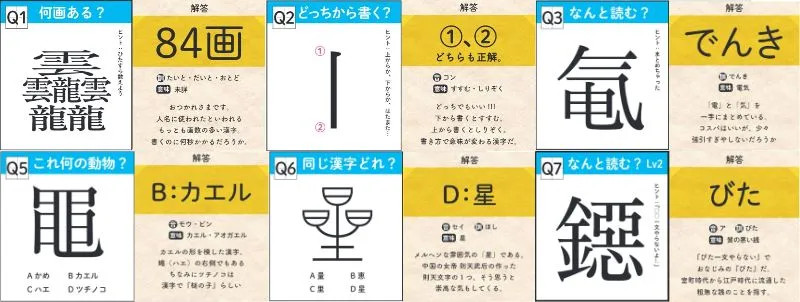
Three dragons and three clouds…A straight line…An upside-down “child”…What could they mean?
The Japanese language is written using three different systems: hiragana and katakana, which are phonetic, and kanji, which is made up of individual characters, each with its own meaning and a pronunciation that changes depending on the context. If you have studied Japanese, you’ll know that kanji is one of the most difficult parts of learning the language.
That’s true for Japanese people as well. In fact, did you know that there are kanji so old or so bizarre that no one can recognize them? Take, for example, this character:
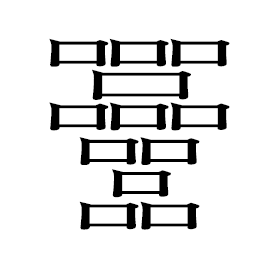
Though it looks like some kind of work of abstract art, this is a Japanese kanji that uses twelve of the “kuchi” radicals. “Radicals” are the individual parts of a character that each have meaning, and “kuchi” means “mouth.” Many people would say that this character, made up of 12 “mouth” radicals, is not a real character, but it is–it’s even listed in Japanese dictionaries!
You can find an example of its use in Uso Jidzukushi, a work by Edo-era novelist Shikitei Sanba. Have you figured out what it means? It’s read as “oshaberi,” which means “chatterbox” or “talkative”. How appropriate!
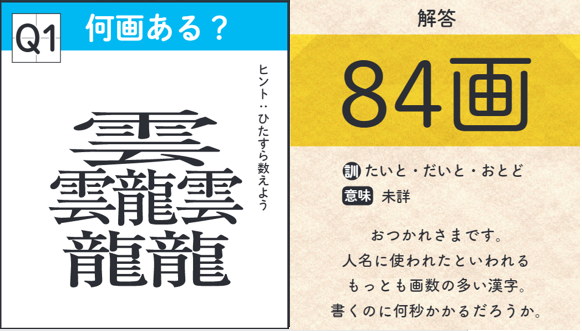
There are lots of other bizarre kanji out there. For example, the one shown above is made up of 84 strokes (the number of movements of a brush or pen needed to write the character), which is apparently the most out of any Japanese character. It’s composed of three characters for “cloud” and three characters for “dragon” mixed together. No one knows what it originally meant, but it was apparently used in people’s names.
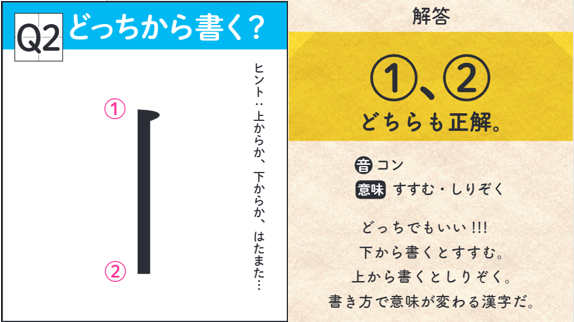
On the flip side, there’s this character, shown below, that’s just a single vertical line. But though it looks simple, it’s really not. When written from the bottom up, it means “to proceed”, but when written from the top down (as pictured below), it means “to withdraw”.
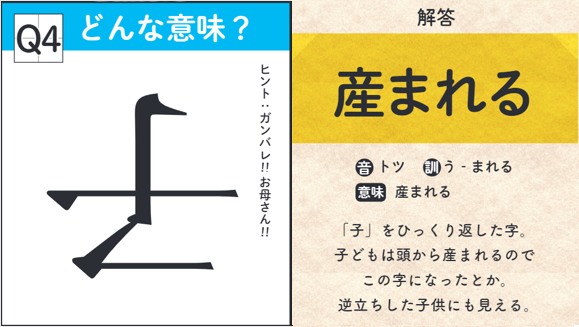
Some strange characters make a lot of sense, once you think about them. For example, the character for “child,” (子), turned upside-down was once used as “to be born”–since children are born head-first.
If this piques your interest, you’ll love the new book “Kimyona Kanji” (奇妙な漢字 “Strange Kanji”), which is where the above excerpts were taken from.
▼ Written by Kotoku Sugioka, the Japanese book was published by Poplar and released on January 11.
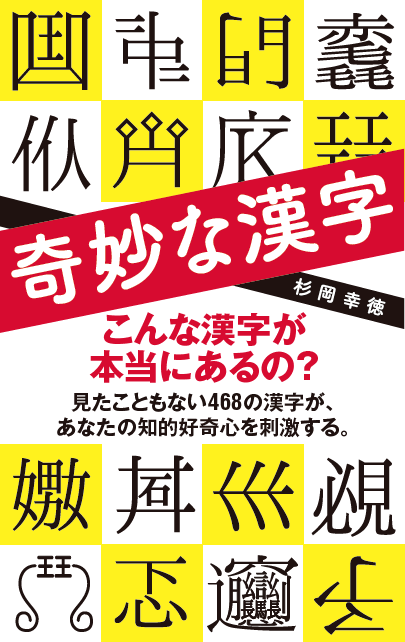
It’s a must-see for fans of kanji or linguistics. There are altogether 468 unusual kanji to explore, so it looks set to be a very interesting read! You can find it on Amazon Japan or Poplar’s official website for 990 yen (US$7.58).
And if you’re looking for more Japanese language fun, here are some really cool phrases to add to your vocabulary, or you can learn 11 different ways to say “father” in Japanese.
Source, images: PR Times
● Want to hear about SoraNews24’s latest articles as soon as they’re published? Follow us on Facebook and Twitter!
[ Read in Japanese ]


Japanese government tells teachers not to be so strict, at least about some kanji radicals
Cool design on Japanese posters lets you look at kanji upside-down for a whole new meaning
German linguist living in Japan says kanji characters used for Germany are discriminatory
Why is the Japanese kanji for “four” so frustratingly weird?
Japanese study tip: Imagine kanji characters as fighting game characters, like in this cool video
Beautiful exclusive Totoro tenugui towel is a gift from Disney to Ghibli physical media buyers
Brand new Shinkansen bullet train unveiled in Japan… but it won’t carry passengers
Sanrio eco-friendly plushies are here for the earth-conscious lovers of all things kawaii
Cup Noodle releases cold-water instant ramen in Japan, but can it really be made with just cold water?
Japanese convenience store releases Japanese convenience store-flavor fried chicken
Studio Ghibli releases anime T-shirts that pay homage to one of Hayao Miyazaki’s most personal films
Hatsune Miku collaborates with Hokusai’s art in new Vocaloid ukiyo-e illustration series [Pics]
Giant Snorlax, other snoozing Pokémon appear in Yokohama for Pokémon Sleeping Faces Research [Pics]
Japan’s “edible fireworks” wagashi sweets return, but only for a limited time [Photos]
Studio Ghibli’s new moving keychains are the angry, adorable bugs from Nausicaa [Photos]
Japan now has human refrigerators inspired by Japanese vending machines
Cup Noodle unveils first-ever cold-water instant ramen in Japan
Family Mart’s new Tokyo flagship convenience store doesn’t feel convenient, but is that a problem?
Starbucks Japan releases new Discovery Series collection celebrating local regions and traditions
Teen girl in Japan refuses to be victim, personally escorts train pervert to police for arrest
Is Japan’s tourism boom slowing down? Foreign visitor numbers fall for first time in five years
Evangelion beautifully reimagined as iconic classical Japanese folding screen art series [Photos]
Japan announces sudden 400-percent increase in visa fees for foreigners entering the country
Studio Ghibli has a new anime out, and there’s only one place in the world where you can see it
Salomon releases Japan-exclusive Mt. Fuji hiking gear that doubles as an amazing souvenir
Japan triples departure tax, foreign tourists and locals now must pay more to leave country
Japan launches first overnight Shinkansen bullet train between Tokyo and Osaka this summer
Japanese ninja certification exam attracts 131 candidates from Japan and abroad
Family Mart opens new “Famima” flagship store in Tokyo that’s like a tourist attraction
Japan’s human washing machines will go on sale to general public, demos to be held in Tokyo
Starbucks Japan releases new drinkware and goods for Valentine’s Day
Starbucks Japan releases new sakura goods and drinkware for cherry blossom season 2026
Japan’s newest Shinkansen has no seats…or passengers [Video]
Put sesame oil in your coffee? Japanese maker says it’s the best way to start your day【Taste test】
Japan reportedly adding Japanese language skill requirement to most common foreigner work visa
Why does Japanese writing need three different sets of characters? (Part 1)
Why does Japanese writing need three different sets of characters? (Part 2)
One simple kanji character in super-simple Japanese sentence has five different pronunciations
Renowned Japanese calligraphy teacher ranks the top 10 kanji that foreigners like
Japan’s kanji character of the year for 2017 is “north”
W.T.F. Japan: Top 5 kanji with ironic meanings【Weird Top Five】
Kanji Tetris is the coolest way to practice and play with Japanese that we’ve ever seen【Video】
W.T.F. Japan: Top 5 strangest kanji ever 【Weird Top Five】
Japan’s Kanji of the Year announced for 2021, and it’s a familiar choice
W.T.F. Japan: Top 5 kanji with the longest readings 【Weird Top Five】
Japan announces Kanji of the Year for 2019, and it was really the only logical choice
Flipping the kanji for “husband” upside-down reveals slightly worrying double meaning
U.S. college student learns the hard way to get your Japanese kanji tattoo checked by an expert
The extremely violent backstory of how to write the word “take” in Japanese
Students of Japanese despair – you’ve probably been writing some of the simplest kanji wrong