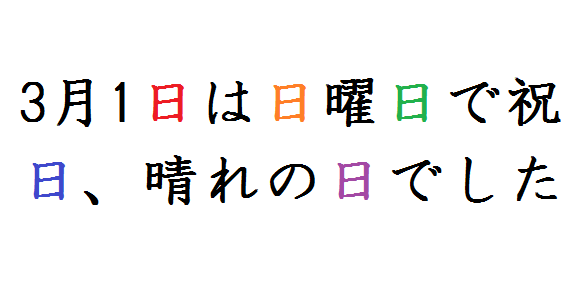
Amazing versatility shows the depth and difficulty of the Japanese writing system.
Most people will tell you that the most difficult thing about learning Japanese is dealing with kanji, the written characters originally imported from China. Not only are there more than 2,100 general-use kanji, some of them are incredibly complex, even the ones with rather mundane meanings.
For example, this 27-stroke monster…
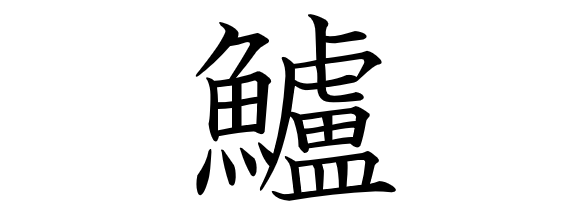
…is what you have to write out if you want to use the kanji for suzuki, or “sea bass.”
Thankfully, sometimes the Japanese language throws you a bone, with kanji that show up incredibly frequently also being a snap to write. For example, the kanji meaning “sun” or “day” only has four strokes, and isn’t much more difficult to write than the numeral 8.
But just because a kanji is easy to write doesn’t mean it’s simple to read. Kanji represent concepts, not sounds, and since they were originally brought over from a different language, they can be read with a corrupted version of their original Chinese pronunciation, an indigenous Japanese pronunciation, or an irregular pronunciation that came about as a force-fit of assigning kanji with an appropriate meaning to preexisting Japanese vocabulary. Driving home that point is this tweet from Japanese Twitter user @DNApro_mikokoro, which contains a sentence in which the 日 kanji shows up five times…
この文章、読めますか?
— 佐野美心 (@DNApro_mikokoro) March 16, 2017
「3月1日は日曜日で祝日、晴れの日でした」
おそらく皆さんほとんど読めたと思いますが
実はこの文、海外の日本語学校では超難問です
気づかれましたか?「日」の字の読み方全部違うのです
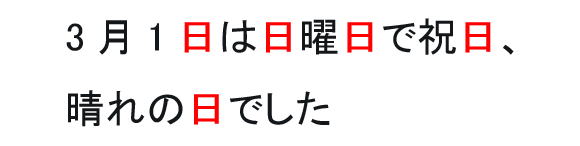
…and is pronounced five different ways!
Let’s break them all down.
● In 1日/tsuitachi, meaning “the first of the month,” the pronunciation of 日 is part of an unbreakable set with the numeral one
● In 日曜日/nichiyoubi, meaning “Sunday,” the first instance of 日 is pronounced nichi and the second bi
● In 祝日/shukujitsu, meaning “holiday,” 日 is pronounced jitsu
● And finally, all by itself, the fifth time 日 shows up it’s pronounced hi, meaning “day”
Put it all together, and “3月1日は日曜日で祝日、晴れの日でした” is read “Sangatsu tsuitachi ha nichiyoubi de shukujitsu, hare no hi deshita,” which translates into “March 1 was Sunday, a holiday, and a sunny day.”
By the way, look close enough and you’ll notice that two more of the kanji in the sentence, the yo part of nichiyoubi (曜) and the ha portion of hare (晴), both have miniature versions of the 日 kanji as part of their components, in keeping with their respective meanings of “day of the week” and “sunny.”
“I think everyone [who’s Japanese] could read the sentence,” tweeted @DNApro_mikokoro, which is a totally reasonable assumption, as all of the vocabulary and kanji are pretty rudimentary by native-Japanese standards, who are used to their language’s heavy reliance on context for meaning. “But this is a really tough task for students studying Japanese overseas,” @DNApro_mikokoro continued.
Still, if you want to learn the language, it’s one of the hurdles you’ll have to get over. Keep at it, and remember that while some parts of Japanese can be hair-pullingly aggravating at first glance, it’s not all bad news.
Source: Hachima Kiko
Images ©RocketNews24
Follow Casey on Twitter, where he’d be happy to talk about Japanese linguistics all day.


Why does Japanese writing need three different sets of characters? (Part 2)
Why does Japanese writing need three different sets of characters? (Part 1)
Japanese teacher shares surprising reason why the kanji for crow has one less line than bird
What does a kanji with 12 “kuchi” radicals mean? A look at weird, forgotten Japanese characters
Why is the Japanese kanji for “four” so frustratingly weird?
Japanese ninja certification exam attracts 131 candidates from Japan and abroad
Japanese sweets brand creates new drinkable Cigare and we’re totally here for it
Studio Ghibli store Donguri Republic announces opening of first-ever store in America
7-Eleven Japan to start selling Vietnamese banh mi sandwiches this summer
Starbucks Japan releases new Frappuccino, tea and soda drinks for summer
Japanese sweets shop sells an ohagi so exquisite it sells out by noon
Ginza Happo: One of Tokyo’s best all-you-can-eat seafood restaurants is an extreme buffet affair
We invent ice slurry somen to combat the extreme Japanese summer heat【SoraKitchen】
Forget Tokyo go-karts – there’s a new way to sightsee on four wheels in Japan
Harajuku Custom Icees come to help Tokyo’s Takeshita Street stay cute and cool this summer
Universal Studios Japan is giving Frieren anime fans the chance to make unforgettable memories.

New Japanese overnight train coming to connect Tokyo with Tohoku in sleep-travel style
Tokyo’s life-size Gundam is getting a new look before its end-of-summer removal
Starbucks Japan releases new limited-edition summer drinks…and a pastry for dunking
Uniqlo reveals third round of massive 100-year-anniversary manga T-shirts for Jump’s Shueisha
Even at twice regular Daiso price, this handy item is still great for summer travel in Japan
New official Ghibli anime food cookbook will teach you how to make Ponyo’s ramen and more
Japanese convenience store Lawson launches new “mini supermarket” chain, L Minimart
Japan’s real-world Pokémon hot spring’s first photos are here![Photos]
Japan’s human washing machines will go on sale to general public, demos to be held in Tokyo
Starbucks Japan releases new drinkware and goods for Valentine’s Day
We deeply regret going into this tunnel on our walk in the mountains of Japan
Starbucks Japan releases new sakura goods and drinkware for cherry blossom season 2026
Japan’s newest Shinkansen has no seats…or passengers [Video]
Put sesame oil in your coffee? Japanese maker says it’s the best way to start your day【Taste test】
Japan reportedly adding Japanese language skill requirement to most common foreigner work visa
Japan’s 5.3 million beautiful Hitachi Nemophila flowers are now in full bloom[Photos]
Pokémon and Ikea Japan cross over into each other’s worlds with collaboration events
Wisteria season starts early with blooming of Japan’s Great Wisteria in its beautiful garden
Nippon or Nihon? No consensus on the Japanese pronunciation of “Japan”
Japanese government will check and judge new baby name pronunciations, presents guidelines
German linguist living in Japan says kanji characters used for Germany are discriminatory
Japan’s kanji character of the year for 2017 is “north”
Japanese study tip: Imagine kanji characters as fighting game characters, like in this cool video
Japanese government tells teachers not to be so strict, at least about some kanji radicals
New wave of “creative” Japanese names read more like riddles
Top Japanese baby names for 2025 feature flowers, colors, and a first-time-ever favorite for girls
W.T.F. Japan: Top 5 kanji with ironic meanings【Weird Top Five】
Japan announces Kanji of the Year for 2019, and it was really the only logical choice
“Bear” voted Japan’s Kanji of the Year for 2025 in extremely close race
Japan’s Kanji of the Year announced, shows the bright and dark spots of 2024【Video】
U.S. college student learns the hard way to get your Japanese kanji tattoo checked by an expert
The extremely violent backstory of how to write the word “take” in Japanese
Clever font sneaks pronunciation guide for English speakers into Japanese katakana characters
Only one out of five Japanese people can pronounce these hiragana — can you?