We’re back and ready to take on the third, and most puzzling, type of Japanese text: katakana.
Recently, we started taking a look at the question of why the Japanese language needs three sets of written characters. To recap, we saw that kanji (complex characters that originated in China) are used to symbolize a term or concept, while hiragana (simpler, indigenous Japanese characters) represent sounds and provide extra context and grammatical information.
What we haven’t talked about yet is why Japanese needs two sets of phonetic script. Aside from hiragana, there’s also katakana, yet another group of 46 low-stroke-count characters used for writing things phonetically. Specifically, katakana get used for writing foreign loanwords.
But wait. We don’t need a whole new set of letters to write foreign loanwords in English. What makes things different in Japanese? Let’s dive into the answer, and since it’s going to take a while to explain, go ahead and pour yourself a cup of coffee.
▼ Which, incidentally, is written with katakana as コーヒー.

As mentioned last time, there are two huge advantages to using a mix of kanji and hiragana. There’s an extremely limited number of sounds available in the Japanese language, which results in many Japanese words having the same pronunciation but wildly different meanings, but the conceptual meanings kanji possess help to avoid confusion. Second, since Japanese is written with no spaces between words, using kanji for vocabulary and kana for grammar (to put things in broad terms) makes it easy to see the components of a sentence.
▼ Watashi ha kuruma wo mita or “I saw the car,” with kanji (i.e. vocabulary) written in red and hiragana (i.e. grammar) in blue.

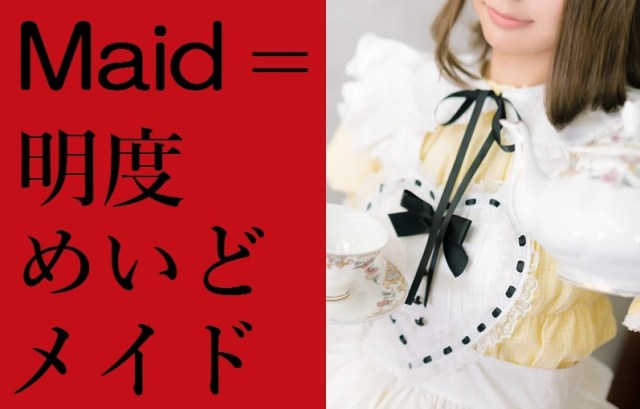
But that limited number of sounds means most foreign words can’t be properly rendered in written Japanese, which threatens to give the language even more homonyms. For example, let’s say we wanted to talk about a maid, of the maid cafe variety. Since Japanese syllables can’t end in a “D” sound, “maid” becomes meido (pronounced close to “maid-o”).
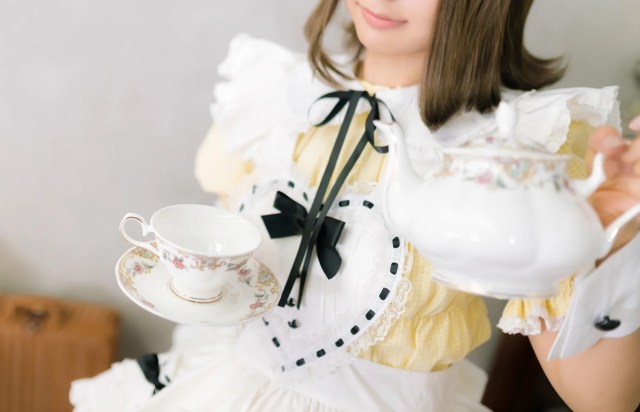
If we want to write meido in Japanese, it seems like the obvious thing to do is to write it in simple, phonetic hiragana. Technically we could do that, and it would look like this:

But this would make things confusing once we combined it with other words. Since hiragana is most commonly used for grammatical modifications, using it for a whole noun like “maid” can make it hard to see the breakdown of ideas in a sentence. Remember how easy it was to spot the breaks in “Watashi ha kuruma wo mita/I saw the car?” Look what happens when we replace the kanji for kuruma/car, 車, with meido, written all in hiragana (once again with kanji in red and hiragana in blue), to try to write Watashi ha meido wo mita/I saw the maid.

Now we’ve got that whole はめいどを cluster of hiragana, which makes it confusing to figure out where to draw the lines to separate the different ideas in the sentence. The は, めいど, and を are all serving different purposes, but because they’re in a singular mass of hiragana, it becomes difficult to differentiate one from the other. As a matter of fact, it can actually be somewhat confusing and cumbersome for Japanese adults to read young children’s storybooks if they’re predominantly written in hiragana without severely slowing down their reading speed so they can pick things apart.
OK, so now we’ve seen that using hiragana to write meido would be a bad plan. So how about writing it in kanji? The problem with that approach is that it raises the question of how, and more importantly when, to decide what the kanji for meido should be. There isn’t a starkly defined point at which vocabulary crosses over into other languages. Just look at the gradual manner in which “anime,” “otaku,” and “moe” have seeped into English.
In order to write everything in kanji, you’d need some sort of linguistic authority group constantly scanning for foreign words and developing new kanji for them before anyone in Japan has a need to write them. Even if such a framework existed, there’s the problem that if you chose the kanji based on how they’re pronounced, in an attempt to stay close to the original pronunciation of the loanword, the meaning of those individual kanji is going to be something completely different from that of the loanword they’re supposed to be representing.
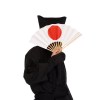
▼ It’d be sort of like if I told you this picture represents a maid, and not approval, because “may” sounds similar to “maid.”

So now hiragana and kanji are both out. Using either for meido would both create new problems, and there’s no practical way to produce a universally accepted kanji for it either, so there needs to be another phonetic character set for writing foreign loanwords: katakana.
Which is why meido gets written in katakana like this:

Now armed with all three sets of characters, let’s go back and write Watashi ha medio wo mita again.
▼ Kanji in red, hiragana in blue, katakana in green

Now we’ve got a nice kanji-hiragana-katakana-hiragana-kanji-hiragana pattern, giving us the easy-to-spot breakdown of:
1. 私は: Watashi (I) and ha (the subject marker)
2. メイドを: meido (the maid) and wo (the object marker)
3. 見た: mi- (the verb see) and -ta (marking the verb as past tense)
Looking at the situation from the standpoint of how a language advances and evolves, katakana gives Japanese a way to quickly incorporate new concepts from other cultures with a non-kanji-based writing system. Without katakana, there’d be no way for Japan to efficiently add global ideas to its writing. Without hiragana, there’d be no way to easily modify grammar. And without either, you’d end up with basically the Chinese writing system, which makes the Japanese one look like a cakewalk in terms of difficulty for foreign learners.
Speaking of foreign learners, the existence of katakana actually works out in your favor, once you get the hang of some of the more common ways the pronunciation of foreign words gets corrupted in Japanese. Once again, say you’re reading the sentence Watashi ha meido wo mita/I saw the maid.

Even if you didn’t already know that meido is the Japanese word for “maid,” once you see that it’s written in katakana, you know it’s a foreign loanword. When you spot メイド, even if you’ve never seen the word used in Japanese before, you can ask yourself “Is there a word in English/French/Spanish/etc. that sounds like this?” and you’ve got a chance of deciphering the meaning on the spot.
Yes, until you get a little experience with the language and build up a base of vocabulary, sometimes it’s going to be extremely frustrating that Japanese has three different styles of writing. It didn’t all start making sense to me until a couple of months into studying the language, but one day it clicked, and in the roughly 20 years since I haven’t reversed my stance on it. Trust me, as weird as it might seem in the beginning, I’ve never met anyone for whom the relationship between kanji, hiragana, and katakana was the insurmountable stumbling block that kept them from becoming proficient in Japanese, so if that’s your goal, stick with it (and all three of them).
Got a burning question about Japanese? Ask Casey on Twitter! Got a question about any other kind of burning? Ask your doctor!
Top image: RocketNews24, Pakutaso (edited by RocketNews24)
Insert images: Pakutaso (1, 2), RocketNews24, Pakutaso (2)