
It would just be silly if the kanji for “strong” had “weak” in it… right?
Honestly, considering most kanji were created thousands of years ago in an ancient Asian culture, it’s amazing how many of them still make a decent amount of sense today to foreign learners. For example, you have kanji like 人 (hito, meaning “person”), 木 (ki, meaning “tree”), and when you put them together: 休 (yasumu, meaning “to rest”). Makes just as much sense today as it did when it was first created!
But sometimes the individual pieces of kanji can come together in odd ways. In fact, every so often, the pieces might make you think the kanji has the complete opposite meaning than it actually does.
That’s why today we’re counting down the top five kanji with ironic meanings. What are they and how did they get this way? Today, we find some answers.
So let’s get to it! Starting off with…
Honorable Mention: 家 (“home”)
First up we have to touch on one well-known kanji that, while not quite ironic, is still made up of pieces that stand out in stark contrast to its meaning.
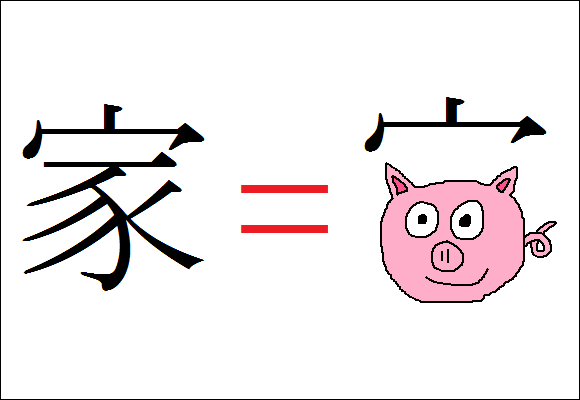
The kanji is one that most Japanese learners encounter pretty quickly: 家 (ie, “house”). Just looking at it, even if you don’t know any Japanese, it might seem like it makes sense. There’s a little roof thing on top… but what’s that thing underneath the roof? A person? A table?
Nope. It’s a pig.
▼ Just in case that wasn’t clear, here’s the parts of the
kanji for “house” shown a little bit more blatantly.
So why does this kanji mean “house” and not “barn” or “pig sty” or something?
According to Kenneth G. Henshall’s amazing book on kanji etymology, A Guide to Remembering Japanese Characters, the reasoning behind using “pig” has nothing to do with pigs. Instead it was likely used phonetically to stand in place for the word “relax.”
If that doesn’t make much sense, imagine if we wanted to write the English word “pigment” using pictures. One way to do it would be like this:
▼ The word “pigment” has nothing to do with “pigs” or “men,” but they can be used
phonetically to stand in for the sounds. Just like the kanji for “home.”

So in the ancient proto-Chinese or whatever language the people who first invented kanji spoke, the word for “relax” was probably close to if not identical to the word for “pig,” leaving us with the confusing kanji we have today.
#5. 強 (“strong”)

Oh yeah! The kanji for “strong.” That’s gotta be a badass kanji, right? Maybe it’ll be made up of “muscle” and “tearing open shirt?” Or “giant boulder” and “destroy with one fist?”
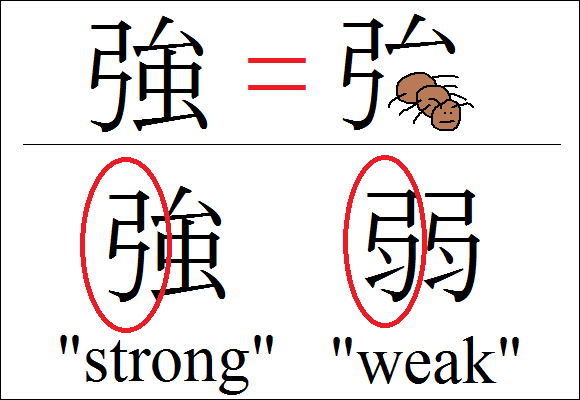
Or, you know, it could be made up of a part meaning “bug” and the same parts as the kanji for “weak.”
▼ Above: the part of the kanji that means “bug” replaced by an actual bug.
Below: the kanji for “strong” and “weak” share some pretty close features.
So what’s going on here?
Well, everything in the kanji for “strong” that’s not “bug” is a simplification of an older kanji that by itself means “big/strong.” The “bug” got added in at some point to refer to a horsefly, a “strong” insect whose bite can pierce the skin, and we’re left with the kanji we have today.
And for the similar parts that “strong” and “weak” share, that squiggly thing means “bow” and the two extra lines on the kanji for “weak” mean “hair.” So in the kanji for “strong,” the “bow” implies strength, as in the strength necessary to pull a bow. But in the kanji for “weak,” the “bow” implies something that can bend easily, like “hair” too.
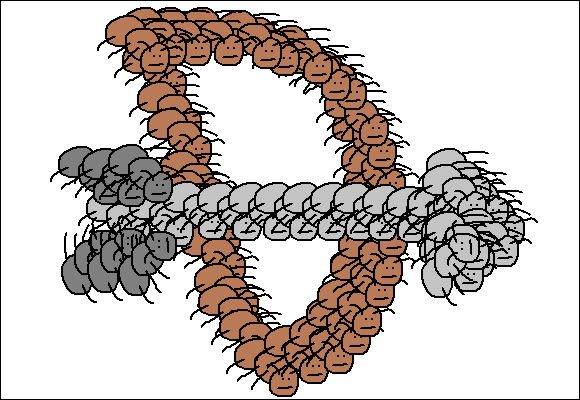
▼ So remember, a “bow with bugs” means “strong,” not “weak.”
Thanks a lot, ancients.
#4. 異 (“different”)
Next up is a kanji that doesn’t come up for a little while in most Japanese learners’ studies, but I know that once I hit it, it took me by surprise.
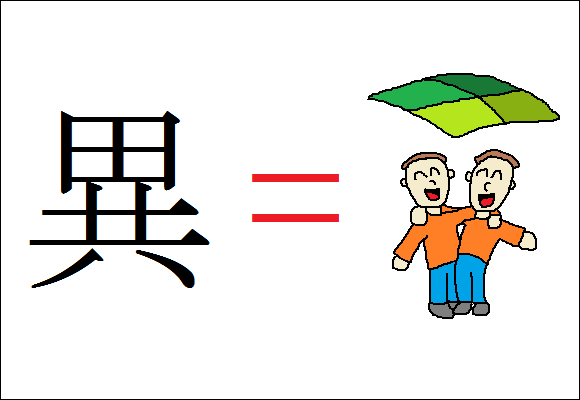
The kanji is 異 (kotonaru) meaning “different.” By this point you might be saying: “let me guess… is it made up of parts meaning ‘the same?'” And the answer is, yeah, kind of.
▼ The top part means “rice field” and the bottom part means “together.”
Because nothing quite says “different” like “together in the rice field?”
To explain this one, we have to go further back than before kanji even resembled anything like they do today, back when they were just basically little pictures full of squiggles and curves. One of the earliest forms of this kanji shows a “person putting on a mask” thus becoming “different from normal.”
▼ Yeah, geez, I’d say that ancient form is pretty “different from normal.”
It looks like something I should be running away from in a horror game.
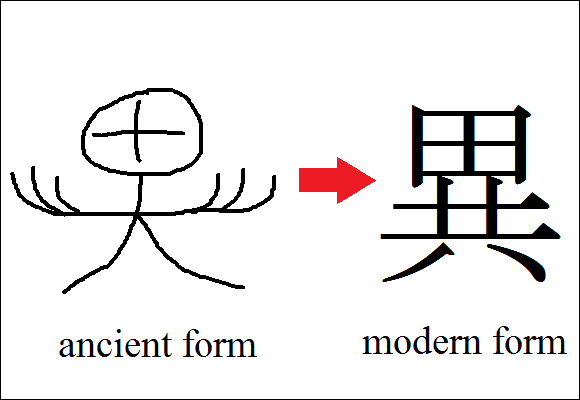
So actually this kanji originally never had anything to do with “together,” the modern form is just the result of making the ancient form more rigid. So we can just thank the ancient scribes who wanted to be able to write faster for transforming this kanji from something that made sense, into something that makes the opposite of sense.
#3. 固 (“hard”)
Now we’re getting to the kanji whose pieces seriously clash with their meaning.
Take 固 (katai, “hard”) for instance. What’s that thing in the center mean? Well it’s certainly not “strong,” we know that. How about “soft?” That would make as little sense as possible.
▼ And you’re close! It’s “old.”
Yep, the kanji for strong is basically an old man inside a box.
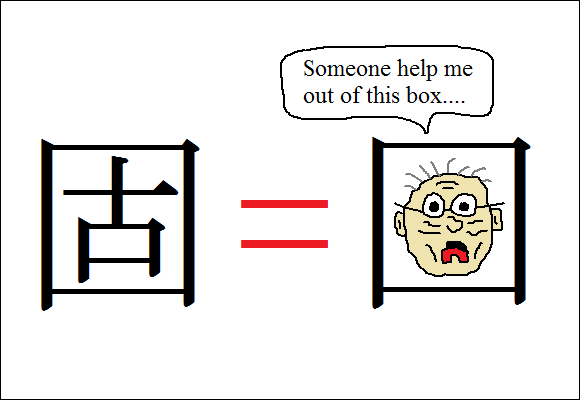
So how do we make sense of this seemingly-ironic make up? Are the walls too “hard” for his wrinkly fists to break through?
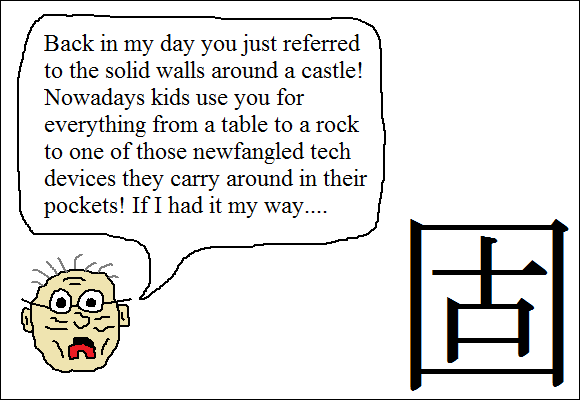
We don’t have to stretch it quite that far. The part meaning “old” is actually being used phonetically to represent “solid” (like how “pig” phonetically represented “relax” earlier), which extends its meaning to “being in a place for a long time” and “firmly established.” That eventually lead the kanji to mean “solid walls surrounding a castle,” then to “solid,” and then its modern meaning of “hard.”
▼ Sigh. Just let him go. He’ll tire himself out eventually….
#2. 暗 (“dark”)
Even though this kanji is only the #2 spot on the list, it’s probably the one that I get the most confused looks from students about. Whenever they first see it, their first reaction is almost always: “That doesn’t make any sense!”
The kanji in question is 暗 (kurai, “dark”). I’m not even going to bother asking for any guesses as to what it’s made up of.
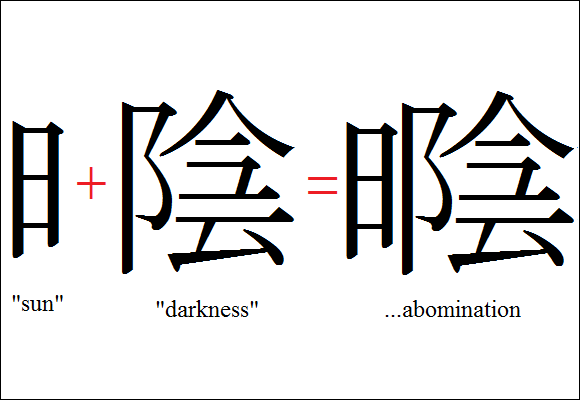
▼ It’s made up parts meaning “sun.” Two of them in fact.
Not exactly the “darkest” kanji in the world….

So how did the kanji for “dark” end up with two “suns” in it, literally the brightest thing in our solar system?
Again, we get to blame phonetics. The right part of the kanji is actually a separate kanji that means “sound,” but here it’s being used phonetically to represent “darkness,” which is pronounced the same.
▼ As you can see, “sound” is a little easier to write than “darkness,”
which is probably why the ancient scribes preferred using it.

Combined with the other “sun” on the left, we get a kanji that means “darkness from the sun” or “shade” and thus “dark.”
But the only “shade” around here is being thrown by me, to those ancient scribes! They should’ve manned up and just used the kanji for “darkness” in the first place.
▼ Ew. Actually, on second thought,
maybe the kanji we got is fine as is.
And the #1 kanji with an ironic meaning is…
.
.
.
.
.
.
.
.
.
.
1. 飢 (“starving”)

This isn’t the most commonly-used kanji, but when I first learned it, I had to double-check several times to make sure I hadn’t misunderstood something.
The kanji is 飢 (ueru, “to starve”), and its left part makes sense: “food/eat.” Okay, sure. So that means the right part is something like “not having” or “lacking,” right?
▼ Haha, nah, it means “table.” So yeah, the kanji for “starving” is literally
made up of components that mean “food on the table.”
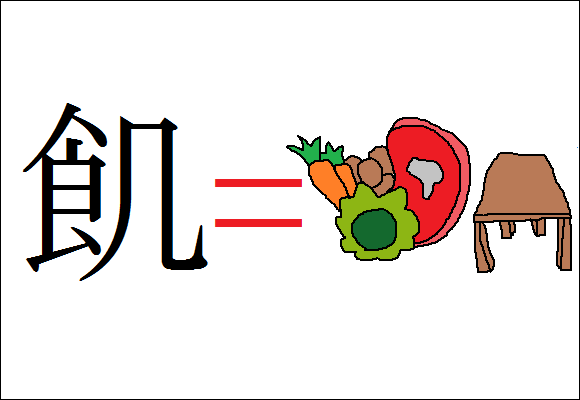
Why am I starving if there’s food on the table? Can someone explain this to me?!
Yet again, blame the words that sound alike. The word for “table” and “little/few” apparently sounded similar to the people who created this kanji, so that’s what they gave us.
And that’s about it. Sure, some have tried to finagle it to mean “there’s [not enough/little] food on the table,” but come on, now you’re just making up things that aren’t even there.
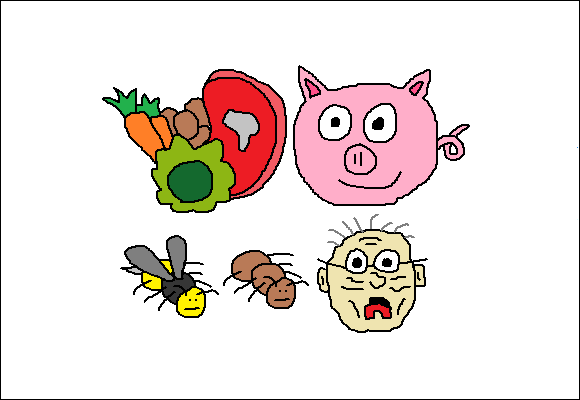
▼ It’d be like if I made a kanji for “feeling befuddled” with “food-pig bee-bug-old.”
…hey! Don’t you go getting any ideas, you ancient kanji-making scribes!
So there you have it, the top five kanji with ironic meanings. Did we miss any kanji that you had to struggle to come to terms with their seemingly-opposite meanings? Let us know in the comments and if you’re also struggling with food to eat in Japan, might we suggest the top five Japanese food for people who don’t like seafood?
References: A Guide to Remembering Japanese Characters
Top image: PAKUTASO (edited by SoraNews24)
Insert images: ©SoraNews24
W.T.F. Japan will be back next Thursday. In the meantime, say hi on Twitter and let me know if there’s any topics you’d like to see covered. See you next week!