
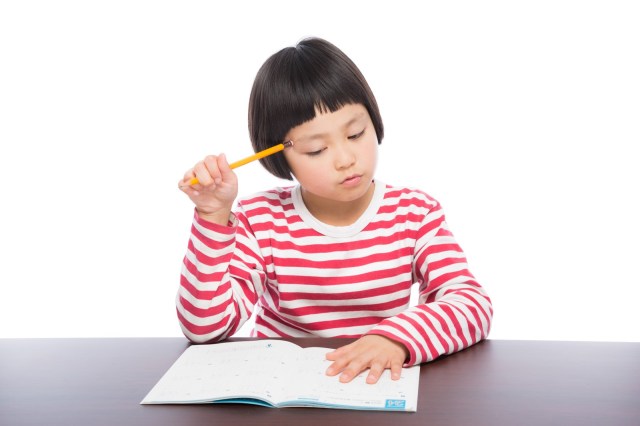
Because apparently three plus two equals morphophonology.
We’ve seen some strange questions on Japanese kids’ math homework before, but this recent one posted to the Internet by Japanese Twitter user @17_workout_kengot is on a different level. Or, at the very least, in a different school subject.
Here’s what they tweeted:
▼ “This is my daughter’s first-grade test. Huh? ‘Five birds’ is read as go-ba?? Is it because you’re being asked how many ba of birds there are instead of how many wa? What is this??”
https://twitter.com/17work_kengot/status/1194942130872913922
Let’s break down what’s going on here. First off, the translation of the math question:
“Question: There are 3 baby chicks. When 2 more baby chicks come, how many are there?
Answer: 5.”
Seems simple enough, but there’s something else going on here. For those unfamiliar, Japanese uses what’s called “counter words,” words that come after a number when counting certain things. Just like how in English we say two loaves of bread or three sticks of butter, Japanese does the same but with a lot more variety. In fact, sometimes too much variety.
Usually, birds are counted using the counter wa. One bird is ichi-wa, two birds are ni-wa, three birds are san-wa, and so on. However, in the above question, the teacher decided to forego using wa and used ba instead to count the chicks… for two out of three times.
Here’s what the question would look like halfway between Japanese and English:
“Question: There are 3-ba baby chicks. When 2-wa more baby chicks come, how-many-ba are there?
Answer: 5-wa.”
While the child got the math part of the question right, their 5-wa was marked incorrect and changed to 5-ba instead.
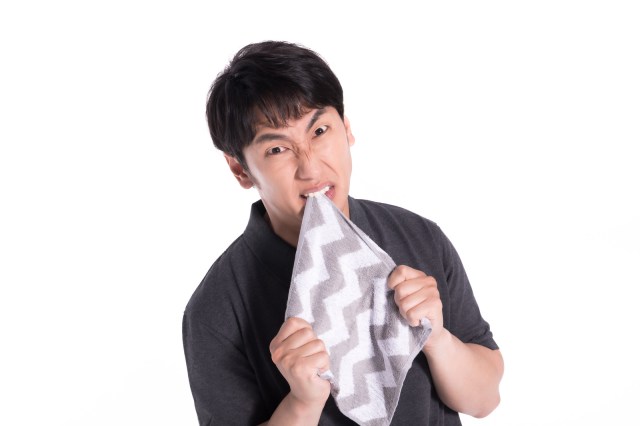
▼ Wa? Ba?? It’s making me angry enough to eat napkins!
Why does this matter? And why the discrepancy? Well friends, it’s time to go deep.
Anyone who’s studied Japanese before knows about the particle wa, used to mark the topic of a sentence. However, it has a bit of an oddity: instead of being written using the character わ (“wa”) it’s written using the character は (“ha”) instead.
This is because the particle used to be pronounced ha, but underwent a sound change, turning into wa. It’s kind of like how in English we still spell “knight” with a “k” at the beginning and a “gh” in there, even though they’re not pronounced anymore.
So, because of this sound change, other words that were originally pronounced with ha changed to wa, such as the counter for birds. While birds were counted using ha in the past, it’s rarely done today. Though not quite as bizarre as an English person pronouncing “knight” as “kuh-nig-uht,” it’s not too far off.
▼ I’m gonna eat the whole tablecloth at the Kuh-nig-uhts of the Round Table!

But wait a second! If it used to be ha, then what’s the deal with the ba in the math question? That’s due to another quirk of Japanese linguistics: morphophonology, the sound changes that take place when words combine together.
Depending on the number that comes before the counter, sometimes the counter changes to make the word flow more easily. For example, when counting “long cylindrical” things like pencils using hon, you say i-ppon, ni-hon, san-bon.
Similarly, back in the day before the sound change, instead of counting chicks as ichi-ha, ni-ha, san-ha, they would likely use i-ppa, ni-ha, san-ba.
But! Here’s the kicker. Even if birds were counted using ha (which they’re not really anymore), the teacher’s corrected answer of go-ba would still be wrong. The number for five (go) does not induce a change on the counter’s pronunciation. Just like you don’t say go-bon when counting five pencils (you say go-hon), go-ba is just not correct Japanese in any way.
Even the NHK’s broadcaster guide, the standard for Japanese spoken on the news, lists san-ba (“three birds”) and yon-ba (“four birds”) as possibilities, but not go-ba (“five birds”).
Basically the only way it’s correct is if the teacher made up her own counter word, and her distinction between it being wa or ba is based on whatever she wants.
▼ Waaaaa baaaaa!

At the end of the day, while the correction on the homework is a bit silly, at least we all got to learn a lot about Japanese linguistics.
And hey, as long as the assignment didn’t instill a sense of existential dread into the students, I’d call that a victory!
Source: Twitter/@17work_kengot via Itai News
Top image: Pakutaso
Insert images: Pakutaso
● Want to hear about SoraNews24’s latest articles as soon as they’re published? Follow us on Facebook and Twitter!
 Counting in Japanese just became a whole lot easier with this handy infographic
 W.T.F. Japan: Top 5 most confusing Japanese counter words【Weird Top Five】
 Japanese first grader wins math contest by quantifying “which hiragana are the hardest to write”
 Can a downtown Tokyo super sento bathhouse beat a hotel for a one-night stay?
 Two food hacks take Japan’s convenience store fried chicken to amazing new sandwich heights
 Pokémon and Ikea Japan cross over into each other’s worlds with collaboration events
 Pokémon Centers across Japan cancel April events after stabbing in Tokyo
 Tokyo Police shows a clever way to conserve water in a disaster and impress children with magic
 Tokyo teahouse serves up a sakura matcha dessert you won’t find anywhere else
 Sakura season arrives at McDonald’s Japan with new range of exclusive menu items
 Does this video about an abandoned dog leave you wiping your eyes or shaking your fist?
 One Piece creator has hidden secret of anime treasure’s identity in chest at bottom of real-world ocean
 How to make a Big Mac in Tokyo at a fraction of the price with minimal effort【SoraKitchen】
 Tokyo’s best museum for foreign travelers finally reopens after being closed for four years
 Pokémon lacquerware series expands for Year of the Horse with new handcrafted design[Video]
 Famous Tokyo cherry blossom spot installs view-blocking screens to fight overcrowding[Video]
 Tokyo subway and almost all Tokyo train lines now accepting credit card tap payments
 Fading Tokyo – Searching for signs of the Showa era as local neighborhoods evolve[Photos]
 Totoro Fund line of beautiful artwork and apparel lets you help the real-world Totoro Forest
 Tokyo turns its phone booths into free Wi-Fi hotspots, and here’s how to use them
 Studio Ghibli adds new My Neighbour Totoro 2026 Corn Gift to its anime store for Mother’s Day
 Japan now has a special desk for people who work at home with a pet cat[Photos]
 Uniqlo announces new T-shirts for One Piece, Naruto and more for manga publisher’s 100th birthday
 Train station platform ramen store closes its doors on half a century of history in Tokyo
 Starbucks Japan releases new My Fruit³ Frappuccino at only 34 stores around the country
 Studio Ghibli releases Catbus pullback keychain that runs like the anime character
 Krispy Kreme releases Super Mario doughnuts in Japan for a limited time
 Japanese onsen egg maker from 100-yen store Daiso needs to be on your shopping list
 Nine great places to see spring flowers in Japan, as chosen by travelers (with almost no sakura)
 Survey asks foreign tourists what bothered them in Japan, more than half gave same answer
 Japan’s human washing machines will go on sale to general public, demos to be held in Tokyo
 Starbucks Japan releases new drinkware and goods for Valentine’s Day
 We deeply regret going into this tunnel on our walk in the mountains of Japan
 Studio Ghibli releases Kodama forest spirits from Princess Mononoke to light up your home
 Starbucks Japan releases new sakura goods and drinkware for cherry blossom season 2026
 Japan’s newest Shinkansen has no seats…or passengers [Video]
 Major Japanese hotel chain says reservations via overseas booking sites may not be valid
 Put sesame oil in your coffee? Japanese maker says it’s the best way to start your day【Taste test】
 No more using real katana for tourism activities, Japan’s National Police Agency says