
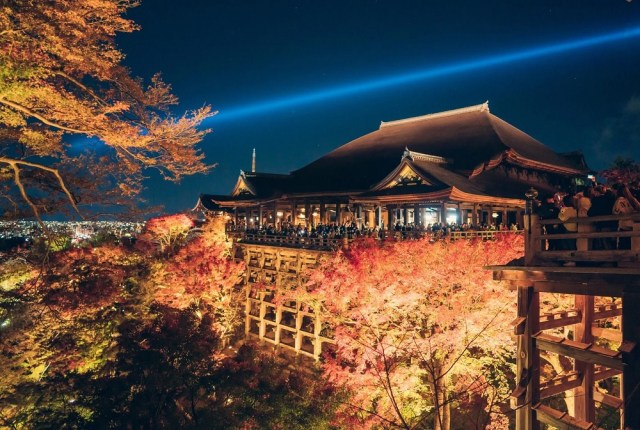
A win-win idea that’s long overdue.
In recent years, the issue of overtourism has been getting increasing amounts of attention in Kyoto. The city was already one of Japan’s most popular travel destinations for both domestic and international tourists, and with the weak yen and pent-up post-pandemic travel desire casing an especially large surge in inbound international visitors, the Kyoto Municipal Transportation Bureau has decided to take action by creating special Tourism Express Bus routes.
Buses have been among the places where tourism most visibly bumps up against locals’ lifestyles. Despite its image as a quiet, cultured community, Kyoto is not a small city, having a population of close to 1.5 million people. However, Kyoto’s train and subway network is fairly compact, with most of its rail stops clustered in a relatively small area in the center of downtown. That means many locals who live outside the very center of the city and are reliant on public transportation need to take the bus.
At the same time, most of Kyoto’s biggest tourism draws are also located outside the rail network, on the outer fringes of the downtown area, and some are also nestled against the foothills on the eastern edge of town, limiting the angles they can be approached from. Those factors regularly funnel tourists onto the same buses that local residents use to get around, more so than in just about any other large Japanese city. The result has been increasingly crowded buses, sometimes so much so that there’s not enough room to even get on unless you wait for multiple buses to come by.
Obviously, that isn’t a situation that locals or travelers enjoy, and a year ago the Kyoto city government announced that it would no longer be offering its popular 700-yen (US$4.70) one-day all-you-can-ride bus passes to address overcrowding, instead bundling a day’s worth of unlimited subway and bus rides together in an 1,100-yen combo pass. As mentioned above, though, many of Kyoto’s most popular sightseeing attractions have no nearby subway stops, and so buses have remained crowded. So on Thursday, the Kyoto transportation bureau announced that it will be starting a pair of Tourism Express Bus routes this summer, specifically designed for travelers, to help divert them away from buses being used by locals.
▼ Tourism Express Bus routes, with the Kyoto Station stop (京都駅前) marked in yellow (note that the bus only stops at Kiyomizumichi (清水道) on its way back to Kyoto Station).
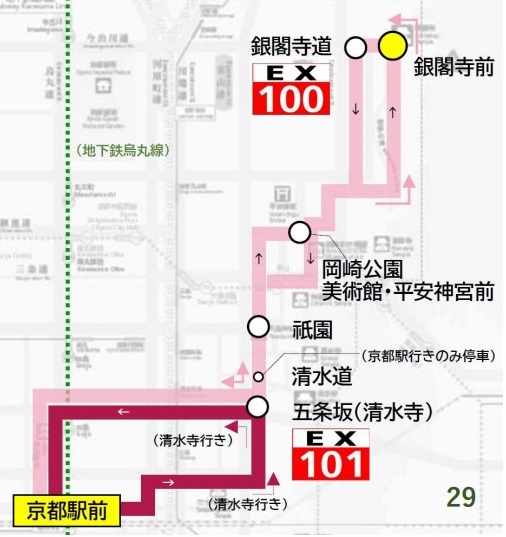
The Tourism Express Buses will run on weekends and holidays, with both routes starting at Kyoto Station. The longer route, designated EX100, will depart from Kyoto Station and head east into the Higashiyama district, with its first stop at Gojozaka, down the hill from Kiyomizu Temple. The bus will then travel north to its next stop at Gion, Kyoto’s famed geisha quarter, and then to a combined stop for Heian Shrine, Okazaki Park, and the Kyoto Museum of Art. After that, the bus goes further north to Ginkakuji (a.k.a. the Silver Pavilion), stopping once in front of the site and again nearby at Ginkakuji-michi, from where it turns back for the return to Kyoto Station, making one additional stop at Kiyomizu-michi, at the base of the slop that leads to Kiyomizu Temple. A shorter route, EX101, stops only at Gojozaka before heading back to Kyoto Station. 24 EX100 buses and 16 EX100 will run daily, approximately three each per hour between 9 a.m. and 4 p.m. The new routes will begin running on June 1.
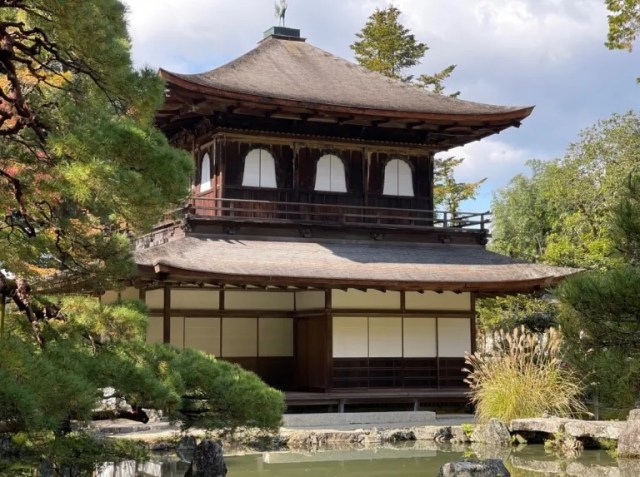
▼ Ginkakuji, located near the northernmost stop on the Tourism Express Bus route
The creation of the Tourism Express Buses doesn’t mean that travelers are barred from using ordinary buses, and locals are likewise allowed to use the nominally for-tourist routes too. Two aspects will likely result in a natural divergence of local and tourist ridership, though.
First, as you can see from the above map, there aren’t a ton of stops on the Tourism Express Bus route. Yes, tourists can easily spend a full-day sightseeing at the spots it provides access to, especially since Ginkakuji is connected to a handful of other temples via the Philosopher’s Path walking street. The absence of stops in any major office, shopping, or residential areas, though, means that there’s little reason for locals to take the Tourism Express Bus while going about their everyday, non-sightseeing lives.
The other divergence factor is the price. A ride on the Tourism Express Bus will cost 500 yen (US$3.35), or 250 yen for children. That’s double the flat fee charged for a ride on normal Kyoto city buses, and while that extra amount is miniscule difference when folded into an entire trip-to-Kyoto/Japan travel budget, residents who are taking the bus dozens or hundreds of times a year will presumably gravitate towards the less expensive standard bus options.
There’s a possibility that extra-thrifty travelers may still feel the allure of the cheaper normal buses, but the smaller number of stops on the Tourism Express Bus routes also mean a shorter ride to the destinations along the way. From Kyoto Station, the ride to Gojozaka is expected to shrink to just 10 minutes, down from the 15 it takes on a normal bus, and the time from Kyoto Station to Ginkakuji is cut almost in half, at only 24 minutes compared to the regular 44. The Tourism Express Bus will also be covered by the 1,100-yen one-day Kyoto bus/subway pass.
One could argue that it’s strange that the Tourism Express Buses will cost more to ride, especially with the truncated EX101 route being so short. After all, if the whole reason they’re being created is because there are so many tourists, it seems there should be enough of an economy of scale to price the Tourism Express Buses like any other. As discussed above, though, the price difference is likely to help separate local and tourist use.
Quibbles about pricing aside, the Tourism Express Bus seems like an idea that’s long overdue. Kyoto has always been a city that attracts travelers, going back to the days when its status as Japan’s capital city made it not just the center for lofty fine arts, but for commerce and commoners’ pursuits too. Its rising popularity as a travel destination continually contributes to an international appreciation and affinity for Japan, and so an initiative like this to help Kyoto continue to be a showcase of Japan’s traditional culture to people from all over the world while still remaining a livable city for those who call it home.
Source: Kyoto City (1, 2)
Top image: Pakutaso
Insert images: Kyoto City, SoraNews24
● Want to hear about SoraNews24’s latest articles as soon as they’re published? Follow us on Facebook and Twitter!
 Kyoto wants to add extra charges for tourists to use city buses
 Kyoto experiencing problems with foreign tourists not paying for bus fares, but not on purpose
 Is Kyoto really as crowded with foreign tourists as they say?
 Kyoto will abolish one-day bus passes to combat tourism overcrowding
 How crowded is Kyoto now without international tourists?【Photos】
 Picturesque Tokyo park plays host to millions of flowers and soap bubbles this spring
 Final Fantasy invites you to adventure in Fukushima with Fukushima Fantasy Chocobo fun[Video]
 Why is Yoshinoya called Yoshinoya?
 50-year-old instant noodle recipe is back from the past in Japan for a limited time[Taste test]
 We eat 13 of the most highly recommended sushi items at Sushiro and pick the best of the best
 Famous Tokyo cherry blossom spot installs view-blocking screens to fight overcrowding[Video]
 Rumors say this is Japan’s very best McDonald’s branch, but what makes it special?[Taste test]
 Japan now has a special desk for people who work at home with a pet cat[Photos]
 Uniqlo announces new T-shirts for One Piece, Naruto and more for manga publisher’s 100th birthday
 Shibuya’s Hachiko Family public art installation will be permanently removed, not relocated
 Krispy Kreme releases Super Mario doughnuts in Japan for a limited time
 7-Eleven Japan releases a crazy new viral sandwich: Chocolate Sprinkles and Whipped Cream
 Japan now has a “for foreign tourists only” Mt. Fuji sightseeing train[Video]
 Totoro and Calcifer become little light-up lanterns for Ghibli-style excursions or at-home decor
 Studio Ghibli releases the My Neighbour Totoro tea caddy, with a magical self-closing lid
 Create a tiny Ghibli anime world on your bookshelf with new miniature papercraft art kits
 Starbucks Japan unveils new sakura cherry blossom collection for hanami season 2026
 Train station platform ramen store closes its doors on half a century of history in Tokyo
 Starbucks Japan releases new My Fruit³ Frappuccino at only 34 stores around the country
 Studio Ghibli releases Catbus pullback keychain that runs like the anime character
 Japanese onsen egg maker from 100-yen store Daiso needs to be on your shopping list
 Nine great places to see spring flowers in Japan, as chosen by travelers (with almost no sakura)
 Survey asks foreign tourists what bothered them in Japan, more than half gave same answer
 Japan’s human washing machines will go on sale to general public, demos to be held in Tokyo
 Starbucks Japan releases new drinkware and goods for Valentine’s Day
 We deeply regret going into this tunnel on our walk in the mountains of Japan
 Studio Ghibli releases Kodama forest spirits from Princess Mononoke to light up your home
 Starbucks Japan releases new sakura goods and drinkware for cherry blossom season 2026
 Japan’s newest Shinkansen has no seats…or passengers [Video]
 Major Japanese hotel chain says reservations via overseas booking sites may not be valid
 Put sesame oil in your coffee? Japanese maker says it’s the best way to start your day【Taste test】
 No more using real katana for tourism activities, Japan’s National Police Agency says
 Japan to have full-flat overnight sleeper buses this spring【Video】
 Kyoto raises hotel accommodation tax to fight overtourism, travelers could pay up to 10 times more
 Tourists warned about fake volunteer guide near Kinkakuji in Kyoto
 Kyoto temple suffering from littering tourists claiming not to understand Japanese verbal warning
 One thing NOT to do in Kyoto if you’re headed there during the vacation period
 Foreign tourists outnumber Japanese ones at Kyoto hotels for first time ever
 Ujicha Bus in Kyoto celebrates Uji matcha green tea with Japanese teahouse interior【Photos】
 Is Kyoto less crowded with tourists after China’s don’t-go-to-Japan warning?【Photos】
 How to travel from Tokyo to Kyoto on the overnight bus and not lose your sanity
 Delicious ramen, cursed hills, green spaces, and more on the Sugimaru bus【Tokyo Loop Buses】
 Hidden history, retro cafes, and a shoe shrine on Asakusa bus loop【Tokyo Loop Buses】
 Kyoto sightseeing live stream for Chinese viewers becomes controversial, sparks ire in locals
 Taking the Kyoto overnight bus for the first time
 Beautiful park, gigantic wholesale market, and smooth-as-silk coffee on Omori bus loop【Tokyo Loop Buses】
 Kyoto losing its luster as a school trip destination as tourist crowds continue to swell
 No-bus Kyoto sightseeing! SoraNews24’s ultimate on-foot guide for Japan’s former capital【Part 2】
 No-bus Kyoto sightseeing! SoraNews24’s ultimate on-foot guide for Japan’s former capital【Part 1】