
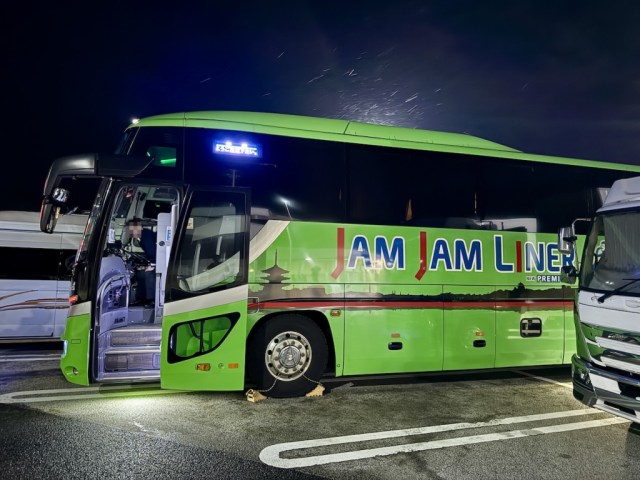
Hop on the bus in downtown Tokyo, wake up in a beautiful historic city in the northernmost prefecture of Honshu.
Every night after work, our reporter Masanuki Sunakoma walks to the bus stop and catches a ride home from our office in downtown Tokyo’s Shinjuku neighborhood. Except on a recent night when he instead hopped on a different bus for a trip to Aomori, the northernmost prefecture on Japan’s main island of Honshu.
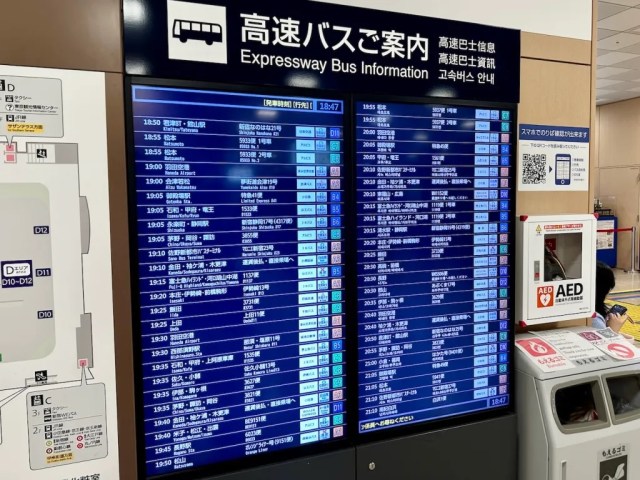
For most travelers headed from Tokyo to Aomori, the Shinkansen is going to be the first mode of transportation they think of. Even by bullet train it takes about three hours to get from Tokyo Station to Shin Aomori Station, and from there it’s another 45 minutes by non-Shinkansen train to Hirosaki, the town that Masanuki was headed to, and the transfer time between trains can take an hour if your timing is bad.
All of that put together, though, is still less time in transit than you’ll spend on the bus, which takes 10 hours to go from Tokyo to Hirosaki. The upside, though, is that there’s an overnight bus, which leaves Tokyo Station at 9:40 p.m., swings by the Shinjuku Busta bus terminal at 10:20 p.m., and then gets to Hirosaki at 7:40 the next morning, letting you make the trip while you sleep, save some cash compared to the cost of a Shinkansen ticket, and eliminates one night’s worth of hotel expenses. What’s more, if you want to really stretch your budget, you can take the next day’s overnight bus back from Hirosaki, letting you do a one-day trip to Hirosaki from Tokyo without needing any hotel at all.

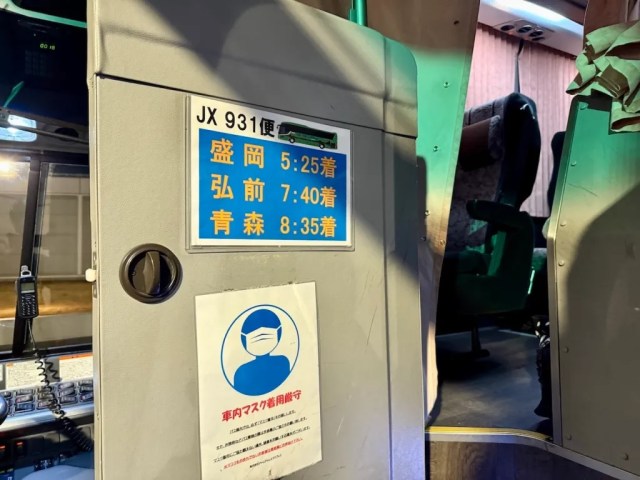
There are multiple bus companies that offer overnight service between Tokyo and Aomori, but the one we booked was the Jamjam Liner JX931 (the Jamjam Liner JX932 is the one that runs from Hirosaki to Tokyo). Tickets for the Shinjuku to Hirosaki stretch of the route start at 8,000 yen (US$54), and we paid just a little more, 10,500 yen, because we were traveling on March 19, one day ahead of the spring equinox holiday.
▼ The bus stops first at Morioka (盛岡) in Iwate Prefecture before arriving in Hirosaki (弘前) and then goes on to its final stop at Aomori City (青森).

The reclining seats are nicely upholstered, with a built-in adjustable head rest. Unlike the overnight bus Masanuki took to Kanazawa, Jamjam Liner has a three-seat configuration for each row, so there’s no one sitting directly next to you, and there are even interior curtains for extra privacy, plus curtains to block the light from the windows as you sleep.
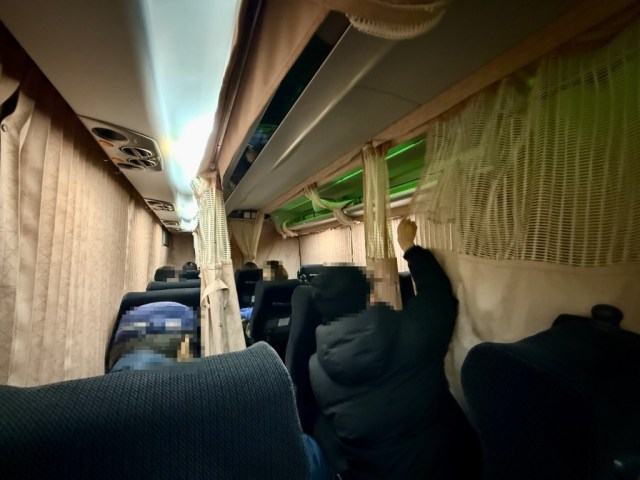
▼ The lights are on during boarding, but turned off shortly after the bus gets underway.

Masanuki is a pretty tall guy, but he still had enough room to get reasonably comfortable, certainly more than he would on an airplane. Seats are reserved/assigned, and one point of advice is that if you’ve booked a seat next to a window, you might want to wear warm clothing or tights if it’s a chilly night since the chill of the glass can sometimes partially transfer into the seating area.
▼ Note the fold-out drink holder by your feet.

Seats are equipped with power plugs/USB charging ports, and there’s a bathroom at the back of the bus in case you hear the call of nature before your arrival. The bus also make a stop at the Kunimi Service Area expressway rest stop in Fukushima Prefecture at around 2:50 in the morning.

Though the rest stop’s restaurants are all closed at this time, there is a convenience store that’s open where you can buy snack or drinks, like the cup of apple juice got. It’s also a good opportunity to stretch your legs if you feel like it, but don’t wander too far, since the bus only stops for about 10 minutes before getting back on the road.

An advantage to driving through the night is that there’s almost no traffic on the road, and Japan’s overnight buses often arrive with nearly train-like punctuality, within just a few minutes of their promised time. That was the case once again for Masanuki, who arrived at the Jotoguchi entrance to Hirosaki Station right around 7:40 a.m.
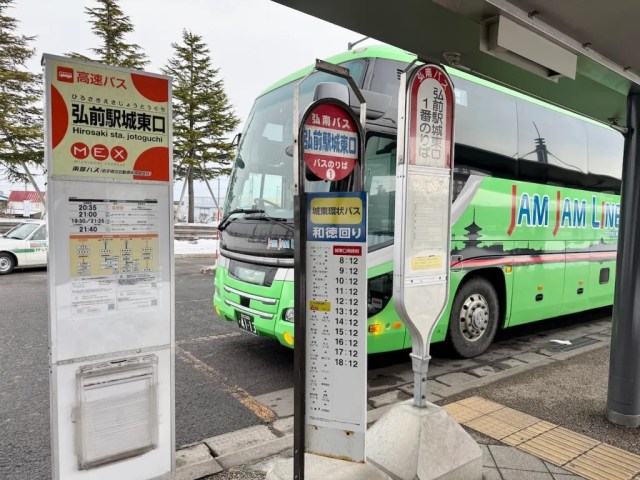

Now, like we said above, Masanuki got on the bus on March 19, arriving on the 20th. And yet, because of how far north Hirosaki is from Tokyo…

…there was a ton of snow on the ground!
▼ “Welcome to Aomori!” says the sign, but all the snow does a good a job of telling you which prefecture you’re in too.

It didn’t take long until Masanuki started spotting something else Aomori is famous for: apples.
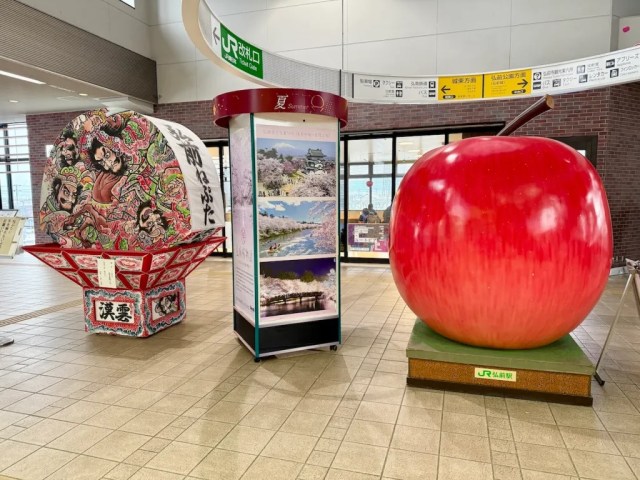

Aomori grows some of Japan’s tastiest apples. As a matter of fact, the Fuji apple, Japan’s most famous export of the fruit, originated in the prefecture and its name comes from the Aomori town of Fujisaki, not Mt. Fuji.
▼ Even this sculpture located outside the station in called Ringo no Kaze, meaning “apple wind.”


Masanuki’s plan was to head over to the Hirosaki Tourist Information Center’s office at the station and rent a bicycle to go exploring on. However, there were two problems with this. First, the office doesn’t open until 8 a.m., and second, they don’t start renting out bikes until mid-April, when the weather gets warmer and the snow melts.

That meant Masanuki was going to have to get around on foot, despite the temperature being a very brisk one degree Celsius (33.8 degrees Fahrenheit) this day. So you’ll want to dress warm and wear comfortable shoes if you’re headed to Aomori at this time of year.


Thankfully, Hirosaki’s city planning takes into account the weather patterns, and there are some subterranean pedestrian paths you can utilize to get out of the elements for a while if you want to. Masanuki was able to use one for part of his walk over to Niji no Mart.
▼ The eight-minute walk from Hirosaki Station to Niji no Mart


Niji is the Japanese word for rainbow, and yes, the place has a colorful exterior. It’s not the architectural aesthetics that draw people to this place, though…

…but the food! Niji no Mart is a fish and produce market considered “Hirosaki’s kitchen.” Built in 1956. it’s the town’s equivalent to Kyoto’s Nishiki Market, except that it’s all indoors since Hirosaki is so chilly for so much of the year.

Niji no Mart opens at 8 a.m., so Masanuki figured this would be a good place to grab breakfast since they also have restaurants, and the one that he decided on was ramen joint Koruton.

Their most popular menu item is the tonkotsu (pork stock) ramen, which is priced at 850 yen.

With bold, hearty flavors this was the perfect way for Masanuki to warm/fill himself up after the long bus ride and early morning walk in the snow.


It was 8:30 by the time Masanuki was done eating, which meant that Hirosaki’s castle, museums, and other tourism facilities still weren’t open yet. Feeling the cold starting to set in once again he decided to head to the Asahi Sauna to chill for a while in the warmest way possible.

▼ The walk from Niji no Mart to Asahi Sauna
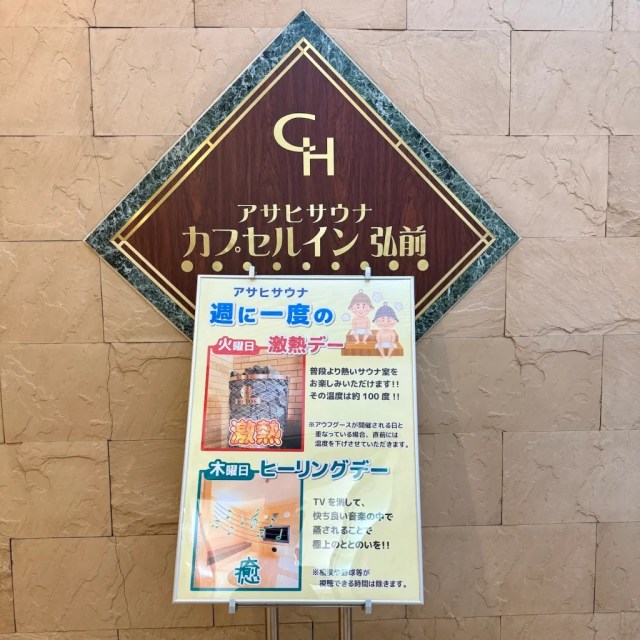
Asahi Sauna is a men-only hot spring bath and sauna that’s open 24 hours a day, with prices starting at 700 yen for a three-hour pass plus 300 yen for a rental towel if you didn’t bring your own. After an extended soak and sauna session, accompanied by the soothing sounds of some new-age healing music, Masanuki felt completely revitalized, and now that it was 10:30, the town was starting to come to life too.

Hirosaki was one of the earlier places in Japan to develop a taste for coffee, and you’ll find a number of old-school cafes around town, like Ichibankan.

▼ Asahi Sauna to Ichibankan
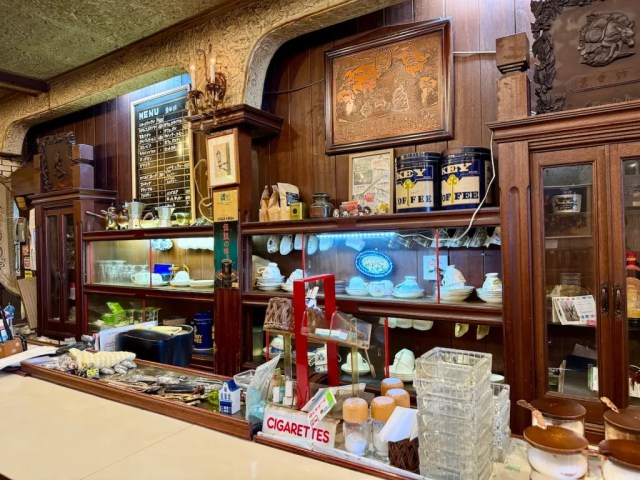
Taking a seat at the counter, Masanuki ordered a Kilimanjaro blend for 400 yen, which came in an exquisitely classy cup and saucer. As he sipped his drink, Masanuki asked the shop’s owner if she could recommend a place for lunch.
She recommended Takasago, a soba restaurant, but the suggestion came with a bit of a warning too. As we said, Masanuki was in town on the spring equinox, a day on which Japanese people traditionally visit their family graves. “After visiting the grave, people in these parts go out to get soba,” the owner informed him. “There’s a soba restaurant around here called Takasago that’s really, really popular. There’s usually an hour wait to get a table, and since they open at 11, if you want to check it out you should probably start heading over there now.”

So that’s what Masanuki dd once he’d finished his coffee. On the way to Takasago he passed by the Aomori Bank Memorial Hall, a preserved building which was constructed in 1904 and is now a government-designated important cultural property.

▼ Ichibankan to Aomori Bank Memorial Hall

▼ Aomori Bank Memorial Hall to Takasago
Takasago has plenty of old-school appeal to it too, with its pine tree-flanked front gate looking like the entrance to a samurai residence.

Masanuki strolled up at 10:50, and shortly after that cars started pulling up with people hoping to get in as part of the restaurant’s first seating of the day. Looking at the license plates, Masanuki saw more than a few from places outside Aomori Prefecture, proving that the place really is popular.

With the restaurant having been so highly recommended, Masanuki decided to splurge on an 1,800-yen ten-zaru set of tempura and cold soba. It was beautiful to look at, and once he started eating he felt even happier that he’d ordered this semi-premium meal.
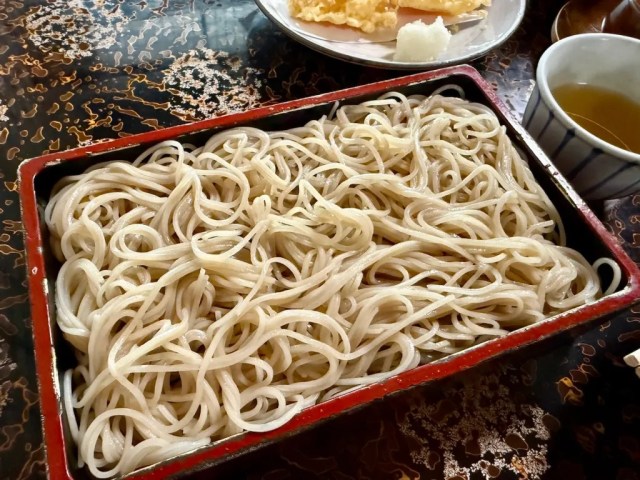
Everything was amazingly delicious. The soba noodles were cooked to perfection with just the right firm-to-chewy texture transition you bite into them, and the tempura shrimp were plump and flavorful.
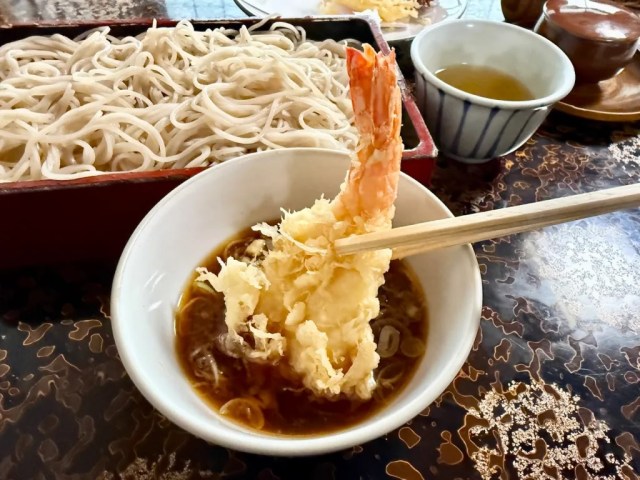
An especially sophisticated touch was the bite-sized bundle of crispy fried soba noodles tied together with a strip of nori seaweed.

As Masanuki left the restaurant happy and full, he noticed that a sign had been taped to the front door saying that there was now an hour wait for a table, so he once again silently thanked Ichibankan’s owner in his heart for her advice to get there early.
Now it was finally time to see the sites of the town, and we’ll be back soon with the second half of Masanuki’s overnight bus trip to Hirosaki.
Related: Jamjam Liner website
Photos ©SoraNews24
● Want to hear about SoraNews24’s latest articles as soon as they’re published? Follow us on Facebook and Twitter!
 How to do an overnight bus trip to Hirosaki from Tokyo – Part 2【Photos】
 How to do an overnight bus trip to Tokushima from Tokyo – Part 1【Photos】
 No train, no hotel – How to do an overnight bus trip to Kanazawa from Tokyo – Part 1【Photos】
 How to do an overnight bus trip to Tokushima from Tokyo – Part 2【Photos】
 How to do an overnight bus trip to Kanazawa from Tokyo【Photos】 – Part 2
 7-Eleven Japan releases a crazy new viral sandwich: Chocolate Sprinkles and Whipped Cream
 Studio Ghibli releases the My Neighbour Totoro tea caddy, with a magical self-closing lid
 Nissin Donbei to sell Classic line of instant udon and soba noodles for its 50th anniversary
 Create a tiny Ghibli anime world on your bookshelf with new miniature papercraft art kits
 Public restrooms in Osaka to get in-stall video screens with ads
 Ghibli Museum building becomes a cuddly cushion
 Starbucks Japan releases new My Fruit³ Frappuccino at only 34 stores around the country
 Here’s what you need to know before the 2026 Sanrio Character Ranking voting goes live
 The massive Pokémon card public art display going on in Japan right now is a thing of beauty【Pics】
 Japanese vending machine sells just one thing at this station
 Japanese onsen egg maker from 100-yen store Daiso needs to be on your shopping list
 Cherry blossoms begin blooming in Japan with record-early starts for sakura season
 Tokyo government organizes food truck event to clear out delinquent/homeless teen gathering area
 Nine amazing off-the-beaten-path cherry blossom spots in Japan for yaezakura and shidarezakura
 Stunning central Japan wisteria festival is like a purple fantasy straight out of a Ghibli movie
 When will the cherry blossoms reach full bloom in Japan this year?[Forecast]
 Studio Ghibli unveils new Rollbahn notebook in honour of Howl’s Moving Castle
 Studio Ghibli adds new anime tumblers to its cool streetwear brand in Japan
 Universal Studios’ Sailor Moon theme park attraction is finally coming to America
 Starbucks Japan unveils new sakura cherry blossom collection for hanami season 2026
 Train station platform ramen store closes its doors on half a century of history in Tokyo
 Studio Ghibli releases Catbus pullback keychain that runs like the anime character
 Nine great places to see spring flowers in Japan, as chosen by travelers (with almost no sakura)
 Starbucks Japan releases first-ever Hinamatsuri Girls’ Day Frappuccino
 Studio Ghibli adds new Mother’s Day gift sets to its anime collection in Japan
 Virtual idol Hatsune Miku redesigned with look that adds new elements and brings back old ones
 Survey asks foreign tourists what bothered them in Japan, more than half gave same answer
 Japan’s human washing machines will go on sale to general public, demos to be held in Tokyo
 Starbucks Japan releases new drinkware and goods for Valentine’s Day
 We deeply regret going into this tunnel on our walk in the mountains of Japan
 Studio Ghibli releases Kodama forest spirits from Princess Mononoke to light up your home
 Starbucks Japan releases new sakura goods and drinkware for cherry blossom season 2026
 Japan’s newest Shinkansen has no seats…or passengers [Video]
 Major Japanese hotel chain says reservations via overseas booking sites may not be valid
 Put sesame oil in your coffee? Japanese maker says it’s the best way to start your day【Taste test】
 No more using real katana for tourism activities, Japan’s National Police Agency says
 Beds on a bus: Travel on Japan’s first-ever full-flat overnight sleeper bus from Tokyo
 Japan has only one time zone, and sunset comes a lot earlier in Tokyo【Photos】
 No-bus Kyoto sightseeing! SoraNews24’s ultimate on-foot guide for Japan’s former capital【Part 1】
 No-bus Kyoto sightseeing! SoraNews24’s ultimate on-foot guide for Japan’s former capital【Part 4】
 Aomori soul food koganeyaki steals our hearts but not our wallets at only 70 yen each
 No-bus Kyoto sightseeing! SoraNews24’s ultimate on-foot guide for Japan’s former capital【Part 2】
 No-bus Kyoto sightseeing! SoraNews24’s ultimate on-foot guide for Japan’s former capital【Part 3】
 Japanese onsen stand is part gas station, part hot spring vending machine
 Japan Extreme Budget Travel! A trip from Tokyo to Izumo for just 30,000 yen [Part 1]
 Hidden travel gems of northern east Japan, presented by the Kita Kanto Brothers!【Photos】
 How far away from Tokyo can you get with 5,000 yen? Let’s find out!
 A trip to see the breathtaking mountain beauty of Nagano’s Kamikochi【Part 1】
 Japan Extreme Budget Travel! A trip from Tokyo to Izumo for just 30,000 yen [Part 2]
 How to get to east Japan’s best highway rest stop for foodies without a car of your own
 A crash course in Japanese folktales from a trip to the five Taro Parks of Gifu【Photos】
 Escape from Tokyo – Another story: Victory beach trip【Photos】