
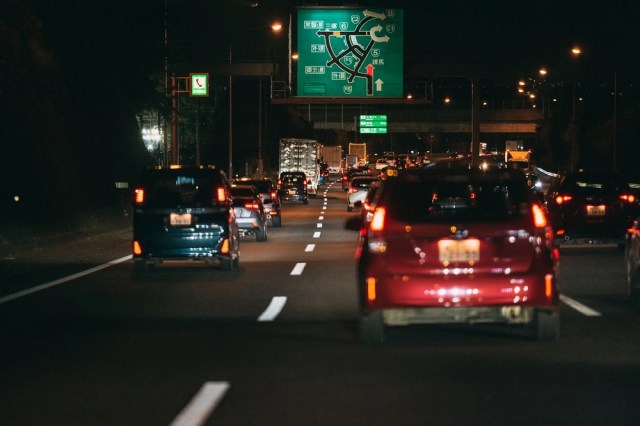
Many more are yet to do so, though, and the toll collector isn’t planning to let them off for free.
Japan’s expressways require drivers to pay a toll to use them, but at least they have a pretty slick payment system. Rather than having to stop at toll both and fiddle with change to pay to an attendant or feed into a machine, the vast majority of drivers make their payments through an ETC (electronic toll collection) card. The system works wirelessly – simply slow down (but don’t stop) as you approach the toll gate, and once your card’s signal is read, the gates will automatically rise and you motor on through. The same process happens when you get off the expressway, with the distance-derived toll then billed to your account.
▼ Japan’s expressway ETC system in action
At least, that’s how things usually go. April 8 and most of April 9 were expectations, though, as the ETC system went down at around 12:30 a.m. on April 8 and wasn’t up and running again until 2 p.m. on April 9, affecting 106 toll gates on the Tomei and Chuo Expressways in Tokyo and the prefectures of Kanagawa, Yamanashi, Nagano, Shizuoka, Aichi, Gifu, and Mie. With the system unable to read driver’s cards and automatically raise/lower the toll gates, expressway operator Central Nippon Expressway Co., also known as NEXCO Central, made the decision to just open them all up and let cars pass through, keeping traffic flowing on some of Japan’s most-used motorways.
However, even though NEXCO Central waved cars through, it has no intention of waiving the tolls. Following the incident, the company stated that drivers who used the expressway while the ETC system was down are still required to pay the full amount of the toll that they would have ordinarily been charged. In a statement regarding the situation on April 9, NEXCO Central president Tadashi Nawada said:
“There are situations listed within the [ETC] terms of service in which drivers do not have to pay the toll fees, but there is no clause that drivers do not have to pay in the event of what can be called system malfunctions, as was the case here.”
It’s not always easy to get people to pay for something after they’ve already extracted the benefits from it and returned home, but NEXCO Central says that by 10 p.m. on April 8, they’d received offers of payment from roughly 24,000 people. That’s admirably scrupulous of them, and given that everyone getting on the expressway in Japan already expects to be charged for it, it’s not like they’re getting hit with an expense they didn’t think they would.
On the other hand, NEXCO Central estimates that there were around 920,000 ETC-equipped cars driving around the expressways during the system outage. It’s unclear whether or not all of those cars were traveling within the affected areas of the network, but it’s a safe bet that more than 24,000 cars got waved through a toll gate without their ETC card being read and thus without being charged.
Those who don’t offer to pay could potentially be accused of defrauding NEXCO Central, but they might not necessarily be twirling their villainous mustaches as they chuckle about pulling one over on the company. A large part of the appeal of the ETC system is its convenience. Toll calculation and billing is automatic, and if you have your ETC account linked to your credit card or bank account with automatic payment enabled, there’s nothing you have to do on your end. So being asked to compute your toll yourself (which would also require you to figure out how kilometers you drove along the 17 routes of the expressway network that were affected), then set up a bank transfer for that amount to be sent to NEXCO Central, is a hassle that a lot of people aren’t enthusiastically volunteering for, even though NEXCO Central says it is covering any associated bank fees.

Ironically, the reason for the outage that’s resulted in drivers being asked to submit payments appears to have been an unexpected error that occurred during a system update to prepare for discounted late-night tolls, which are scheduled to go into effect this summer.
As for how NEXCO Central would go about tracking down non-payers without any ETC records for the period to refer to, ostensibly they could examine security camera images to determine the location where cars got on and off the expressway. With 900,000 vehicles to track, though, that seems like it would be a major undertaking, and the company isn’t currently threatening any legal action, but as of this writing it’s also not made any indication that it plans to officially wave the tolls either.
Source: Mainichi Shimbun via Yahoo! Japan News via Hachima Kiko, Norimono News
Top image: Pakutaso
Insert images: Pakutaso
● Want to hear about SoraNews24’s latest articles as soon as they’re published? Follow us on Facebook and Twitter!
 Yakuza may be blocked from using all expressways in Japan within the decade
 Japanese government promises, for real this time, that expressways will be free by the year 2115
 You can assemble a well-balanced team of Pokémon, them eat them, thanks to Japanese cake chain
 Starbucks Japan closing only Shinkansen platform branch for popularity-triggered renovations
 Sailor Moon’s Artemis is part of the Artemis II NASA mission control team[Video]
 Pokémon and Ikea Japan cross over into each other’s worlds with collaboration events
 Japan’s full-facemask Ninja Parka still lets you eat ice cream[Photos]
 A Kyoto factory vending machine sells gourmet mystery meals at bargain prices
 Fading Tokyo – Searching for signs of the Showa era as local neighborhoods evolve[Photos]
 Which Gundam is the favorite for fans in different countries? Gundam election announces results
 Japan’s prime minister exchanges Dragon Ball kamehamehas with president of France[Video]
 Consumer Reports: Do these workout shirts really show too much nipple?
 Tokyo’s best museum for foreign travelers finally reopens after being closed for four years
 Pokémon lacquerware series expands for Year of the Horse with new handcrafted design[Video]
 Two food hacks take Japan’s convenience store fried chicken to amazing new sandwich heights
 Tokyo subway and almost all Tokyo train lines now accepting credit card tap payments
 Totoro Fund line of beautiful artwork and apparel lets you help the real-world Totoro Forest
 Famous Tokyo cherry blossom spot installs view-blocking screens to fight overcrowding[Video]
 Tokyo turns its phone booths into free Wi-Fi hotspots, and here’s how to use them
 Studio Ghibli adds new My Neighbour Totoro 2026 Corn Gift to its anime store for Mother’s Day
 Japan now has a special desk for people who work at home with a pet cat[Photos]
 Uniqlo announces new T-shirts for One Piece, Naruto and more for manga publisher’s 100th birthday
 Train station platform ramen store closes its doors on half a century of history in Tokyo
 Starbucks Japan releases new My Fruit³ Frappuccino at only 34 stores around the country
 Studio Ghibli releases Catbus pullback keychain that runs like the anime character
 Krispy Kreme releases Super Mario doughnuts in Japan for a limited time
 Japanese onsen egg maker from 100-yen store Daiso needs to be on your shopping list
 Nine great places to see spring flowers in Japan, as chosen by travelers (with almost no sakura)
 Survey asks foreign tourists what bothered them in Japan, more than half gave same answer
 Japan’s human washing machines will go on sale to general public, demos to be held in Tokyo
 Starbucks Japan releases new drinkware and goods for Valentine’s Day
 We deeply regret going into this tunnel on our walk in the mountains of Japan
 Studio Ghibli releases Kodama forest spirits from Princess Mononoke to light up your home
 Starbucks Japan releases new sakura goods and drinkware for cherry blossom season 2026
 Japan’s newest Shinkansen has no seats…or passengers [Video]
 Major Japanese hotel chain says reservations via overseas booking sites may not be valid
 Put sesame oil in your coffee? Japanese maker says it’s the best way to start your day【Taste test】
 No more using real katana for tourism activities, Japan’s National Police Agency says