
As of 1 October this year, knowingly downloading copyrighted music and video in Japan became punishable by up to two years in prison and a 2 million yen (US$25,000) penalty.
The law was passed in June after the Japanese music industry, the second largest in the world after the US, reported continued financial losses, with analysts suggesting that just one in 10 downloads were legal.
Since the law came into effect, there have certainly been some changes, and many internet users have become reluctant to click that download button for fear of receiving a hefty fine, meaning that the law has been a success in a way.
According to a recent statistical survey, however, since the law was passed, sales of music in Japan have continued to fall and consumers are actually showing less interest in music than ever before…
Livedoor News reported yesterday that the results of a consumer survey show that more than 68% of respondents spend “0 yen” on music in an average month; the highest the figure has been in almost ten years.
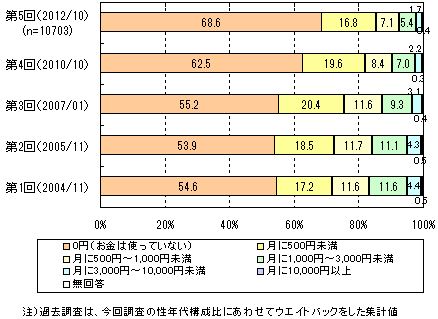
The multiple choice survey asks consumers, “How much do you spend on music in an average month?” with answers ranging from “0-500 yen” (US$6) to “over 10,000 yen” ($125). “0 yen”, shown here in light orange, has risen significantly since 2004, while numbers of every other response have decreased each time since 2007.
Is this the effect of the new download restrictions? Has Japan’s new draconian law actually had a negative effect on music sales? Or has Japanese government simply noticed that music sales continue to fall and mistakenly pinpointed illegal downloads as the cause?
The internet masses had plenty to say about the results of the survey and the Japanese music industry in general:
“Bring the average price of a CD down and I might by one…”
“I rarely actively listen to music now anyway- it’s just on in the background. For the price stores charge I wouldn’t buy an actual CD.”
“In terms of cost performance, CD albums are pretty poor.”
“This is how the Japanese music industry will die…”
“Since they got so strict about downloads I actually don’t feel like buying new music.”
“Listening via YouTube’s enough for me.”
“I used to discover a lot of new bands by downloading their albums without worrying about whether I’d like them or not. Now I can’t do that, so I hardly buy CDs.”
“I usually buy about 100 songs a year, but more often than not I get them from foreign stores. Music here is too expensive.”
“What idiot would pay those prices for a new CD!? I buy my music used now…”
“I don’t want CDs, per-se; I want music. If more tracks were available to download I’d buy more.”
“Why pay? I can sing for free…”
It’s interesting to see that, although one or two people suggest that the tough new law has put them off buying new music, the vast majority of responses suggest that– just maybe– the reason music sales have fallen so much recently is due to a general lack of interest and that new albums are simply not particularly good value for money.
It would seem that the public’s perception of the music industry has changed, and that fewer and fewer people are willing to invest their hard-earned cash in music that they simply use to fill the silence rather than sit and listen to for pleasure.
Perhaps the enormous rise in illegal downloads is a sign that people are interested enough in music to take it for free, but not so in love with what’s on offer that they’d willingly pay the asking price. There seems to be a general vibe on Japanese online message boards that, with the option to download removed, few people are interested in today’s music enough to pay, and so would rather not bother entirely.
But, as one Japanese internet user states: “Well, they’ve implemented this law now, so they’d look pretty silly removing it. Well done, guys!”
We’ll leave you now with the highly amusing government-sponsored eigakan dorobou (movie theatre thief) ads that air in many movie theatres across the country. The ads feature a man with a video camera for a head recording a movie off the screen, much to the dismay of a young woman who- it has to be said- does nothing about it until a police officer with a flashing light for a head is already on the scene.
At the end of the video, we are reminded that downloading music and video for free is now punishable crime, although the woman’s expression when she’s caught by the authorities makes this writer at least wonder just how seriously the law is to be taken…
Source: 痛いニュース
 Still no arrests one year after Japan officially begins prosecuting Internet pirates
 Why is it so tough to buy Japanese digital media downloads?
 Japan overwhelmingly favors CDs to digital music
 Newest Ghibli film brings 40-year-old tune to the top of the music charts
 Survey finds that one in five high schoolers don’t know who music legend Masaharu Fukuyama is
 Mt. Fuji decorated with a 500,000-flower pink carpet is Japan’s ultimate spring view
 Foreign man arrested for walking on Shinkansen tracks, claims he was on the run from yakuza
 30 Pikachus want to share a Tokyo hotel room with you that has separate Grass, Water, Fire spaces
 Pringles Chocolate, but with a Japanese twist, is the snack hack you should be trying right now
 Howl’s Moving Castle’s scene-stealing dog is here to clean your home as a plushie mop
 7 great places to see Mt. Fuji from without having to climb it
 We recreate the delicious-looking meatball stew from Laputa: Castle in the Sky【SoraKitchen】
 New Travelling Bento pouches turn your luggage into a Japanese lunch box
 We find out if one trending phrase can make people from Osaka flip out
 Picturesque Tokyo park plays host to millions of flowers and soap bubbles this spring
 Japan reportedly adding Japanese language skill requirement to most common foreigner work visa
 Pokémon and Ikea Japan cross over into each other’s worlds with collaboration events
 Starbucks Japan closing only Shinkansen platform branch for popularity-triggered renovations
 You can assemble a well-balanced team of Pokémon, them eat them, thanks to Japanese cake chain
 Two food hacks take Japan’s convenience store fried chicken to amazing new sandwich heights
 7-Eleven Japan’s new baked-in-store sweet treat is only available in three parts of the country
 Man bites woman at cherry blossom park in Japan, dies shortly after
 Peanuts and Coke becomes a viral hit in Japan, but is it a trend worth joining?
 Can a downtown Tokyo super sento bathhouse beat a hotel for a one-night stay?
 New Japanese KitKats come in sakura flavour, with poetic symbolism for success
 Japan now has a special desk for people who work at home with a pet cat[Photos]
 Famous Tokyo cherry blossom spot installs view-blocking screens to fight overcrowding[Video]
 Uniqlo announces new T-shirts for One Piece, Naruto and more for manga publisher’s 100th birthday
 Train station platform ramen store closes its doors on half a century of history in Tokyo
 Starbucks Japan releases new My Fruit³ Frappuccino at only 34 stores around the country
 Krispy Kreme releases Super Mario doughnuts in Japan for a limited time
 Studio Ghibli releases Catbus pullback keychain that runs like the anime character
 Japanese onsen egg maker from 100-yen store Daiso needs to be on your shopping list
 Survey asks foreign tourists what bothered them in Japan, more than half gave same answer
 Japan’s human washing machines will go on sale to general public, demos to be held in Tokyo
 Starbucks Japan releases new drinkware and goods for Valentine’s Day
 We deeply regret going into this tunnel on our walk in the mountains of Japan
 Starbucks Japan releases new sakura goods and drinkware for cherry blossom season 2026
 Studio Ghibli releases Kodama forest spirits from Princess Mononoke to light up your home
 Japan’s newest Shinkansen has no seats…or passengers [Video]
 Major Japanese hotel chain says reservations via overseas booking sites may not be valid
 Put sesame oil in your coffee? Japanese maker says it’s the best way to start your day【Taste test】
 No more using real katana for tourism activities, Japan’s National Police Agency says
 Canadian anime vocalist Himeka vents about frustrations working in the Japanese music industry
 Is the AKB48-style idol singer promotion system limiting Japanese music’s global appeal?
 What is “Hiroshima skipping” and why does it have many music and idol fans in Hiroshima upset?
 Seiji and the spirit of Yngwie Malmsteen barely interview Andrew W.K.【Video】
 From Cardigans to Carjackings: The best sellers of Amazon Japan in 2013