The Chinese language is widely regarded as one of the most difficult languages to learn.
There are more than 80,000 Chinese characters in existence, although a non-native speaker can get by with 1,000 of the most frequently used.
To make matters more complicated, the characters that make up each word or phrase individually carry different meanings based on the context in which they’re used. For example, the Chinese character 吃 could mean “eat,” “drink,” “bear,” or “take,” depending on the phrase that surrounds it.
As hard as the language is, it can also be incredibly poetic when translated character by character into English, and sometimes hilarious.
- A cheer (加油) becomes “add oil” or “add fuel.”
This all-purpose Chinese cheer, jiayou!, which literally means “add oil” or “add fuel,” translates as a phrase to “Let’s go!” or “Come on!”
The phrase could also be used to cheer up a sad friend, says Shiqi Liao, Chinese Language Coordinator in the East Asian Studies Department at New York University. The literal meaning of “add oil” is a metaphor, as in, to add fuel to the fire and get the engines going.
Gas stations are also called jiayou stops.
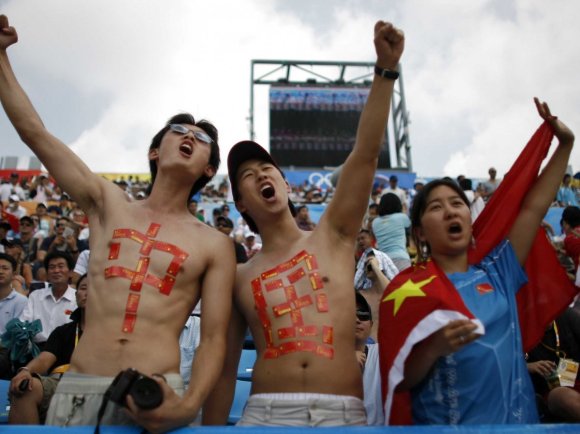
Fans cheer on their nation’s competitors during the 2008 Beijing Olympics.
- “So-so” or “mediocre” (马马虎虎) becomes “horse horse tiger tiger.”
The story goes that there was once a lazy artist who only painted horses but was commissioned to paint a tiger. Trying to stick to what he knew, he illustrated a half-horse, half-tiger monstrosity. Since the painting was neither of a horse nor a tiger, it didn’t sell.
The meaning of the phrase is that something is “horse horse tiger tiger” if it is neither one thing nor the other (“so-so”).
In China, it is widely considered impolite to accept compliments; so if a local tells you, “You speak excellent Mandarin,” you can practice a little modesty with “horse horse tiger tiger.”
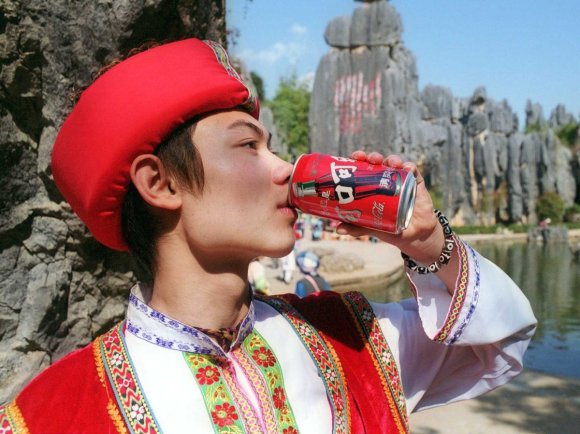
- “Coca-Cola” (可口可乐) becomes “tasty fun.”
When Coca-Cola was about to enter the Chinese market in the 1920s, the company chose characters that perfectly mimicked the English pronunciation of the product. Unfortunately, it translated to “bite the wax tadpole” or “wax-flattened mare.”
They changed it to Kěkǒukělě, meaning “pleasurable to the mouth.” It’s marketing genius, according to Liao. The new name is very close in sound to the brand name “Coca-Cola,” yet is also manages to convey the brand’s sense of taste and fun to a Chinese audience.
- “United States” (美国) becomes “Beautiful Country.”
Geographical names often take on a historical significance, such as this moniker for America the Beautiful. “There’s this image of the United States as a beautiful, powerful, clever nation and I think that’s the dominant sentiment,” said David Lampton, director of China Studies at the Johns Hopkins School of Advanced International Studies.
The U.S. isn’t the only country with a name that attempts to reflect its culture: England (英国) is “Brave Country,” Afghanistan (阿富汗) is “Abundant Sweat,” and Germany (德国) is “Moral Country.”
- “Tequila” (龙舌兰酒) becomes “dragon tongue-shaped orchid.”
An appropriate name for a drink that burns as it goes down your throat, “dragon tongue-shaped orchid” also describes the pointed leaves of the blue agave plant that is used as a main ingredient in tequila.
Fun fact: The Chinese government banned 100% blue agave tequila due to fears of its high methanol content, but President Xi lifted the ban last summer after a visit to Mexico.

The juice distilled from a blue agave plant is the main ingredient in tequila.
- “[I’m] sorry” (對不起) becomes “do not rise.”
“I’m sorry” could literally be translated as “do not rise,” or “face not up.” 對 by itself means “to face,” while the last two characters 不起 by themselves mean “not up” or “not rise.”
It’s used metaphorically, says Liao, in that if you were to do someone wrong, you may not be able to face the person out of shame.
There are many other possible translations of this phrase, depending on the context, but “I’m sorry” is one of the most common ways to use it.
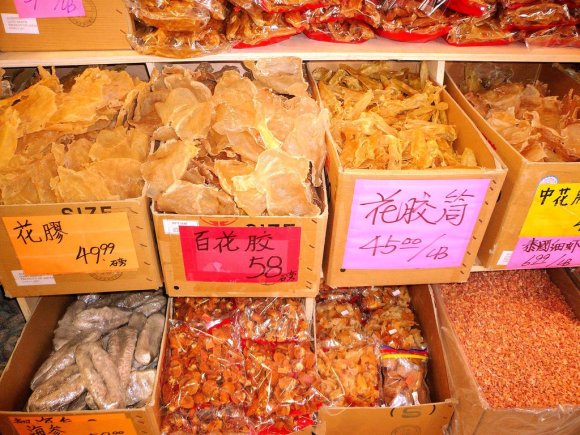
Dried foods at a Chinese market.
- “Stupid” or “lazy” (二百五) becomes “250.”
Calling someone “250” means they are stupid, as in someone who does something rashly without clearly thinking through it, says Liao, and the phrase can be used as a noun or an adjective.
Some people think the origin of the phrase relates to an ancient Chinese unit of currency called a diao (弔). The Chinese scholars, being modest and humble, would call themselves 二百五, which is a quarter of a diao.
- “Being cheated on” or “being a cuckhold” (戴绿帽子) becomes “wear a green hat.”
The story goes that there was a man who worked long hours and left his wife at home. Bored, she started cheating on him. One morning the clueless husband put on his hat and left for work as usual, to find his neighbors pointing and laughing at him. It turned out the man had grabbed his wife’s lover’s hat — a green one — instead of his own.
The older generations in China typically still don’t wear green hats because of this phrase. “Otherwise you open yourself to ridicule,” says Liao.

To this day, older generations in China don’t wear green hats because of what the phrase implies.
- “Sexual harassment” (吃豆腐) becomes “eat tofu.”
“Culturally, food is a very important part of Chinese people’s lives, so ‘eat’ the verb plays an important role in vocabulary,” says Wenteng Shao, Language Lecturer of East Asian Studies at NYU, and the verb has different functions. For example, “suffer” (吃苦) becomes “eating bitterness.“ This makes sense in the phrase meaning of the words, but what about “eating tofu”?
Tofu is known for having properties that promote beauty, and is often associated with women. “Beautiful women really are like tofu in many respects: white skin, shining smooth yet also elastic, delicate souls, gentle as jade…” according to a June 2003 column in the Xinghua News. So the tofu part of the phrase could refer to a woman attracting a man and, subsequently, sexual advances.
- “Computer” (电脑) becomes “electric brain.”
The first character, 电, is one of a handful of pictographic Chinese characters, which are drawn to look like their meaning. Its strokes can be interpreted as rain clouds about to shower and a bolt of lightning — but it’s come to mean “electric” or “electricity” in modern usage.
The Chinese use 电 in an abundance of tech contexts, like for computer. Telephone (电话) becomes “electric words” and movie (电影) becomes “electric shadow.”
- “Everyone” (大家) becomes “large family.”
Another pictographic character, 大, resembles the front profile of a man and means “great” or “large.” Combined with the second character — which invokes the image of a pig under a roof and translates to “family” or “home” — the phrase becomes “everyone.”
- Trite language is described as “wind flower snow moon” (風花雪月).
In classical Chinese literature, these earthy, thematic words were traditionally strung together to imply a romantic atmosphere or poetic images, describing an over-the-top gesture or mood.
Today the phrase is more often used in the context of flowery, trite subjects; some would say the phrase most accurately describes “effete language without substance.” It could also be used to describe someone with his head in the clouds.
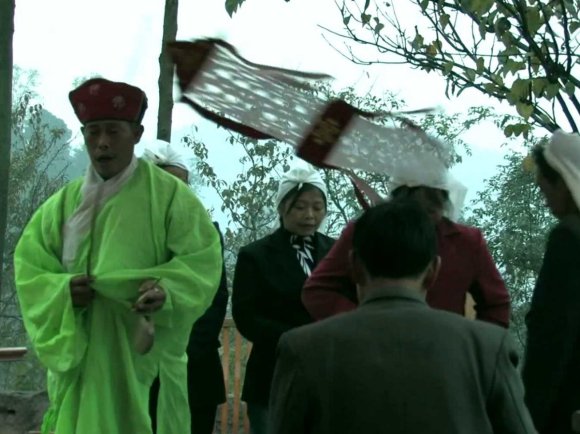
Chinese filmmaker Yang Jianjun directed a 2008 movie called “Wind Flower Snow Moon.”
- A threat or warning (给你点颜色看看) becomes “I will show you some color.”
The act of “showing color” to someone, when warning or threatening them, is metaphorical in one of two ways, Lao explains.
The first could be as in “I’m going to show you my true color,” showing the person what you’re made of; the “color” metaphor could also be taken one step further to imply black and blue, like a bruise, or red, like blood, if threatening physical violence.
Other sources suggest that the color relates directly to the person who is angry, who could be “seeing red” or feeling hot-tempered.